New Wyoming “Dinosaur Mummies” Reveal Unexpected Skin, Hooves and Preservation Pathway

Science
New Wyoming “Dinosaur Mummies” Reveal Unexpected Skin, Hooves and Preservation Pathway
Researchers rediscovered a historic Wyoming site and recovered two Edmontosaurus specimens with clay-cast soft-tissue outlines, revealing midline crests, tail spikes and hoofed toes and identifying a rapid, biofilm-assisted clay-template preservation process.

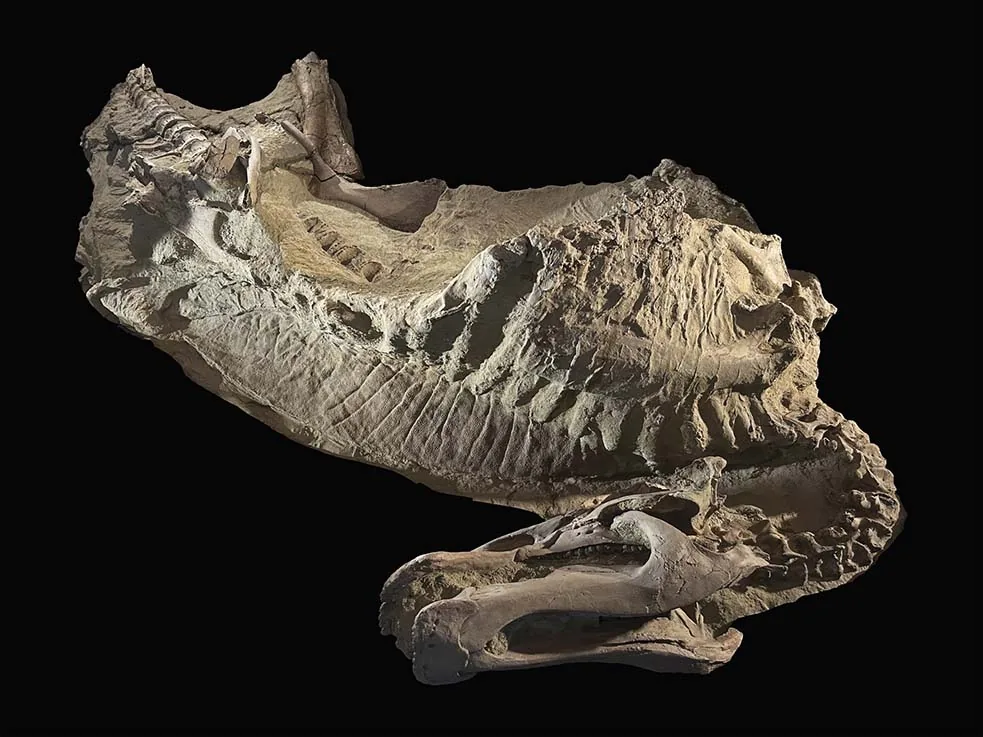
Two unusually well-preserved duck-billed dinosaur specimens recovered in eastern Wyoming provide a new look at hadrosaur anatomy and clarify how large terrestrial animals can leave detailed soft-tissue impressions. The finds, led by researchers from the University of Chicago, include a late juvenile and an adult Edmontosaurus annectens recovered from a zone the team calls the “mummy zone.”

Recovering a lost site

The site’s significance traces to early 20th-century collector C. H. Sternberg, who documented exceptionally preserved hadrosaur remains in 1908. Over subsequent decades the exact location of those quarries was lost because photographic materials were misfiled in archival publications. The research team reexamined historical photos, correspondence and local memories to narrow the site to a roughly 10-kilometer area and relocate the fossil-bearing exposures.

What the specimens show

The newly recovered specimens preserve clear clay-cast outlines of skin and other soft tissues rather than original organic tissues. They display a complex midline crest and a fully preserved row of tail spikes, features that differ from many prior reconstructions of duck-billed dinosaurs. The adult also preserves a thin clay layer forming a hoof-like cap over the toe bones, representing the earliest known reptilian hoof morphology in the fossil record.

How the impressions formed

Detailed analyses using optical imaging, CT, electron microscopy and X-ray spectroscopy indicate the preserved outlines are thin clay layers trapped between sandstone. The team proposes a rapid burial scenario in which seasonal river dynamics and microbial biofilms produced clay templates that recorded the animals’ external surfaces during early decay. No organic tissues were detected within the clay layers; preservation is interpreted as a mineralized clay impression rather than true soft-tissue fossilization.

This mechanism expands the range of environments where paleontologists might expect to find soft-tissue outlines: instead of requiring long-term anoxic lagoonal conditions, clay-template preservation can occur quickly in river sediments under the right conditions.

Additional discoveries and implications

Alongside the hadrosaurs, excavations in the same area produced a Triceratops skeleton with flesh imprints and a fully articulated Tyrannosaurus rex. The co-occurrence illustrates the diversity of integument types—scales, smooth skin and feathers—within the same late Cretaceous environment.

The team plans further papers that will detail the broader taphonomic context and the anatomical implications for all three species. The lead researcher emphasized that the finds highlight both the value of reexamining historical records and the continued potential for significant discoveries in well-studied regions.

James Lawson

James Lawson

Investigative science and tech reporter focusing on AI, space industry and quantum breakthroughs

University College London (UCL) • United Kingdom

Readers

Readers Questions Answered

Q What is newly found about Edmontosaurus specimens in Wyoming?
A The Wyoming finds include a late juvenile and an adult Edmontosaurus annectens whose fossils preserve clear clay-cast outlines of skin and soft tissues, including a complex midline crest, a full row of tail spikes, and a thin clay layer forming a hoof-like cap over the toe bones—the earliest known reptilian hoof morphology in the fossil record. The impressions arise from rapid clay-template preservation, not preserved organic tissue.
Q How were the specimens found and relocated?
A The specimens were recovered from a Wyoming site dubbed the mummy zone, with roots in early 20th-century field work by C. H. Sternberg. Researchers reexamined historical photos, correspondence and local memories to locate a roughly 10-kilometer area and relocate the fossil-bearing exposures after decades of lost site information caused by misfiled archival materials.
Q What preservation mechanism did the researchers propose, and what does it imply?
A They propose a rapid burial scenario in which seasonal river dynamics and microbial biofilms produced clay templates that captured the animals’ external surfaces during early decay. No organic tissues were detected within the clay layers; preservation is interpreted as a mineralized clay impression rather than true soft-tissue fossilization, expanding the environments where such outlines might be found, beyond anoxic lagoons.
Q What other discoveries were made and what broader implications are suggested?
A In addition to the hadrosaurs, excavations in the same area produced a Triceratops skeleton with flesh imprints and a fully articulated Tyrannosaurus rex. The co-occurrence illustrates the diversity of integument types—scales, smooth skin and feathers—within the same late Cretaceous environment. The team plans further papers detailing the broader taphonomic context and anatomical implications for all three species.
Q Why is this discovery significant for paleontology and future research?
A The discovery underscores the value of reexamining historical records and demonstrates that rapid clay-template preservation can capture external surfaces in river sediments under suitable conditions, not just anoxic lagoons. It suggests new sites for fossils with soft-tissue impressions, reveals diverse integument in late Cretaceous ecosystems, and paves the way for additional studies on taphonomy and anatomical implications.

Have a question about this article?

Questions are reviewed before publishing. We'll answer the best ones!

Comments

No comments yet. Be the first!