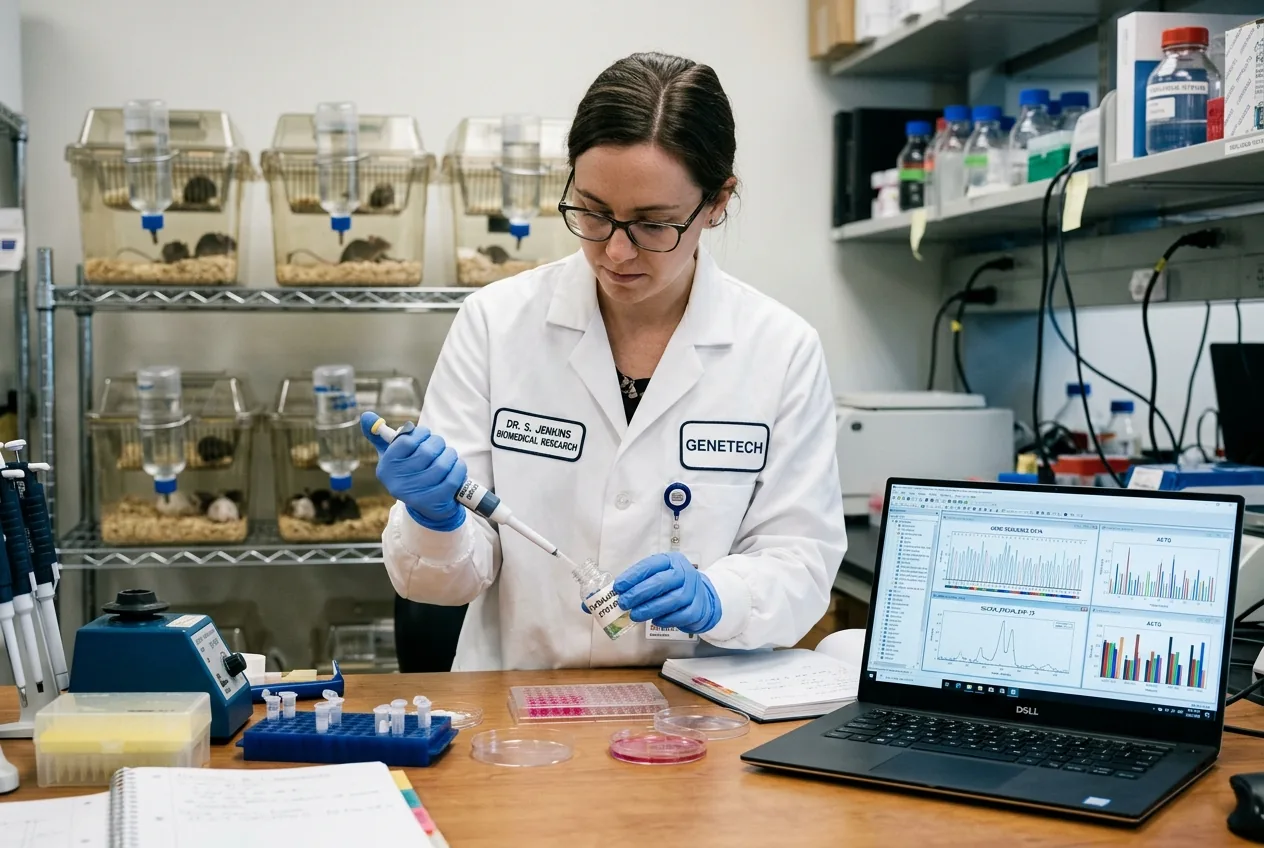
Francisca Concha Celume and her team at the University of Chile ran a strictly controlled catering service for rodents. They took a cohort of mice, spiked their drinking water with either sucralose or stevia at human-equivalent doses, and eventually let them breed. The catch was in the follow-up: the subsequent two generations of offspring drank nothing but plain tap water.
By the time the researchers tested the "grandchildren" of the sucralose group, the initial dietary exposure was long gone. Yet those second-generation mice still exhibited impaired glucose responses and reduced expression of lipid-metabolism genes in their livers.
The results, published this week in Frontiers in Nutrition, suggest that the biological footprint of non-nutritive sweeteners might be inheritable. It is a finding that drags the debate over sugar substitutes out of dietary guidelines and into the complex realm of epigenetics and microbiome inheritance. While public health officials are quick to stress that mice are not humans, the data exposes a blind spot in how regulators assess long-term food additive safety.
The biological inheritance of a diet soda
The experiment isolated two heavily consumed sweeteners: sucralose, a synthetic chlorinated sugar derivative, and stevia, a plant extract. The divergent effects between the two compounds were stark.
Sucralose left a heavier, more persistent footprint. The original exposed mice showed overexpression of inflammation-linked genes in their intestines, alongside a drop in the liver gene Srebp1. These specific markers, along with disrupted glucose handling, echoed into the first generation of offspring and stubbornly persisted into the second.
Stevia proved less aggressive. It triggered measurable biological shifts in the immediate offspring—proving that even plant-derived alternatives carry a transmittable metabolic signal—but those markers vanished by the second generation.
Both sweeteners, however, altered the fundamental makeup of the gut. The researchers recorded lower levels of short-chain fatty acids (SCFAs)—crucial metabolites produced by gut bacteria—and a higher representation of potentially pathogenic microbes. The exact mechanism of inheritance remains a point of friction among biologists. Some argue that maternal microbial metabolites programme an offspring's immune trajectory during pregnancy. Others suspect the sweetener compounds or their breakdown products directly rewrite epigenetic markers.
The Brussels safety dossier
Translating a rodent's metabolic chart into human dietary policy is a historically fraught exercise. Mice have highly compressed lifespans, distinct metabolic pathways, and live in tightly controlled environments that tend to amplify minor biological noise. The study authors themselves classify these findings merely as "early biological signals"—regulatory nudges that might make an organism more vulnerable to a high-fat diet, rather than causing outright disease.
But the Chilean data hits at an awkward time for European food policy. The European Food Safety Authority (EFSA) sets the continent’s acceptable daily intakes for additives based on rigorous, but highly traditional, safety dossiers. Those dossiers are rarely required to track the microbiome profiles of a subject’s unborn grandchildren.
In Germany, where consumer suspicion of ultra-processed food runs high and world-class microbiome labs are plentiful, the study will likely fuel demands to update testing protocols. Yet, updating regulatory standards requires vast, longitudinal human cohort studies that track diet, epigenetics, and gut flora across decades.
From an EU industrial-policy perspective, this is a classic coordination problem. Europe has the stringent regulatory framework and the public appetite for precaution, but the funding to actually collect this data remains fractured across member states. Until the EU harmonises its approach to multigenerational endpoints, regulators are stuck trying to oversee modern synthetic food chains with mid-century toxicology metrics.
Europe has the bureaucracy to demand the answers. It just hasn't figured out which member state is paying for the human trials.
Sources
- Frontiers in Nutrition
- University of Chile




Comments
No comments yet. Be the first!