
The 'marsupial' robots building a 3D replica of Europe's forests

Breaking News Technology
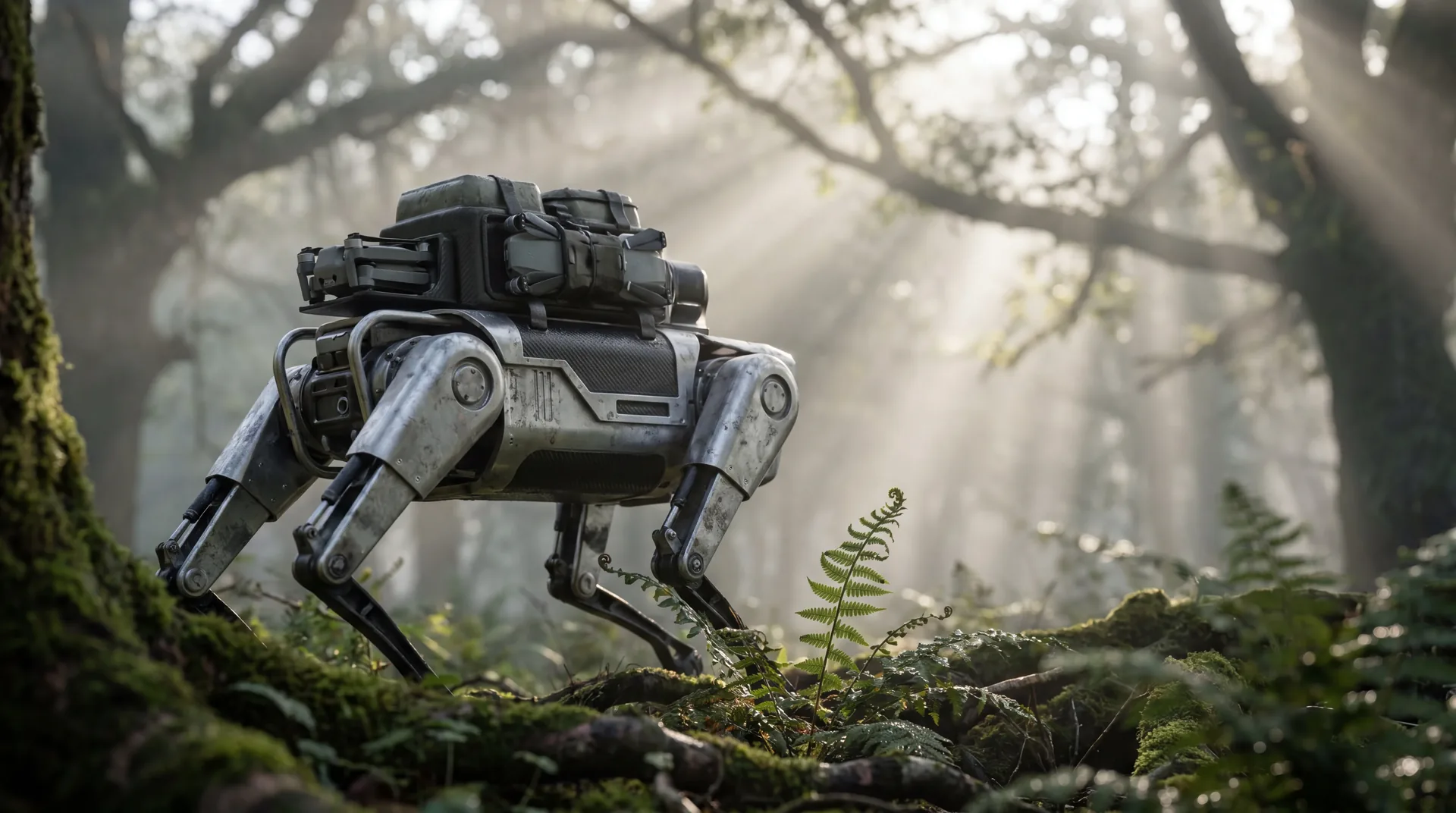
A metallic quadrupedal forest robot carrying modular drones on its back, standing on a lush, mossy floor of a misty forest.
4K Quality
Walker-and-drone robotic duos are navigating GPS-dead zones to map woodland carbon capture with surgical precision.

Deep in a Swiss pine forest, the GPS is completely dead. A ground-based robotic walker navigates the undergrowth entirely blind to satellites, relying on its own sensors to read the terrain before launching a drone directly from its back into the canopy.

This mechanical "marsupial" pairing is the hardware driving DigiForest, a multinational push to build exact 3D replicas of European woodlands. The European Union needs to know exactly how much carbon these forests are sequestering to hit its climate targets, and rough estimates based on acreage no longer cut it. By feeding high-fidelity maps into AI models, the project aims to replace manual guesswork with hard, automated data.

Retiring the tape measure

Calculating the biomass of a forest has traditionally required human workers to literally pull tape measures around trunks. The walker-and-drone teams are designed to remove that bottleneck entirely.

Operating across managed test sites in Finland, Switzerland, and the United Kingdom, the robots autonomously extract specific tree traits. They log trunk diameter, calculate height, and identify species without human intervention. By building a granular digital twin of the landscape, the system tracks soil health and biodiversity markers across vast areas.

Crucially, these models function as an early warning network. If a specific patch of woodland is struggling, the digital replica flags the decline long before the damage becomes visible to a forester standing a mile away.

Surgical timber extraction

This mapping data is designed to push the timber industry towards a "continuous cover" model. Instead of clear-cutting large swaths of land, foresters use the digital twins to pinpoint exactly where to thin the woods.

It is a surgical approach to logging. By extracting specific trees for long-lived wood products, the wider forest remains intact and functional as an active carbon sink. It also preserves the older, complex habitats where woodland biodiversity actually lives.

Vines and price tags

A machine that walks flawlessly among neatly managed European pines faces a stark reality check elsewhere. The algorithms currently driving the DigiForest robots still struggle with extreme environments.

Engineers are trying to adapt the navigation protocols for the chaotic, multi-layered foliage of tropical rainforests and the deep snow of boreal zones. A robot that maps a Swiss valley perfectly is effectively useless if it immediately gets snagged on a jungle vine or stalls in a drift.

Then there is the financial hurdle. The current models are bespoke, highly engineered research prototypes. If this technology is going to make any real dent in global conservation, the hardware must be simplified for mass production, bringing the price down for smaller timber holdings and developing nations.

Sources

  • DigiForest Project
James Lawson

James Lawson

Investigative science and tech reporter focusing on AI, space industry and quantum breakthroughs

University College London (UCL) • United Kingdom

Readers

Readers Questions Answered

Q How does the marsupial robotic system navigate and map dense forest environments?
A The system utilizes a ground-based robotic walker that carries a drone on its back, launching it once the duo reaches a target area. Because satellite signals are often blocked by dense canopies, the robots rely on onboard sensors to interpret terrain and obstacles autonomously. This allows the pair to capture high-fidelity data on trunk diameter, tree height, and species identification while building a comprehensive 3D digital twin of the landscape.
Q Why is this robotic technology essential for meeting European Union climate targets?
A To hit carbon neutrality goals, the European Union requires precise data on how much carbon woodlands are sequestering. Traditional manual measurements using tape measures are slow and often inaccurate. The DigiForest project uses AI-driven mapping to replace guesswork with granular data on biomass and soil health. These digital twins act as an early warning network, flagging forest decline and health issues long before they are visible to human observers.
Q How do digital forest replicas improve the sustainability of the timber industry?
A By providing surgical precision, digital twins allow foresters to move away from clear-cutting toward a continuous cover model. This approach enables the thinning of specific trees for wood products while keeping the wider forest canopy intact. Preserving the forest structure ensures the area remains a functional carbon sink and protects complex habitats where biodiversity thrives, allowing for timber extraction that does not compromise the long-term health of the ecosystem.
Q What technical and economic barriers currently prevent the global use of these robots?
A Current navigation algorithms are optimized for managed European pines and struggle with the chaotic foliage of tropical rainforests or deep boreal snow. Robots can become snagged on vines or immobilized by drifts, making them less effective outside of specific test zones. Furthermore, the hardware is currently composed of expensive research prototypes. For widespread conservation use, engineers must simplify the designs to lower costs for smaller timber holdings and developing nations.

Have a question about this article?

Questions are reviewed before publishing. We'll answer the best ones!

Comments

No comments yet. Be the first!