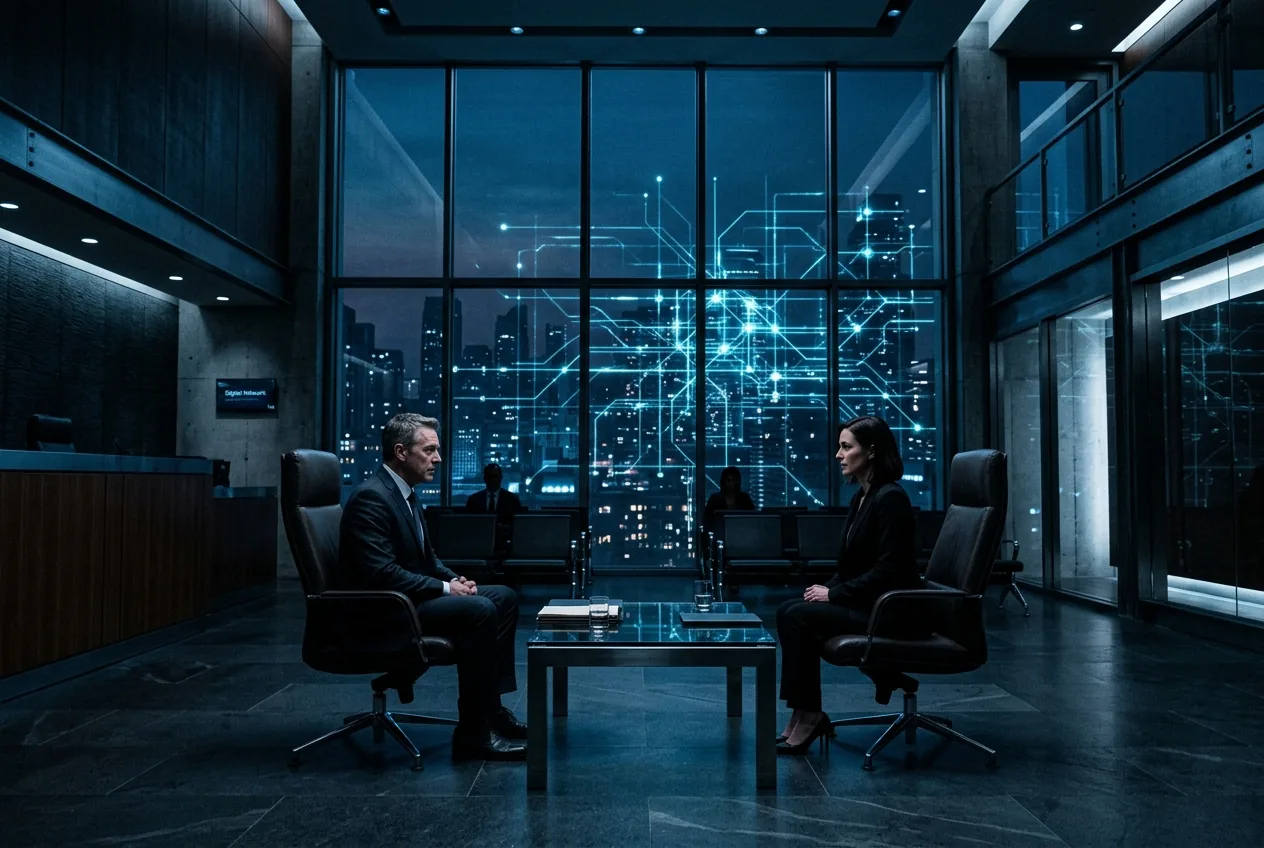
In February 2023, Sam Altman sent an email to Elon Musk that read like a heartbreak letter from a jilted startup founder: “You’re my hero... it really (expletive) hurts when you publicly attack OpenAI.” Musk’s reply, sent with the characteristic gravity of a man who believes he is the protagonist of history, was predictably cold: “The fate of civilization is at stake.” This exchange, now entered into the public record, is no longer just a private spat between two of the world’s most influential men; it is the cornerstone of a legal trial in Oakland, California, that seeks to determine whether the world’s most powerful technology was built on a lie.
The trial pits Musk against OpenAI and its CEO, Sam Altman, in a high-stakes litigation that probes the gap between Silicon Valley’s messianic rhetoric and its cold-blooded commercial reality. Musk, who provided roughly $38 million in seed capital to OpenAI between 2015 and 2017, alleges a “betrayal” of the company’s founding mission to develop artificial general intelligence (AGI) for the benefit of humanity rather than for profit. OpenAI, for its part, dismisses the suit as a case of “sour grapes,” an attempt by Musk to hobble a competitor while he scales his own rival firm, xAI. For those watching from Brussels or Berlin, the case is more than a celebrity grudge match; it is a stress test for the industrial policies and regulatory frameworks that will govern the next decade of global computing.
The architecture of a broken promise
The technical and legal crux of Musk’s argument rests on the transition of OpenAI from a non-profit research lab to a “capped-profit” entity that has effectively become an R&D wing for Microsoft. When OpenAI was founded in 2015, the pitch was simple: a counterweight to Google’s perceived monopoly on AI talent. Musk, Altman, and Greg Brockman promised a transparent, open-source approach to AGI. Today, OpenAI’s most advanced models are proprietary, their internal architectures are trade secrets, and Microsoft has poured billions into the venture in exchange for a massive share of future profits. Musk’s legal team argues this pivot constitutes a breach of contract, even if that contract was more of a “founding agreement” based on shared philosophical goals than a traditional corporate charter.
From an industrial policy perspective, the trial highlights the extreme difficulty of maintaining “openness” in a field where the cost of entry is measured in billions of euros worth of silicon. In Europe, the debate over open-source AI is currently a central pillar of the AI Act. Startups like Paris-based Mistral and Heidelberg’s Aleph Alpha have positioned themselves as the “European alternative” to the closed American models. If the California court finds that OpenAI’s non-profit roots were legally binding, it could create a massive precedent for how “open” foundations are treated globally. If, however, the court sides with Altman, it confirms that in the current geopolitical climate, altruism is a luxury that few compute-heavy firms can afford once they reach a certain scale.
Microsoft’s strategic retreat and the firewall of revenue
The timing of this revenue-share cut suggests that Microsoft’s legal team is more worried about the trial’s discovery process than the actual verdict. In any high-stakes tech litigation, the most damaging evidence isn't usually the headline-grabbing email, but the dull spreadsheets found in the appendix. If Musk’s lawyers can prove that OpenAI’s technical milestones—specifically the jump to GPT-4—represented a level of AGI that, according to the founding documents, should have been made public, Microsoft’s entire investment strategy is at risk. For a company like Microsoft, which has effectively tied its entire Azure cloud growth to OpenAI’s models, the prospect of being forced to open-source its crown jewels is an existential threat.
The Burning Man defense and the credibility gap
Judge Yvonne Gonzalez Rogers, the same judge who presided over the Apple v. Epic Games trial, is no stranger to the eccentricities of the tech elite. She has already ruled that Musk cannot be questioned about his alleged use of ketamine, though his attendance at the 2017 Burning Man festival is fair game. This might seem like tabloid fodder, but it serves a specific legal purpose: establishing the “credibility” of the witnesses. In a trial where there is no signed, single-page contract titled “The AGI Agreement,” the case hinges on the intent of the founders during the mid-2010s—a period of Silicon Valley history characterized by a bizarre mix of techno-optimism and counter-cultural posturing.
The spectacle of 54-year-old Musk and 41-year-old Altman testifying about their shared vision for humanity’s survival is likely to be a study in contrasting personas. Musk will likely lean into his role as the world’s most expensive Cassandra, warning that he only funded OpenAI to save us from a Google-driven apocalypse. Altman, recently described by some profiles as an “unscrupulous executive,” will have to convince the jury that the pivot to profit was the only way to fund the massive server farms required to make AI functional. For the engineers actually building these systems, the drama is a distraction from the hardware bottleneck. Regardless of who wins in court, the reality remains that the AI race is currently dictated by the supply chain of Nvidia’s H100 chips and the energy requirements of massive data centers—areas where Europe is struggling to keep pace.
Industrial sovereignty and the ghost of the non-profit
There is a peculiar irony in Musk, the ultimate capitalist, suing to enforce a non-profit mission. But the underlying tension is one that European policymakers understand well: the struggle for technological sovereignty. Musk’s suit argues that by privatizing OpenAI, the founders have essentially stolen a public good. This mirrors the rhetoric used in Brussels when discussing the need for a “European AI Infrastructure.” If the core of AI development is moved entirely behind the paywalls of a few American conglomerates, the ability of smaller nations or regions to regulate that technology effectively evaporates.
The trial’s outcome will likely not result in the $100 billion in damages Musk originally sought, but it could force a restructuring of OpenAI’s board or its charitable arm. Musk has pivoted his demand toward funding for OpenAI’s original altruistic goals, to be paid for by the for-profit side. This “charity tax” on AI profits would be a novel legal outcome, essentially treating AGI as a regulated utility rather than a standard software product. It is an outcome that would likely find a lot of fans in the European Parliament, even if it sends shivers down the spines of venture capitalists in Menlo Park.
Ultimately, the Musk-Altman showdown is the first great trial of the AI era, not because it will solve the technical problems of alignment or safety, but because it exposes the fragility of the governance structures we have built around these technologies. We are watching two men fight over the steering wheel of a vehicle that neither of them fully understands, using a legal system designed for 20th-century property disputes. It is a reminder that while the code might be new, the human flaws—ambition, deceit, and the inability to share power—are as old as the hills. The trial will likely end with a settlement that allows both men to claim victory, while the actual technology continues its march toward a closed, profitable, and increasingly opaque future. In the end, the jury might decide what OpenAI owes Elon Musk, but they cannot decide what it owes the rest of us.


Comments
No comments yet. Be the first!