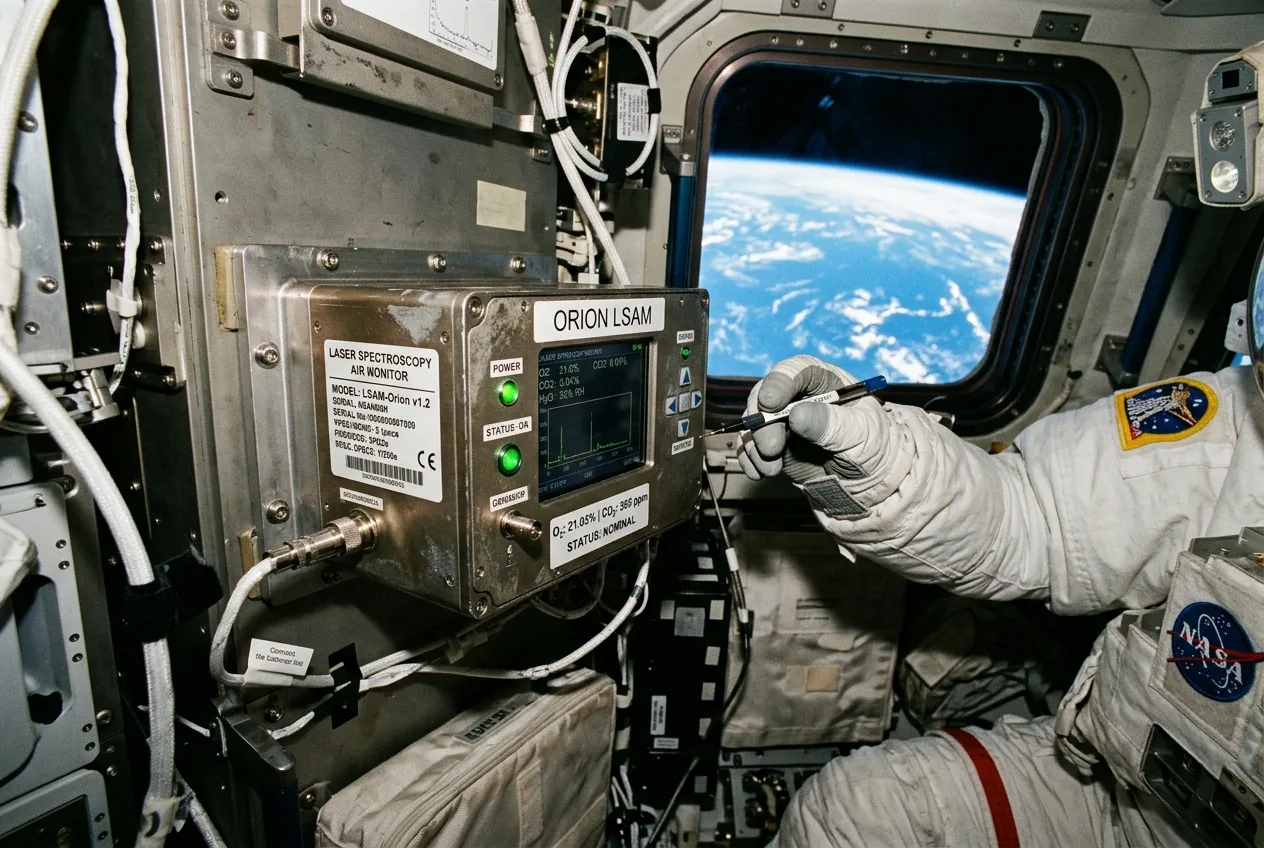
Sometime around 8:00 p.m. Eastern Time on Friday, an Orion capsule will hit the Earth’s atmosphere at hypersonic speeds. Tucked inside the cabin with four astronauts is a small box that represents two decades of stubborn optical engineering.
The Artemis II splashdown in the Pacific Ocean concludes a ten-day lunar flyby, but for space procurement officers, the most critical data is not just about the vehicle itself. They are watching a compact laser air sensor built by Vista Photonics, a New Mexico-based supplier. If the instrument’s calibration survives the vibration and thermal shock of reentry, it could rewrite how space agencies monitor life-support systems on long-duration lunar missions.
From bench-scale chemistry to deep-space telemetry
The hardware is the culmination of a career that started in 1995, when Jeff Pilgrim completed a chemistry PhD at the University of Georgia. His academic focus on laser spectroscopy for environmental sensing eventually migrated from a laboratory concept to a commercial enterprise when he founded Vista Photonics. Now, that graduate-school idea is being measured against the raw physical risk of an actual lunar mission.
For agencies planning weeks or months in cislunar space, life-support is where missions accumulate quiet risks. Legacy gas sensors are often bulky and power-hungry, and manual checks mask subtle hardware shortcomings. Pilgrim’s laser system provides faster, species-specific gas readings, allowing mission controllers to catch a slow seal leak or localised chemical contamination before it becomes an emergency.
The brutal honesty of a ballistic return
Orion is returning from farther out than any human spacecraft since the Apollo era. The splashdown phase is not ceremonial. It is a high-stakes validation of heat shields, parachutes, and internal hardware resilience.
Engineers will soon correlate the sensor's on-orbit telemetry with the physical condition of the returned unit. They are looking for specific structural and software failures. Did thermal cycling and micro-vibration shift the baseline readings in deep space? Did the capsule’s thruster firings trigger transient false positives?
The physical inspection will also reveal whether the delicate optics, alignments, and connectors survived the shock of parachute deployment and hitting the Pacific Ocean.
Small suppliers and the European optics deficit
NASA’s willingness to fly sensors from small suppliers is a deliberate choice to broaden its industrial base. However, forcing niche companies to climb a steep aerospace qualification curve—endless testing, documentation, and acceptance reviews—routinely swallows their working capital. A successful return gives Vista Photonics the technical credibility to survive in a sector otherwise dominated by entrenched prime contractors.
For the European space sector, there is a quiet lesson in Orion's payload manifest. Germany holds a distinct industrial advantage in precision mechanics and laser optics, with dozens of mid-sized firms capable of building similar spacecraft-grade instruments. Yet, rigid ESA procurement rules and complex export controls often deter these companies from entering the transatlantic supply chain.
The Pacific splashdown will prove whether a New Mexico startup can build hardware robust enough for the Moon. Brussels and Bonn will then have to decide if European firms will be funded to compete, or if they will just watch the telemetry from the sidelines.




Comments
No comments yet. Be the first!