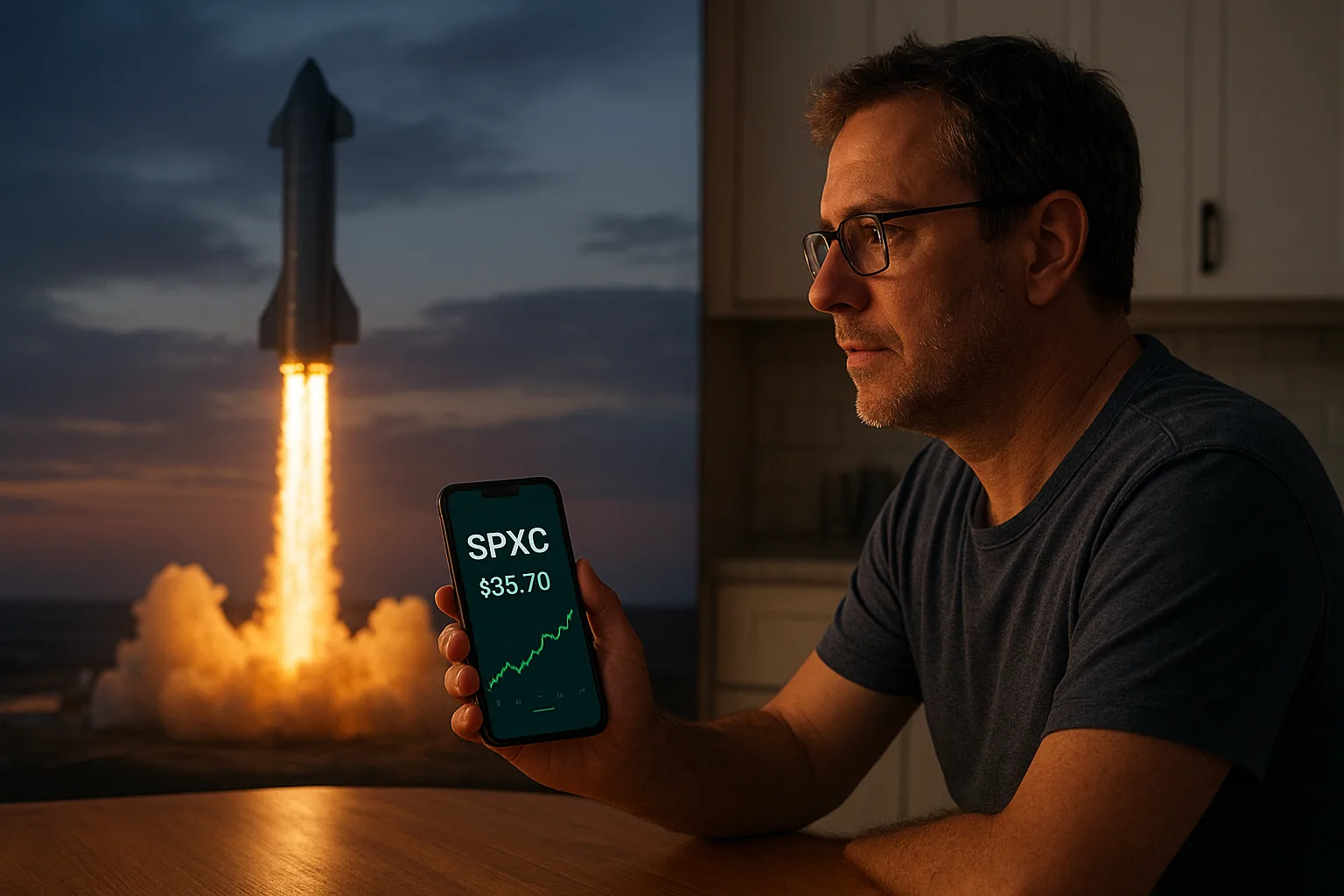
Order books were full before the bell, and bankers logged twice as many requests as shares
When the prospectus landed and bankers opened retail channels for the Nasdaq flotation, the striking detail was not the face value — $1.75 trillion — but the demand pattern. Underwriters recorded roughly twice as many orders as there were shares to sell, a sign that even at that stratospheric valuation a huge group of investors wants in. SpaceX also did something unusual for a deal of this size: it carved out as much as 30% of the offering, roughly $22.5 billion, specifically for retail buyers. That decision matters. It means ordinary investors — not just sovereign wealth funds and hedge funds — will take a large slice of the downside if execution slips.
The listing will trade under the ticker SPCX on Nasdaq. Brokers pushed different access thresholds: platforms such as Robinhood, SoFi and E*Trade offered low or no minimums; Fidelity set a $2,000 account minimum for this deal after cutting its usual bar, while Charles Schwab placed a $100,000 threshold. Submitting an order is not a guarantee of allocation; with demand outstripping supply, many retail customers will be disappointed and may have to buy on the open market when trading begins.
This combination — gargantuan valuation plus an unusually large retail tranche — creates a particular investor profile. SPCX buyers are not only betting on rockets, satellites and AI. They're also betting that a very public, very expensive growth story will remain untarnished through execution risks, regulatory noise and the inevitable waves of secondary selling that follow lockup expirations.
spacex goes public: spcx — how retail allocations actually work
Brokers were the gatekeepers. For most retail investors there were three practical routes into SPCX: get an IPO allocation through a participating broker, buy on the open market after the stock lists, or gain indirect exposure through index funds that add SpaceX. The underwriters gave a short list of U.S. brokerages authority to distribute shares to customers, and each brokerage applied its own criteria. Some apps required nothing more than an eligible account and an indication of interest; others required balances or special account types. If you see an order screen that asks for an "indication of interest," treat it as a ticket in a lottery, not a guarantee.
Missing the IPO allocation is not the end of the road. SPCX will trade on Nasdaq, and anyone can attempt to buy shares when the market opens — though expect high volatility on day one. Many hot listings "pop" at the open because supply is thin and demand remains high. For more conservative exposure, index funds tracking large-cap Nasdaq indexes will likely add SpaceX quickly, which provides a way to buy without facing the opening-hour frenzy. That path, however, dilutes the immediate upside and comes with the opposite risk: being part of a large, slow-moving investor base that can exacerbate downward moves if sentiment sours.
Practical buying rules matter: IPO shares are often subject to informal broker policies that penalise “flippers”—customers who sell right after the IPO. If you sell within a few weeks, some brokers may reduce your priority for future allocations. That policy is worth factoring into your decision if you were counting on a quick short-term gain.
spacex goes public: spcx — the valuation, the math and the risk
Here is the uncomfortable arithmetic baked into SPCX. The offering values SpaceX at roughly 110 times trailing sales. That multiple assumes years of near-perfect growth: every launch, every Starlink satellite batch and every AI contract must proceed precisely as planned. SpaceX’s own prospectus is candid — profit is not expected in the near term — which rules the company out of indexes such as the S&P 500 until profitability tests are met.
That matters for buyers. A public company can raise capital more easily, which can accelerate Starship builds and satellite rollouts. But the public market also places a premium on predictability. Miss a launch cadence, see a regulatory snarl in Europe, or face an unexpected competition win by a rival and the valuation can re-rate quickly. Lockup expirations — when early investors and employees can sell shares after the IPO — create predictable waves of supply that can depress prices even if operations look fine.
There is also macro timing risk. The IPO arrives in a crowded window of large tech and AI offerings. If market appetite cools or several mega-deals compete for attention and capital at once, SPCX could trade through periods of acute volatility. For retail buyers the question is not just how much upside exists, but how much downside they can stomach at a price that already expects near-faultless execution.
How to buy SPCX — brokers, timing and international access
If you live in the U.S., the immediate practical step is to check whether your broker participates and what the minimums are. For this listing some brokers required nothing; others asked for thousands or even six-figure balances. Indicating interest before pricing is typical, but getting an allocation depends on the broker’s internal rules and how many customers they can satisfy. Fill out the form, but don’t make life-changing bets on getting shares.
Outside the U.S., the story is patchwork. SpaceX listed countries where qualified investors can participate once local prospectus approvals are in place. That list spans large markets — from Germany, France and the U.K. to Singapore and South Korea — but local rules determine who qualifies and how much they can buy. In many European markets you will need either a qualified investor status or wait until shares trade and buy on your exchange’s Nasdaq access. For most retail investors outside the U.S., the practical route will be to wait for public trading and then buy through a broker that offers Nasdaq access.
Another route is index exposure. Because Nasdaq indices will likely add a company of this size quickly, funds tracking those indices will be forced buyers. That creates an indirect — and often less volatile — way to participate if you prefer to avoid the IPO storm.
Governance, future growth and what being public will change
Going public does more than put a ticker on a balance sheet. It shifts incentives. SpaceX will now answer to a broader group of shareholders, face quarterly scrutiny, and confront new disclosure obligations. That structural change can be stabilising — investors demand transparency — but it also narrows managerial freedom. Executive decisions that once could prioritise long-term engineering timelines will now be judged through a public-market lens.
For SPCX buyers that has three implications. First, governance pressure can accelerate commercialisation efforts, which could be good for revenue but risky for engineering timelines. Second, the company’s future funding path changes: public equity offers a new capital pool but also creates an exit route for early private backers whose sales can increase supply and pressure price. Third, public scrutiny brings regulatory attention — from national telecom regulators over Starlink deployments to European competition and security reviews — and negative regulatory outcomes can affect growth trajectories just as surely as launch failures.
Put simply: a public SpaceX could access more capital to scale faster, but it will also be less able to absorb messy, high-capital engineering setbacks without a market reaction. That trade-off is central to whether the SPCX story is ultimately a long-term winner for retail holders or an expensive bet on continued perfection.
Practical checklist for anyone thinking about SPCX
If you are considering buying SPCX, treat the decision like a high-risk startup bet, not a blue-chip allocation. Check whether your broker is distributing shares and what minimums apply; understand that an order is not an allocation guarantee; consider whether you want the day-one volatility or prefer to buy later; and think about your time horizon. IPOs that price at breathtaking multiples favor patient capital with a tolerance for large drawdowns.
Also, beware of narratives. Retail availability and a huge fan base can create a sense of ownership and momentum — think Tesla — but that social dynamic can keep a stock elevated longer than fundamentals justify and then unwind rapidly. If you need liquidity in the short term, SPCX’s early days are not a safe place to park capital.
Europe’s investors and policymakers will be watching too. A giant U.S. space company with global satellite infrastructure listed on Nasdaq amplifies geopolitical questions about spectrum, infrastructure control and industrial policy. For European industrial strategists the listing is a reminder: engineers are plentiful, but the money often stays on Wall Street.
SpaceX’s Nasdaq debut under SPCX is a rare combination of retail access and extreme valuation. That makes the trade unusually loud — and unusually binary. Either the company keeps executing at near-impossible speed, or the market will demand a reset. For ordinary buyers, the sensible step is modest participation, clear limits, and an acceptance that owning SPCX is a bet on flawless engineering meeting patient capital.
Europe has the engineers. It just hasn't decided which country gets to pay them.
Sources
- U.S. Securities and Exchange Commission (SpaceX S-1 / IPO prospectus)
- Nasdaq listing documentation
- European national prospectus approvals (Germany, France, Sweden and other EEA filings)




Comments
No comments yet. Be the first!