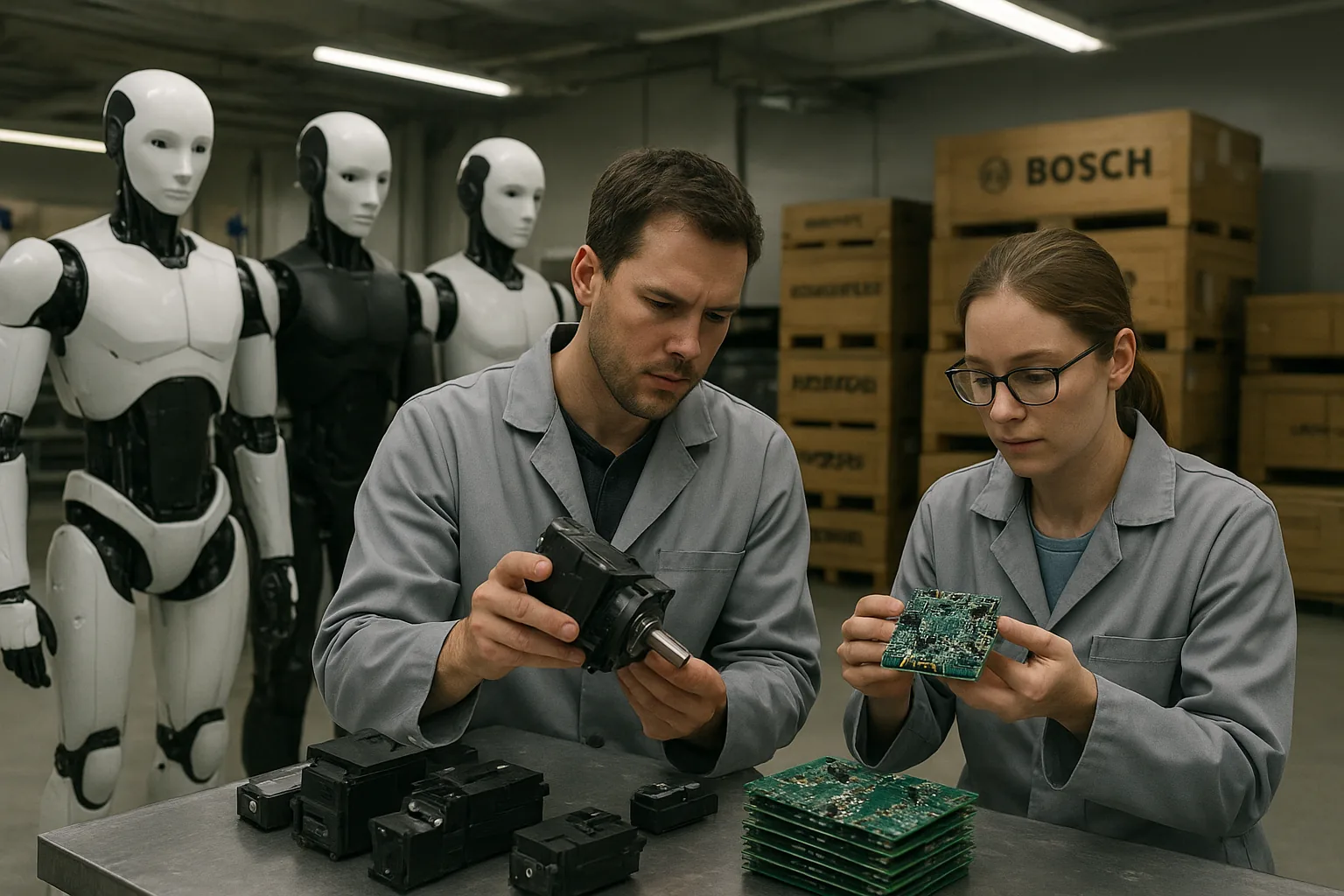
In Metzingen, the funding announcement arrived like a freight shipment
On 10 June, a press statement rolled out from Neura Robotics in Metzingen that read like an industrial shopping list: partners for chips, actuators, cloud, manufacturing and — unexpectedly — a stablecoin issuer willing to lead the round. That statement said neura robotics raises 1.4 in a Series C that values the company at roughly $7 billion (about €4 billion). The sum is eye‑catching; the detail that matters is not how much was promised but how and when it will land. The round is structured as a ceiling — "up to" $1.4 billion — tied to milestones. For anyone who has watched robotics fundraises, "up to" is a different story than "already in the bank."
neura robotics raises 1.4: who's in the syndicate and why each name matters
The investor list is the clearest hint of Neura's playbook. Tether is listed as lead investor, with strategic participation from Nvidia, Amazon, Qualcomm, Bosch, Schaeffler and the European Investment Bank, among others. Each name maps to a layer Neura must assemble to make humanoids useful at scale. Nvidia brings large‑scale simulation and inference tooling; Qualcomm covers battery‑efficient edge inference; Bosch and Schaeffler bring sensors, actuators and high‑volume manufacturing know‑how; Amazon represents early, plausible demand and cloud integration; and the EIB signals that European public capital considers this an industrial strategic bet, not merely a gadget.
That configuration explains much of the hype and some of the caution. Strategic investors are buying optionality across the supply chain, not a short demo reel. For Amazon and AWS the logic is straightforward: warehouses produce the physical training data robots need and they have the operational scale to run pilots that actually teach manipulation, not only simulation. For Tether, the logic is different and explicitly experimental: it wants robots to have a financial layer so machines can autonomously order parts, pay for cloud cycles or settle service fees. In short, the syndicate reads like a procurement plan packaged as a financing round.
neura robotics raises 1.4: why milestones matter more than the headline
Practical consequences follow. If Neura can't hit milestones, the company loses not only cash but credibility with partners whose components and software must integrate into a single production line. If it can, the round becomes a launchpad: mass production in Germany and India, expanded "Neura Gyms" — warehouses and training halls that generate real interaction data — and a live Neuraverse marketplace for models and skills. The financing is therefore as much a vote on infrastructure as it is on product.
Neuraverse, Gyms, WDK and QVAC: the technology stack investors bought into
Neura positions itself as a full‑stack physical AI company. The stack comprises three visible pieces. First, the hardware family (from lightweight arms to the 4NE‑1 humanoid) and the industrial supply links with Bosch and Schaeffler. Second, Neuraverse — an integrated software and data ecosystem where models, simulation, and live deployments share data and upgrades. Third, the training infrastructure: Neura Gyms, which are large, instrumented physical environments built to generate manipulation and interaction data at scale. Investors are explicit that the Gyms solve the "data drought" in embodied AI: robots must practice in the real world, not only in silico.
Tether's involvement layers new tech onto that stack. Its Wallet Development Kit (WDK) aims to embed self‑custodial payment capabilities directly into devices, and QVAC is pitched as an edge AI runtime to run critical models locally. That combination is a direct answer to two engineering constraints: latency and autonomy, and the practical question of machine‑to‑machine billing. In Neura's vision, a humanoid could autonomously pay for a replacement part or cloud training time without human clearance — which sounds exotic until you remember modern factories already automate procurement workflows.
Production, supply chain and the European industrial angle
Anyone interested in whether Neura's raise changes the global robotics race should look at production planning, not PR. Neura claims an order backlog and pipeline above $1 billion and a goal of scaling to millions of units by 2030. Those are aggressive numbers. Scaling from demonstrators to tens of thousands requires fast suppliers for motors, bearings, sensors and power electronics — the exact capabilities Schaeffler and Bosch supply — plus access to semiconductor IP for power‑efficient compute, the reason both Nvidia and Qualcomm are on the cap table.
From a European industrial policy perspective the round is important but ambiguous. The EIB's participation signals political interest in retaining robotics value chains inside Europe; yet mass production will likely require cross‑border coordination. Component factories, labour costs, regulatory regimes and export rules will all shape where final assembly happens. Europe has engineering depth; the question is whether Brussels and the member states can harmonise procurement, subsidies and standards fast enough to turn Neura's raise into domestic industry rather than an export of IP and jobs.
What Neura Robotics makes and the milestones investors will watch
Neura builds cognitive robots — humanoids and manipulators intended to perceive, reason and act in unstructured, human environments. The company emphasises enterprise integration: Neuraverse connectors for ERP systems, cloud providers and logistics software so robots can be told by an SAP or AWS system what tasks to prioritise. That enterprise focus explains the Amazon and SAP integrations journalists have noted: this is not first‑party consumer play; it is a B2B effort where integration risk is as real as mechanical risk.
The milestones behind the "up to" $1.4 billion will be concrete: serial production throughput, reliability metrics, safety certifications, deployment agreements that convert backlog into revenue, and successful scale of Neura Gyms to produce training data. Failure on any of those fronts delays funding tranches and forces re‑engineering — expensive and common in robotics history.
Who benefits — and who should be skeptical?
If Neura executes, the beneficiaries are obvious: European suppliers, cloud providers (AWS will host parts of Neuraverse), and logistics operations that will gain automation options. Nvidia and Qualcomm could expand their addressable markets if Neura ships at scale. For Tether, Neura is an experiment in machine economics that, if it works, would bootstrap a new use case for programmable settlement and stablecoins.
But healthy skepticism is warranted. Robotics is littered with companies that could demo dexterity but failed at volume. The conditional funding structure and the reliance on strategic partners becoming paying customers are pragmatic guardrails — and also a warning. The headline "up to $1.4 billion" is an invitation to read the term sheet.
What this means for Europe’s robotics landscape and the competition with the US
The round moves a European company to the front of the global humanoid conversation, but it does not end the geographic contest. The US retains strengths in cloud, venture capital and AI research; China retains strengths in low‑cost manufacturing and scale deployment. Neura's strategy is a hybrid: stitch European industrial supply‑chain competence together with US cloud and AI tooling and a novel financial experiment from the crypto sector. If it works, Europe's advantage will be its ability to integrate industrial champions into a single supply chain; if it doesn't, the field will look like another set of missed industrialisation bets.
Europe has the engineers. It now needs to decide which factories and which political frameworks will turn them into robots that actually leave the warehouse and pay for their own spare parts.
Sources
- NEURA Robotics (company announcement / Series C materials)
- Tether (press materials on lead investment, WDK and QVAC)
- NVIDIA (physical AI / Isaac / Omniverse developer tools)
- Amazon / AWS (collaboration and deployment agreements)
- European Investment Bank (participation in strategic financing)




Comments
No comments yet. Be the first!