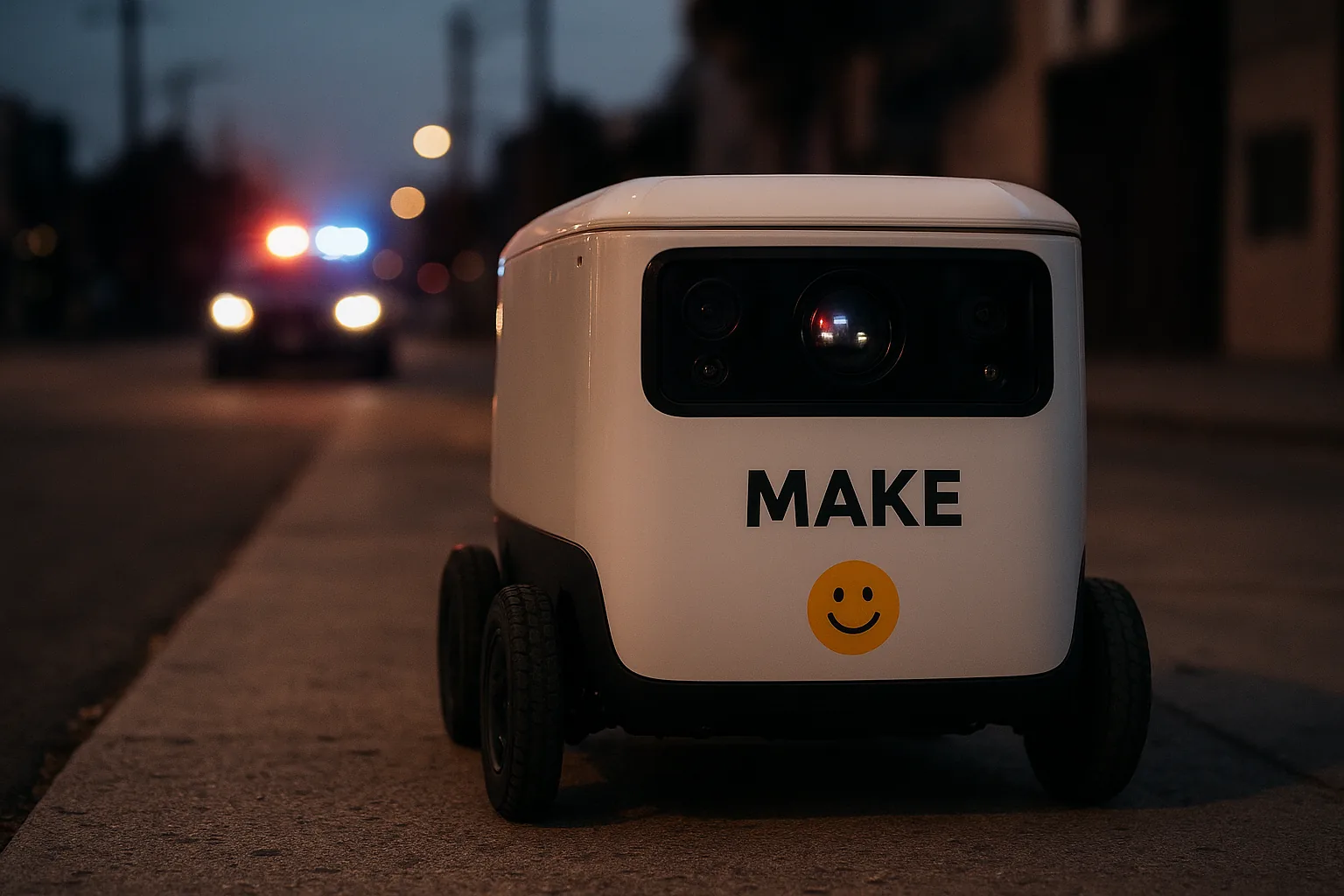
The two men who tried to steal a delivery robot last year in Los Angeles probably did not see it as a pivotal moment in surveillance history. They were just after a free meal. The bot, a knee-high cooler on wheels sporting Serve Robotics livery, was idling at a kerb when they grabbed it. What they failed to account for were the half‑dozen cameras stitching a 360‑degree view of their faces, clothes, and getaway route directly into a cloud server. Serve Robotics handed that footage to the LAPD within hours. No warrant. No judge. Just a corporate decision.
“Without the video, there was no way of identifying the perpetrators,” an LAPD detective later admitted in an internal email. The footage was “highly beneficial.” The suspects were convicted of grand larceny. The robot, meanwhile, returned to its day job ferrying pad thai, its sensors quietly reclassifying every pedestrian as a potential data point.
This is not an isolated glitch. It is the shape of policing to come, and it has arrived on a wave of venture‑funded logistics. Across Europe, regulators who spent the past five years wrangling the GDPR and the AI Act are now waking up to a harder question: what happens when a restaurant delivery becomes a mobile wiretap?
The bot that volunteered its memory
Serve Robotics, a spin‑out from Uber’s experimental division, operates a fleet of roughly 200 autonomous drop‑offs in Los Angeles and plans to scale to thousands. Each unit carries an array of cameras, ultrasonic sensors, and GPS modules. The company’s privacy policy, like most, is written in the soothing cadence of “data minimisation” and “anonymisation.” But the LA incident peeled back the curtain.
When the suspects grabbed the bot, its navigation cameras captured them clearly. The company reviewed the footage, determined a crime had been committed, and proactively contacted the LAPD. There was no subpoena, no court order. The data was gifted without the suspects’ knowledge—or anyone else’s. For the police, it was a gift. For everyone else walking the same sidewalk, it was a demonstration of how thoroughly the rules have collapsed.
Serve Robotics is not alone. Competitors such as Coco and Starship Technologies log thousands of hours of street video daily. Their policies differ: some resist law‑enforcement requests, others comply. The patchwork mirrors the early days of Ring doorbell footage, when Amazon cheerfully shared clips with police departments until public outcry forced a retreat. But a doorbell is stationary; a delivery robot roves through neighbourhoods, parks, and pedestrian zones, building a stunningly granular record of everyday life.
A data trove with no custodian
The legal void is glaring. In the United States, the third‑party doctrine—a relic of 1970s banking records—holds that content individuals voluntarily share with a company loses Fourth Amendment protection. Because the robot’s cameras record public streets, and because the footage belongs to the operator, police can often obtain it without a warrant if the operator agrees. That turns every delivery into a pre‑packaged evidence locker.
Europe has stronger baseline protections, but they were written for static CCTV, not a moving platform that captures faces, dresses, conversations, and vehicle plates in a continuous stream. Under the GDPR, any image that identifies a person is personal data. Processing it for law‑enforcement purposes requires a specific legal basis—usually consent, a statutory mandate, or a legitimate interest that overrides individual rights. In most EU member states, handing over a bystander’s image to police without their consent is not obviously covered by any of those justifications.
“Companies cannot just decide they like the police and click ‘share’,” says Anna‑Lena Vogeler, a data‑protection lawyer with the Berlin‑based think tank Privacy & Automation. “A delivery robot is not a witness. It is a data controller, and it must respect the ePrivacy Directive and the GDPR from the moment the shutter opens. That includes technical measures like real‑time blurring, retention limits, and refusing voluntary requests without a judicial order.”
So far, few operators have implemented any of those measures. Most bury the reality in terms of service the public never reads. And while Europe’s delivery‑robot industry remains a fraction of the US market—Starships trundle around Milton Keynes and Tallinn, DPD pilots a few units in Germany—the direction of travel is clear. The European Commission has flagged autonomous delivery as a key pillar of sustainable urban logistics, and the Horizon Europe programme is pouring millions into last‑mile automation. The bot fleets are coming. The question is whether European regulations will be ready for them.
What Brussels can learn from a botched heist
The European Data Protection Board has yet to issue guidance on mobile autonomous surveillance, but the LA case is forcing the issue. An internal discussion paper circulated among member‑state data‑protection authorities in early 2024, obtained by Apollo Thirteen, argues that delivery robots should be treated as “high‑risk” under the AI Act’s classification for “biometric categorisation,” even if they do not perform facial recognition. The reasoning is simple: because the footage can be used to identify individuals after the fact, the mere act of recording constitutes a high‑risk processing operation.
That designation would trigger a cascade of requirements: mandatory data‑protection impact assessments, human oversight, strict retention limits, and an absolute prohibition on automated sharing with law enforcement absent a judicial warrant. It would also force operators to redesign their camera systems to collect the minimum data necessary for navigation—not for forensic archiving.
The industry is already pushing back. Lobbying documents from the European Robotics Forum show that operators argue they are merely capturing “environmental data” essential for obstacle avoidance, akin to a car’s parking sensors. They want delivery bots classified as “transport vehicles” rather than “surveillance platforms.” The semantic battle is far from trivial: transport vehicles fall under the General Safety Regulation, not the AI Act. Win that argument, and the privacy obligations thin dramatically.
But engineers know the difference. A robocar’s lidar point cloud will not help police identify a suspect; a 4K video stream with stabilised face shots will. The cameras on Serve’s bots are not just for crossing intersections—they are a business asset. Aggregated footage reveals traffic patterns, pedestrian density, and even which storefronts draw eyes. Several operators have already experimented with selling de‑identified mobility data to city planners and insurers. The line between operational necessity and surveillance capitalism is blurring by the block.
The uncomfortable silence in the boardroom
Another dimension rarely discussed publicly is the insurance calculus. When a bot is stolen or vandalised, the operator files a claim. Footage that helps police recover the asset or convict a suspect directly reduces the loss ratio. That gives every delivery company a quiet financial incentive to act as a de facto security camera network. It is the same logic that nudged Amazon to share Ring footage: a few minutes of video can save a payout.
In Europe, where insurance premiums are already rising for autonomous systems, the temptation will be even stronger. EU regulators, however, have tools the US lacks. The ePrivacy Directive already requires that location data—including inferred location from camera feeds—be anonymised or scrubbed before any processing beyond the core service. And the upcoming AI Liability Directive will make it far easier for individuals to sue if their data is mishandled. A class‑action claim from pedestrians who discover they have been recorded and shared without notice could reset the risk models overnight.
Until then, the default remains trust‑based, which is no basis at all. A Serve Robotics spokesman told US media that the company only shares footage “when it assists a lawful investigation.” But who defines lawful? A police detective’s hunch? An internal corporate policy that can change with a board resolution? The bot does not carry a badge, but it can now land someone in a police lineup.
Europe’s appetite for sidelining privacy rights in the name of efficiency has never been tested in this lane. As cities from Cologne to Copenhagen gear up for autonomous delivery trials, the LA episode ought to focus minds. A bot that wheels past your front door three times a day is not just a convenience; it is a witness under corporate control. Whether it becomes a spy or a sentinel depends entirely on the laws we draft now—and Brussels has a habit of finalising the regulation only after the technology has already scaled.
One day, a European court will have to answer the question that two opportunistic thieves inadvertently posed on a Los Angeles sidewalk: who exactly does a delivery robot work for? The answer might determine whose streets we are really walking on.




Comments
No comments yet. Be the first!