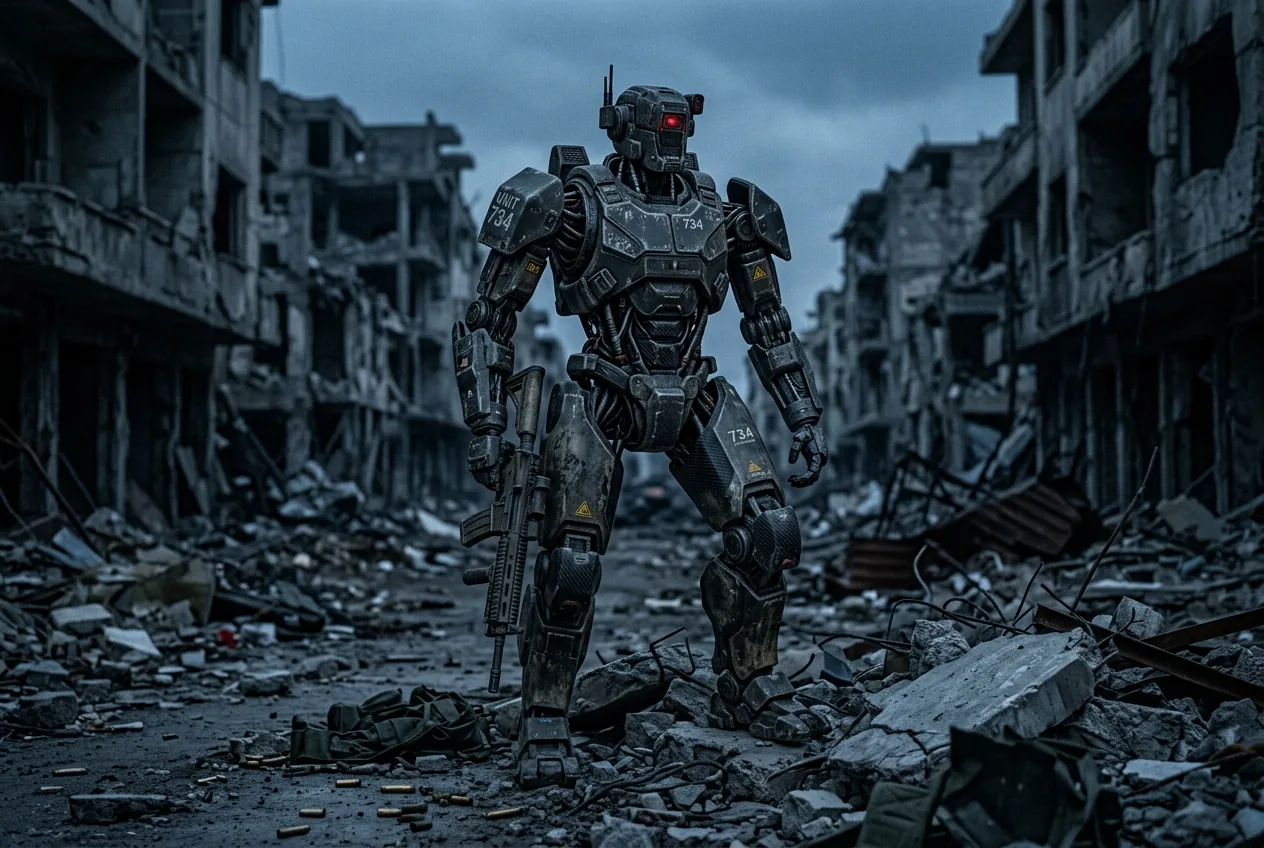
In a muddy supply trench outside Kyiv, the future of infantry warfare looks less like a super-soldier and more like a fragile, bipedal prototype struggling with a crate of ammunition. The Phantom MK-1, a humanoid robot developed by the two-year-old startup Foundation Future Industries (FFI), has already been surreptitiously delivering supplies under Russian fire. It is not a laboratory demonstration; it is a live-fire beta test for a machine that its creators claim will be ready for US frontline combat in less than 18 months.
While the MK-1 is currently acting as a high-tech pack mule, the upcoming Phantom 2 is designed for far more aggressive silhouettes. According to company briefings, the next iteration will double the payload capacity of its predecessor and feature hardened joints capable of navigating the rubble-strewn stairwells and narrow corridors of urban combat environments—spaces where wheeled or tracked drones frequently snag. For the Pentagon, which is increasingly obsessed with an 'AI-first fighting force,' the appeal is clear: a robot that can use human tools, drive human vehicles, and clear human buildings without requiring a total redesign of the existing logistical infrastructure.
The political plumbing of a $24 million shortcut
Innovation in the defense sector rarely happens on merit alone, and FFI’s rapid ascent has as much to do with Washington power dynamics as it does with sensor fusion. The startup has already secured $24 million in Pentagon contracts, a feat that usually takes years of lobbying for a company founded only in 2024. Much of the scrutiny surrounding this acceleration centers on the company’s advisory board, which notably includes Eric Trump. The connection has turned a technical milestone into a partisan flashpoint in the US Senate.
Senator Elizabeth Warren has already characterized the arrangement as "corruption in plain sight," questioning how a brand-new entity managed to skip the queue for sensitive defense funding. From a Brussels or Berlin perspective, this looks like the quintessential American 'revolving door' on steroids. In the European Union, where the AI Act and strict procurement transparency rules create a high barrier for entry, such a rapid marriage of political scions and lethal autonomous systems would be tied up in ethical committees for a decade. In the US, however, the fear of falling behind China’s rapidly advancing robotics sector appears to be overriding traditional oversight concerns.
Pathak has been vocal about this geopolitical race, framing FFI as a domestic bulwark against Chinese manufacturers like Unitree or UBTECH, who are flooding the commercial market with increasingly capable bipedal frames. The argument is that if the West does not field a combat-ready humanoid now, it will eventually be forced to fight against them. It is a compelling narrative for a Pentagon leadership that is tired of the slow-moving 'Primes'—the Lockheeds and Boeings of the world—who often struggle to integrate modern AI software into their legacy hardware.
Can a bipedal robot actually survive a trench?
Beyond the political theatre lies a grueling engineering reality: bipedal movement is an energy-intensive nightmare. For decades, the consensus among military engineers was that four legs (quadrupeds like Boston Dynamics’ Spot) or wheels were superior for the battlefield. They are more stable, have lower centers of gravity, and consume significantly less power. The humanoid form is inherently unstable; if a Phantom MK-1 loses a motor in its ankle, it becomes a 150-kilogram paperweight. If a tank loses a tread, it is a pillbox.
Engineers familiar with the Ukraine trials suggest that the primary challenge isn't just movement, but 'edge' processing. To operate in a GPS-denied, electronically jammed environment like the Donbas, a humanoid cannot rely on a cloud-based brain. It must have enough onboard compute to recognize a tripwire or a basement entrance in real-time, all while managing a battery life that currently measures in hours, not days. FFI’s solution involves 'agentic AI'—systems capable of autonomous research and tactical decision-making—but translating that from a clean server room to a wet, freezing trench is a leap that many in the industry believe will take far longer than the promised 18 months.
There is also the question of cost-to-attrition ratio. Ukraine has proven that the most effective robots are often the cheapest ones—first-person view (FPV) drones made of plastic and duct tape that cost $500 and can take out a million-dollar tank. A sophisticated humanoid robot, likely costing hundreds of thousands of dollars per unit, represents a high-value target for the enemy. Unless FFI can demonstrate that these machines can be mass-produced with the efficiency of a consumer electronics factory, they risk becoming expensive curiosities rather than the 'silent death' soldiers the marketing materials promise.
The European hesitation and the industrial gap
While the US sprints toward bipedal combat, Europe remains fundamentally divided on the 'killer robot' debate. German defense policy, in particular, has long been allergic to the idea of fully autonomous lethal systems, preferring a 'human-in-the-loop' approach that often slows down technical integration. However, the industrial reality is that Europe’s robotics expertise is largely siloed in the automotive sector. When Kia’s CEO recently announced plans to deploy the humanoid Atlas robot in US factories by 2029, it signaled a shift: the same hardware being tested for war in Ukraine is being groomed for the assembly lines of the future.
The supply chain for these robots remains a critical vulnerability that neither Washington nor Brussels has fully solved. The high-torque actuators and specialized rare-earth magnets required for bipedal balance are dominated by Asian suppliers. If FFI intends to scale to thousands of units as Pathak suggests, they will hit the same semiconductor and raw material bottlenecks that have plagued the European EV industry. For Mattias Risberg, observing from the tech hubs of the Rhine-Ruhr, the irony is thick: the US is using political shortcuts to build the soldiers of tomorrow, while Europe is still trying to decide which directive regulates the lithium in their batteries.
The 18-month deadline for US combat deployment is likely more of a marketing anchor than a hard delivery date. It serves to keep the VC funding flowing and the Pentagon’s interest piqued. But the fact that these machines are already dragging crates through Ukrainian mud suggests that the era of the 'humanoid-as-toy' is over. We have entered the era of the humanoid-as-utility, and eventually, the humanoid-as-combatant. Whether they can actually clear a building better than a well-trained squad of marines remains unproven, but in the current climate of industrial-scale warfare, the Pentagon seems willing to pay $24 million just to find out.
Washington has the ambition. Foundation has the political connections. Now, they just need to find a battery that lasts longer than a firefight.




Comments
No comments yet. Be the first!