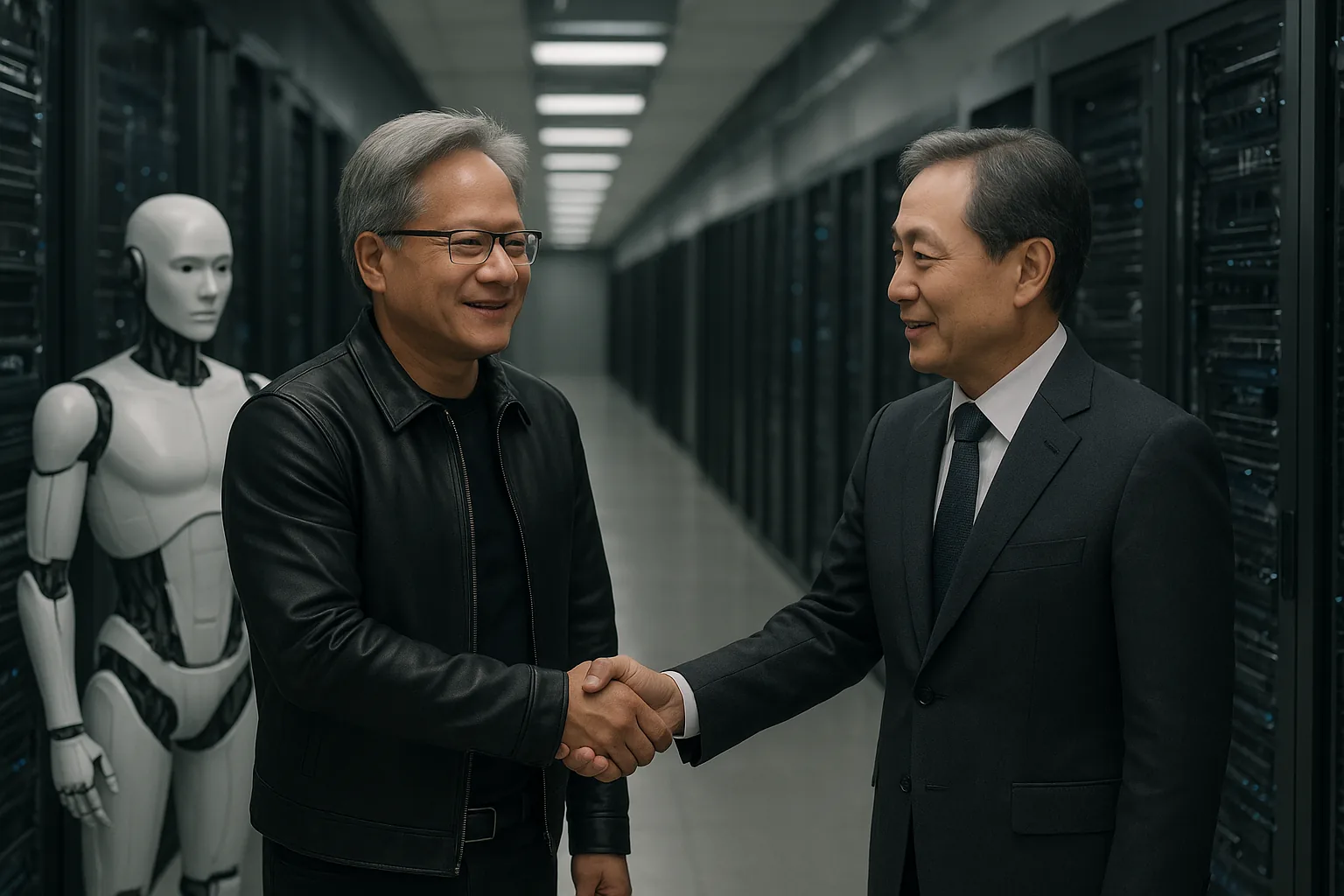
Nvidia working humanoid robots — the Seoul handshake that mattered
On June 8, 2026, after a tightly scheduled meeting at LG Group's headquarters in western Seoul, Nvidia CEO Jensen Huang stood beside LG Chairman Koo Kwang‑mo and spoke bluntly: "We are working with them in motor technology as well as mechanical systems so that we can bring together humanoid robotics and the future of robotics." That sentence — short, public and oddly specific — is the clearest evidence so far that nvidia working humanoid robots is not merely a software exercise but a hardware and factory problem.
Huang's comments came during a week of announcements and bilateral deals across South Korea in which Nvidia outlined multi‑year co‑development plans with LG, SK hynix, SK Telecom, Naver and others. The headlines have highlighted humanoid prototypes and Jetson/Blackwell chips, but the substance of the collaboration reaches deeper: modular data centre architecture, liquid cooling, power delivery (including 800‑volt DC experiments), digital twins for simulation and factories designed to generate the physical training data that robots need. In short, Nvidia and LG are linking robots and data centres into a single industrial stack.
Why nvidia working humanoid robots with LG matters for "physical AI"
This is a different conversation from putting a large GPU in a research lab. Nvidia is pitching an end‑to‑end AI factory: chips, simulation, synthetic data, mechanical platforms and the facilities that host them. LG brings motor and mechanical competence, sensors from LG Innotek, power systems via LG Energy Solution and carrier links through LG Uplus. Nvidia brings Blackwell GPUs, NeMo models, Isaac Sim/Isaac Lab and DSX factory orchestration. Put together, they aim to shorten the loop between simulation, training and real‑world validation for robots.
That matters because humanoid robotics is not primarily a software problem any more than jet engines are a software problem: motion control, thermals, power transient behaviour and human safety are all physical engineering domains. If you want robots that can handle real homes and factories, you need huge volumes of physical test data and facilities that can repeatedly exercise actuators, sensors and failure modes. Nvidia and LG are proposing those facilities — and that is why the deal matters beyond a single robot demo.
How nvidia working humanoid robots ties into next‑generation data centers
Nvidia's public language frames the partnership as "humanoid robots and the architecting of future data centres." The link is literal: robots need data and simulation at scale, and training or fine‑tuning large models for on‑device decision‑making requires different infrastructure than conventional cloud AI. Nvidia's DSX AI factory platform, referenced in press material, is designed to orchestrate model training, digital twins and deployment pipelines inside purpose‑built facilities.
LG will not only host compute but co‑design cooling (cold plates, liquid loops), power delivery topologies and modular racks tailored for sustained AI throughput. That hardware work — 800V DC distribution, direct liquid cooling and modular, rapidly deployable pods — changes the cost and siting calculus for large inference and robotics labs. The plan is to turn data centres into production‑grade labs that continuously generate, label and validate the physical data robots require.
What Nvidia actually brings to the table
Put simply: software, chips and a playbook. Nvidia's assets include Blackwell GPUs for high‑performance inference, the Jetson Thor / Jetson family for edge compute, the Isaac suite for robotics simulation and the NeMo family for language and multimodal models. The company is packaging these into a "reference robot" approach — bundling software stacks with a validated mechanical platform so research labs can skip the months of integration work that normally eats budgets.
That strategy mirrors the Unitree announcement earlier this year: Nvidia selected Unitree's H2 humanoid body as a research platform and loaded it with Nvidia Jetson/Blackwell compute and Isaac GR00T models. In other words, Nvidia is selling an integrated block: compute, stack, simulation and a choice of mechanical shell. With LG, the same block becomes industrial‑scale rather than research‑only.
How this compares with other robotics and data‑centre moves
There are three reasonably close comparisons. First, Nvidia's Unitree tie‑up targets academic and lab adoption — the low‑friction path to broad software testing. Second, rivals such as specialized robotics startups (1X Technologies and others) are building vertically integrated hardware/software robots but without the same data‑centre angle. Third, hyperscalers and chip rivals (Intel, AMD, AWS custom silicon) are racing to optimise racks for AI, but few combine the mechanical robotics feedstock and facility design the LG pact encompasses.
That combination — a single supplier chain from actuator to model to cooling loop — is the industrial bet. It creates a moat if executed well, but it also concentrates technical risk: if the facility or power architecture is wrong, the robots won't scale. It also raises geopolitical stakes, because sovereign AI models and supply chains are now being woven into national industrial policy in Korea, China and beyond.
Supply‑chain, policy and the European angle
From a European industrial policy perspective the Nvidia‑LG tie‑up is a reminder that Asia is still where many end‑to‑end AI manufacturing experiments are happening. Europe has robotics engineering strength and automation champions — Germany's Mittelstand — but it lacks the same integrated push between chip vendor, conglomerate and telco that Seoul is hosting. The EU Chips Act and IPCEI schemes aim to close that gap, but building a comparable AI‑factory stack requires coordinated investments in HBM supply, liquid cooling expertise and local compute manufacturing.
There are also export‑control and competition wrinkles. Nvidia is deepening ties with SK hynix and Samsung for HBM memory and exploring foundry and HBM cooperation; that supply profile matters for whether Europe can get competitive pricing or must rely on imports. Regulators in Brussels will be watching whether these cross‑border industrial blocs entrench single‑vendor dependencies that EU policy has tried to avoid.
Who pays, who benefits and the timelines
For now the deal framing is multi‑year and incremental. Unitree's H2 Plus for research is slated for later this year and will reach labs in October; wider LG‑led factory deployments will take longer. Building modular, liquid‑cooled facilities and domestic power systems is capital‑intensive. LG's involvement reduces risk: it has manufacturing capacity, system integration skills and customer channels. Nvidia supplies the software and compute economics — the two sides split the heavy lifting.
Beneficiaries are obvious: research labs, big manufacturers and cloud customers who need robotics‑grade datasets and validated inference platforms. The losers — at least in the short term — are competitors who sell discrete parts rather than integrated stacks and jurisdictions that do not secure memory, packaging and cooling supply chains soon.
Answering the likely questions
What is Nvidia's role in LG's humanoid robot project? Nvidia supplies the compute (Blackwell GPUs, Jetson Thor), the software stack (Isaac simulation, NeMo models, DSX orchestration), and reference designs. It will also collaborate on motor control and mechanical subsystems so that the stack can be validated end‑to‑end.
When can we expect LG‑Nvidia humanoid robots to be released? For researchers, Nvidia's reference systems (Unitree H2 Plus integrations) are scheduled this year; industrialised factory rollouts and larger‑scale data‑centre integrations will unfold across multiple years and depend on memory and power availability.
It is progress. The kind that doesn't fit on a slide deck.
Sources
- Seoul National University (visit and engagement materials)
- Stanford Robotics Center (research use announcements)
- ETH Zurich (research collaboration mentions)
- UC San Diego Advanced Robotics and Controls Laboratory (research user lists)
- Unitree IPO filing and exchange disclosures (Shanghai STAR board documents)




Comments
No comments yet. Be the first!