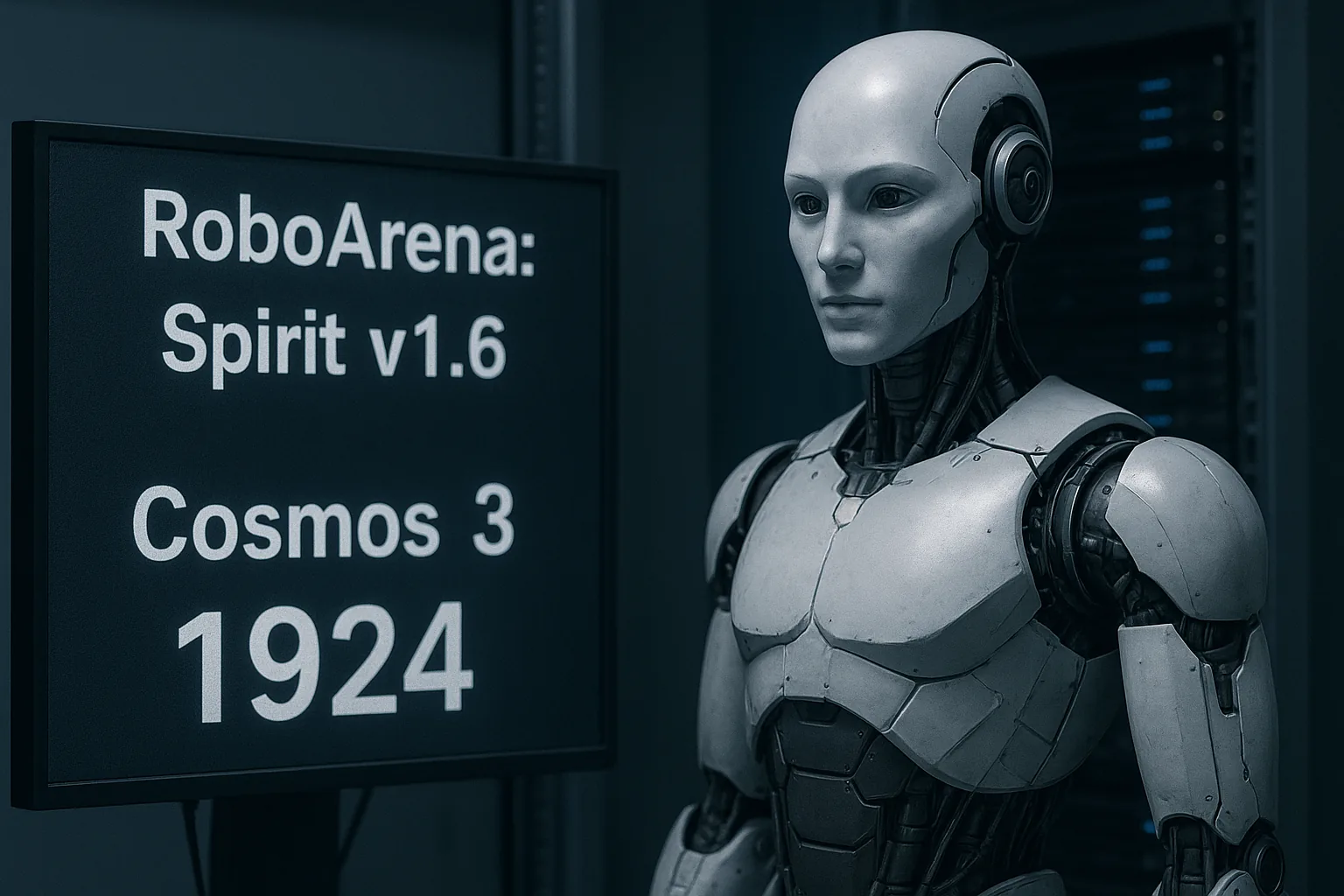
us-china tech war: china’s Spirit v1.6 and the RoboArena upset
Two days after Nvidia unveiled Cosmos 3, a small start‑up in Hangzhou published a score that made boardroom monitors blink. Spirit AI’s Spirit v1.6 logged 1,924 on the RoboArena benchmark — edging Nvidia’s Cosmos3‑Nano‑Policy at 1,881 — and the company simultaneously announced a 1.5 billion yuan (about US$222 million) financing round. In cold numbers, the headline is simple; in practical terms, the clash forces a rethink of where advantage in robotics actually lives in the current us-china tech war: china phase.
RoboArena matters because it tests how well a generalist robot policy turns perception and planning into real‑world movement across randomized, adversarial environments. The benchmark was built with heavy academic input; Stanford and UC Berkeley are listed among its co‑developers. Yet a single leaderboard snapshot doesn’t reveal the supply‑chain, regulatory and data dynamics that produced it — and those backstage factors are where China looks strongest right now.
Why a benchmark win is a political as well as a technical event
Benchmarks like RoboArena are useful for comparing policy architectures, but they are not fate. The leaderboard rewards models that translate observations into robust actions across many simulated tasks, using strict anti‑overfitting measures. Still, performance gains can come from several routes: model architecture, better synthetic or real‑world training data, clever domain randomisation, or targeted engineering to squeeze more from limited compute. Spirit’s rise looks like a combination of aggressive data gathering, pragmatic model engineering and a funding sprint — not simply access to top‑end GPUs.
That combination is itself political. Nvidia helped design RoboArena and then put Cosmos 3 into the ring. Spirit’s victory signals that the embodied‑AI race has moved beyond raw chip horsepower into an arena where data scale, task coverage and deployment pipelines matter at least as much. For geopolitical watchers, that’s significant: it changes where leverage sits in the us‑china competition.
us-china tech war: china’s structural edge — data, factories and state capital
The most obvious advantage China brings to robotics AI is data. Industry insiders and executives have repeatedly said that “data is the hardest problem” for physical AI; Nvidia’s own CEO reiterated that point in recent announcements. In China, municipal and provincial governments have quietly supported centralized robotics data collection — sometimes described as “data factories” — which can produce curated, labelled streams for training manipulation, navigation and human‑interaction tasks at industrial scale.
How China is competing with NVIDIA on AI hardware and software for robotics
China’s response to chip export controls has been two‑pronged. Companies like Huawei and Baidu are shipping increasingly capable domestic accelerators (Huawei’s Ascend family and Baidu’s M100 chips were explicitly designed to reduce dependence on foreign GPUs). That doesn’t mean parity with Nvidia’s top datacenter GPUs yet, but the gap is shrinking for many robotics workloads, which often prioritise latency, determinism and power efficiency over sheer throughput.
For robotics developers, the new Chinese processors are attractive: they cost less, integrate with local cloud stacks and can be paired with large, locally available datasets. They also come with different software ecosystems and toolchains, which raises migration and validation costs for teams used to CUDA and Nvidia’s SDKs. Practically, many robotics developers will operate in a mixed world: Nvidia for heavy offline training, and local accelerators for edge inference and closed‑loop control where cost and latency matter most.
What this means for NVIDIA’s roadmap and robotics customers
Nvidia’s response has been predictable: double down on partnerships and product lines optimized for embodied intelligence. Cosmos 3 was engineered with that pivot in mind, and recent collaboration announcements with Unitree and Sharpa signal a push to lock developers into an ecosystem that spans simulator, model and hardware. But leaderboard losses like this one will nudge Nvidia to emphasise software robustness and developer ergonomics alongside raw FLOPs.
For European and German firms, the choice is not just technical but strategic. The EU Chips Act and German industrial policy aim to secure access to cutting‑edge tooling while preventing over‑dependence on any single supplier. That means procurement decisions — whether to standardise on Nvidia, adopt local Chinese accelerators for cost reasons, or design hybrid pipelines — will increasingly be political as well as technical.
Which Chinese companies are shaping next‑generation AI accelerators for robotics?
Beyond the headline makers, the Chinese ecosystem is broad. Household names such as Huawei are developing high‑end accelerators; Baidu is both building chips and integrating them with its cloud and autonomous stacks. Start‑ups and national labs are filling niches: some focus on low‑power inference for robotic limbs, others on accelerated perception networks for dense 3D point clouds. The net effect is a layered supply chain where inexpensive local silicon plus abundant data can produce competitive robotics stacks at lower price points.
That competition is what Justin‑in‑the‑field teams should know: Chinese silicon is not yet a drop‑in replacement for every Nvidia workload, but for the mix of perception, control and simulation that defines many embodied AI systems, it is often “good enough” and far cheaper at scale.
How to judge a robotics benchmark result (and when to be sceptical)
erboards incentivise optimisation. Good teams build models that generalise; smart teams also tune for the test. RoboArena’s designers attempted to make the benchmark robust — randomized tasks, adversarial scenes, anti‑overfitting measures — yet no benchmark can fully replicate the messy cost, safety and regulatory challenges of deployment. Spirit’s victory is an important technical marker, but deployment in factories, hospitals or public streets imposes software validation, regulatory compliance and supply‑chain guarantees that a score cannot capture.
That’s especially relevant for EU procurement officers and German industrial robotics integrators. A top benchmark score won’t substitute for safety certification, long‑term maintenance plans, or a secure hardware supply chain.
Practical advice for robotics developers choosing between Chinese accelerators and Nvidia
First: inventory your risk. If your product must meet Western defence or export‑control constraints, Nvidia and TSMC‑fabricated GPUs may be mandatory. Second: profile your workload. If your control loop needs millisecond determinism and low power, local accelerators may be cheaper and perfectly adequate. Third: plan for portability. Use abstraction layers, containerised inference stacks and hardware‑agnostic ML ops so models can be retargeted if supply or policy changes.
Finally, consider where your training data comes from. If you rely on large proprietary datasets hosted in China — or on third‑party services that use Chinese data — the geopolitics of data access and localisation may affect your ability to reproducibly train and maintain models in the future.
Why Europe should care (and what it can still influence)
Europe supplies crucial parts of the global semiconductor and manufacturing puzzle — from precision tools to specialist sensors — and German engineering remains central to high‑value robotics. But Europe’s policy response has been cautious compared with state‑led approaches in China. The EU Chips Act gives Brussels tools to subsidise capacity and resilience, but it won’t instantly create the data pipelines, venture‑funded rapid iteration cycles or regulatory speed that China currently leverages.
If Europe wants meaningful industrial sovereignty in robotics, policymakers need to match hardware subsidies with investment in shared real‑world data collection, permissive regulatory sandboxes for testing embodied systems, and clearer procurement strategies for cross‑border supply resilience. Otherwise Europe will still have the engineers; it will just lose the high‑margin use cases to cheaper, better‑data incumbents.
Spirit’s RoboArena win matters because it reframes the competition. The us-china tech war: china phase is not only about who designs the next LLM or who controls the fabs; it is also about who owns the messy, expensive business of teaching machines to move and work in the real world. That business rewards data, deployment pipelines and patient state capital as much as it rewards compute.
In short: Spirit didn’t ‘beat’ Nvidia with a magic algorithm alone. It did so with money, data, and a national ecosystem that turns robots into training rigs. Nvidia still sells the chips that underpin big training jobs, but the battlefield for applied robotics is broader than GPUs — and that’s the change to watch.
Europe has the engineers. It just needs to pick a payer for their lunch.
Sources
- RoboArena (benchmark co‑developed with Stanford University and University of California, Berkeley)
- Peking University (BigAI institute and related research)
- Ministry of Industry and Information Technology, People’s Republic of China (policy plans on low‑altitude economy and industrial AI)




Comments
No comments yet. Be the first!