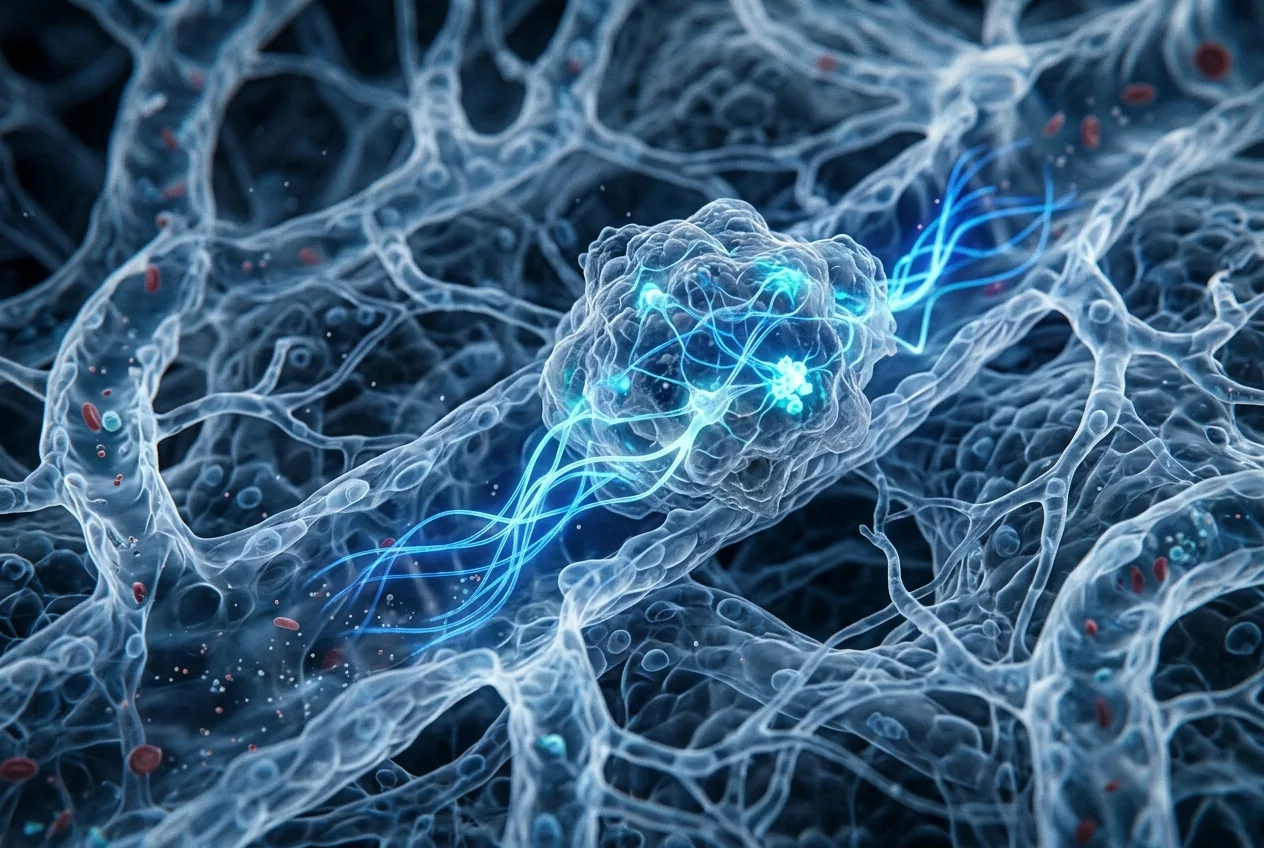
In a temperature-controlled incubator at Tufts University, a microscopic cluster of human tracheal cells did something that silicon-based systems still struggle to replicate with such low energy: it sensed a localized tear in a layer of neurons and moved to bridge the gap. It did not require a lithium-ion battery, a pre-programmed path, or a remote operator. It simply followed the chemical and bioelectric gradients of its environment. This was the birth of the "neurobot," a biological machine that doesn't just move, but processes information through its own rudimentary nervous system.
While the headlines suggest we are on the verge of organic Terminators, the engineering reality is far more fragile and, in many ways, more interesting. These constructs are not built in the traditional sense; they are grown. By coaxing human cells into specific shapes and now integrating neuronal components, researchers are attempting to solve the fundamental problem of micro-robotics: how to power and control a machine too small for a traditional motor and too complex for simple magnetic steering. The answer, it seems, is to stop fighting biology and start subcontracting the labor to evolution.
The Architecture of the Biological Bot
The transition from "Xenobots" (derived from frog embryos) to "Anthrobots" (derived from human adult cells) marked the first major shift in this field. Now, the integration of a nervous system—the "neuro" in neurobot—represents a move toward true autonomy. In traditional robotics, sensors, processors, and actuators are distinct components joined by copper or gold traces. In a neurobot, these functions are blurred. The cilia—tiny hair-like structures on the surface of the cells—act as the propulsion system. The neurons, integrated into the cellular mass, serve as the signal processing unit.
The Metabolic Bottleneck and the Energy Paradox
One of the primary drivers behind bio-hybrid research is the staggering energy efficiency of biological systems. A human brain operates on about 20 watts of power—roughly the same as a dim lightbulb—performing computations that would require megawatts for a modern AI data center. For a micro-robot, the energy problem is even more acute. Batteries do not scale down well; as they shrink, the ratio of packaging to active material becomes prohibitive. A neurobot, however, draws its energy directly from its environment, metabolizing glucose from the surrounding fluid.
This metabolic advantage comes with a severe trade-off: the life support system. A silicon robot can be turned off and put in a drawer for a year. A neurobot dies within hours if the temperature fluctuates by more than a few degrees or if the pH of its medium shifts. This makes the "supply chain" for these machines a logistical nightmare. You cannot ship a box of neurobots through DHL; you have to ship a living culture in a mobile incubator. For industrial applications, this limits their use to highly controlled environments like the human body or specialized laboratory vats.
Brussels and the Regulatory Vacuum
In Germany, the Max Planck Institute for Intelligent Systems has been tracking these developments with a mix of academic interest and industrial skepticism. The German Federal Ministry of Education and Research (BMBF) has recently funneled millions into "Bio-intelligence" initiatives, but there is a growing realization that our current regulatory frameworks are wholly unprepared for a machine that is also a living organism. If a neurobot is made of human cells, does it fall under the European Medical Devices Regulation (MDR) or the Advanced Therapy Medicinal Products (ATMP) framework?
The distinction is not merely academic. If classified as a robot, the path to market is relatively straightforward. If classified as a living tissue product, the clinical trial requirements are so onerous that they could effectively kill the industry before it starts. There is also the matter of the EU AI Act. Since neurobots use biological neural networks to process information and make "decisions" (such as which direction to swim), they technically represent a form of non-silicon AI. Brussels has yet to decide if a cluster of cells with a nervous system requires the same ethical oversight as a deep-learning algorithm trained on the open internet.
Why Silicon Won't Be Replaced Anytime Soon
Despite the potential for "self-healing" machines, the manufacturing throughput for neurobots is currently abysmal. Creating these bots involves a process of self-assembly where thousands of cells are placed in a mold and left to organize themselves over several days. In a semiconductor fab, a lithography machine can stamp out millions of transistors in seconds. The biological process is slow, prone to contamination, and yields are inconsistent. A single stray bacterium can wipe out an entire "production run" of neurobots.
Furthermore, the control interface remains the Achilles' heel of the technology. While we can now grow a nervous system into the bot, we are still quite bad at talking to it. Researchers use light (optogenetics) or chemical triggers to tell the neurobots where to go, but the commands are blunt. It is like trying to drive a car by yelling at the engine through a closed hood. Until we can achieve high-fidelity, two-way communication between electronic control systems and biological neural networks—a true bio-interface—the neurobot will remain a sophisticated lab curiosity rather than a functional tool for, say, clearing arterial plaque or repairing nerve damage.
The Problem of Biological Sovereignty
European labs are often caught between high-level ambition and ground-level bureaucracy. A researcher in Munich or Cologne attempting to modify a cell line for better neural integration faces a mountain of paperwork that their counterparts in Boston or Shanghai can often bypass. This has led to a "brain drain" of a different kind: biological data and tissue expertise migrating to jurisdictions where the "living machine" is seen as an engineering challenge rather than a philosophical crisis.
Europe has the engineers and the biologists to lead this field. It just hasn't decided whether it wants to give them a license to grow the future or if it would rather wait for a directive from Brussels to explain what a nervous system is allowed to do in a petri dish. For the moment, the neurobots are moving, but they aren't going anywhere fast.




Comments
No comments yet. Be the first!