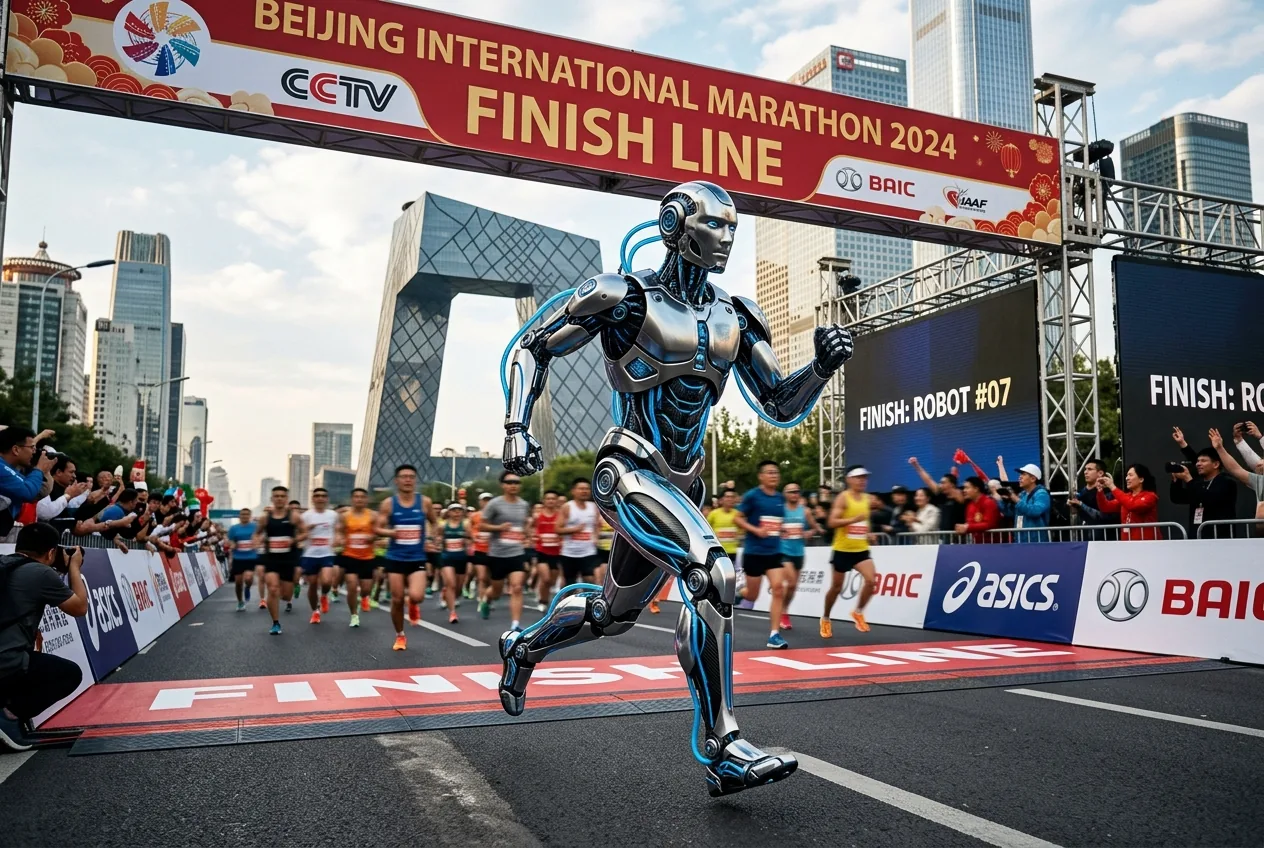
The Thermal Limits of Metal and Bone
When an elite human runner collapses after a race, it is often due to thermal regulation failure. The body simply cannot shed heat fast enough to maintain its pace. Honor’s engineers solved this problem by borrowing from the very industry that funded the robot’s development: mobile telephony. Lightning is equipped with a proprietary liquid-cooling system adapted from high-end smartphone thermal management. While a human runner relies on sweat and evaporation, Lightning uses a closed-loop liquid system to manage the heat generated by its joints and batteries during high-speed locomotion.
The mechanical specifications are equally aggressive. The robot features legs measuring 95 centimeters, roughly the proportions of an elite Olympic sprinter, and actuators capable of 400 Nm of torque. During the race, Lightning maintained an average speed of 25 km/h. For comparison, the highly publicized Atlas robot from Boston Dynamics typically operates at a fraction of that speed in controlled lab environments. The Beijing race was a public stress test of “structural reliability,” a term used by Honor’s test development engineer Du Xiaodi to describe the robot’s ability to withstand the repetitive impact of asphalt without a mechanical seizure.
However, the engineering reality is more nuanced than the headline suggests. While Lightning ran autonomously, using a suite of sensors to navigate the course and avoid the 12,000 human runners sharing the road, it was not the fastest machine on the track. A separate, remotely-controlled robot from the same stable finished in 48 minutes and 19 seconds. The fact that the human-piloted robot was two minutes faster than the autonomous one reveals the current ceiling of on-board processing. The “brain” of the robot still hesitates where a human operator, even one miles away with a low-latency connection, does not.
The Geopolitics of a 50-Minute Mile
For those of us watching from Europe, the Beijing race is less about sports and more about industrial policy. The event featured over 300 robots from more than 100 teams, a scale of competition that is currently impossible to replicate in the European Union or North America. China has committed approximately $138 billion to robotics and embodied AI under its latest Five-Year Plan. The goal is not to win marathons, but to dominate the supply chain for the next generation of industrial laborers.
In Brussels, the reaction to such displays is usually a mixture of regulatory concern and funding envy. While the EU Chips Act aims to secure the silicon necessary for these machines, China is already moving into the “shipment phase.” According to a recent report from technology research group Omdia, three Chinese firms—AGIBOT, Unitree Robotics, and UBTech—have already reached “first-tier” status, shipping thousands of humanoid units last year alone. In contrast, European robotics remains largely focused on high-precision, fixed-arm industrial automation (Industry 4.0) or niche research projects that struggle to scale past the prototype stage.
Autonomous Navigation or Remote Control?
One of the more telling data points from the race was the breakdown of autonomy. Beijing E-Town officials noted that only 40% of the robots navigated the course autonomously. The rest were “tethered” via 5G or local radio to human pilots. This gap highlights the fundamental challenge of humanoid robotics: walking is easy, but deciding where to walk at 25 km/h is incredibly hard. The winning robot, Lightning, received its championship based on a weighted scoring system that rewarded its autonomous navigation despite being slower than its remote-controlled sibling.
This distinction is crucial for the future of the industry. A remotely controlled robot is a sophisticated toy; an autonomous robot is a labor-market disruptor. The transition from 2025’s winning time of 2 hours and 40 minutes to this year’s 50 minutes suggests an exponential improvement in balance algorithms and real-time sensor fusion. Last year, only six robots finished. This year, the field was crowded with machines that didn’t just finish, but thrived. The mishaps—the robot that hit a barrier and the one that tripped at the start—are now the outliers rather than the norm.
From a technical standpoint, the use of liquid cooling in a humanoid frame is a significant pivot. Most Western designs, including those from Tesla or Figure, have historically focused on air cooling or efficient motor design to manage heat. By opting for a heavy, complex liquid system, Honor has prioritized raw performance over weight efficiency. It is a brute-force approach to robotics that mirrors China’s approach to the semiconductor industry: if you can’t out-design the physics, out-engineer the heat.
The European Dilemma
Where does this leave the European robotics sector? Germany, in particular, has long prided itself on being the world’s factory for high-end machinery. But the humanoid form factor presents a unique challenge to the German model. Our strength lies in specialized precision—machines that do one thing perfectly a million times. The humanoid is a generalist, a jack-of-all-trades that requires a level of software integration and rapid iteration that European corporate structures often find stifling.
Furthermore, the supply chain for these robots is increasingly centralized in East Asia. The high-density batteries, the compact motor controllers, and the specialized sensors used in Lightning are almost all sourced within a two-hour drive of the Pearl River Delta. For a European firm to compete, it would have to navigate a labyrinth of export controls and rising costs, while the Chinese firms benefit from direct state subsidies and a massive domestic testing ground like the Beijing E-Town district.
The Beijing half-marathon has effectively ended the era of humanoid robots as slow-moving curiosities. The image of Lightning crossing the finish line ahead of the world's best athletes is a powerful piece of propaganda, certainly, but it is also a data point that cannot be ignored. The technical hurdles of bipedal locomotion at speed have been cleared. What remains is the much harder task of making these machines useful for something other than running in circles.
China has the robots and the world-record times. It remains to be seen if they have a plan for what happens when the race ends and the machines have to go to work. For now, the scoreboard says the humans are losing, and the cooling systems are just getting started.




Comments
No comments yet. Be the first!