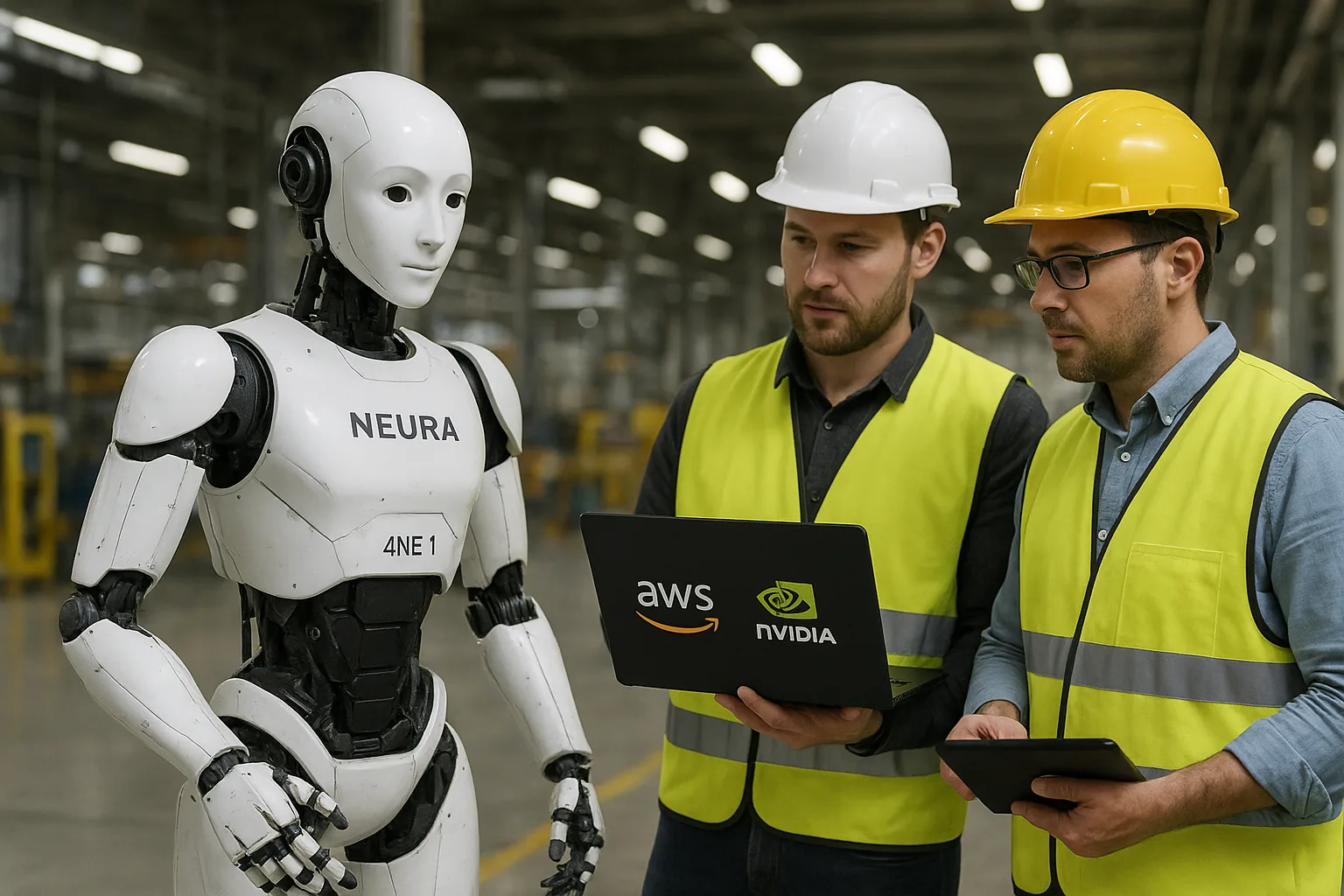
At a German factory gym, the slide that matters reads ‘up to $1.4B’
On the morning of June 10, Neura Robotics’ investor deck — the one the company posted and the press copied — switched the conversation inside Europe’s robotics corridors from demo videos to a single, cautious line: the Series C could reach up to $1.4 billion, contingent on milestones. For anyone who watches robot companies closely, those last three words matter more than the headline. They turn a splashy funding total into a financing timetable that pays out as the company proves it can build, train and ship at scale.
That caveat didn’t stop a roll call of strategic names from stepping forward. The round lists Tether as lead investor, with participation from Nvidia, Amazon, Qualcomm, Bosch, Schaeffler and the European Investment Bank, among others. The syndicate maps almost exactly onto the layers a humanoid maker needs: cloud and logistics demand, simulation and GPU compute, edge silicon for on-device inference, industrial-grade sensors and mass-manufacturing partners — and, oddly, a stablecoin company. The result: neura robotics raises $1.4 has become shorthand for a very particular European gamble on “physical AI.”
neura robotics raises $1.4 — who's in the syndicate and why that matters
The roster is striking because it is pragmatic, not celebrity-driven. Nvidia brings Isaac and Omniverse simulation stacks that let robots train in digital twins before risking hardware. Qualcomm supplies the edge compute chips that battery-powered humanoids will need to run inference without a coaxial umbilical to a datacenter. Bosch and Schaeffler offer the actuation, bearings and industrial scale that separate lab curiosities from fielded machines. Amazon provides distribution and, crucially, a testing ground: the company has told partners it will run cognitive robots in select fulfillment centers to generate the real-world experience robots need.
Then there is Tether. The stablecoin issuer is the outlier but also the signal. Blockhead’s coverage shows Tether is not only writing a big cheque; it plans to embed a Wallet Development Kit (WDK) and an edge runtime called QVAC into Neura’s stack. That means Neura’s machines could, in principle, earn and spend money autonomously for specific tasks — reordering parts, paying for compute time or settling between logistics partners. It is a provocative idea that forces regulators and corporate buyers to think about payments, auditing and liability in machine workflows.
Strategic investors as a supply‑chain map
One way to read the syndicate is as a shopping list for scale: compute, edge silicon, sensors, manufacturing, logistics and institutional finance. It is an unusually end-to-end cast for a startup round, and that is intentional. Neura has called its software ecosystem Neuraverse and is building ‘‘Neura Gyms’’ — large training floors where robots generate manipulation and navigation data. The partners provide both components and immediate demand, shortening the path from prototype to production if the technical and operational puzzles are solved.
neura robotics raises $1.4 — what the money buys (and what it doesn’t)
Neura’s public statements list five concrete priorities: expand Neuraverse, scale the Gyms, grow manufacturing across Germany and India, deploy humanoids into industry and logistics, and continue R&D on physical AI. Ambitious. The more interesting line is that the $1.4 billion is an upper bound tied to performance milestones. That structure protects investors if real‑world deployment stays stubbornly difficult — and it tells you where Neura will have to spend its time and cash: on manufacturing yield, repeatable reliability and data acquisition.
Those three problems are why the field has been noisy for years. Unlike language models that can endlessly chew on web text, robots must collect embodied data — the bruises and failed grasps of real manipulation — and that requires time, space and often destructive testing. Neura’s bet is that Gyms plus Amazon’s fulfillment floors will break that data drought. If they do, the company claims an order book and pipeline exceeding $1 billion; if they don’t, the payout is capped and milestones will be missed.
Engineering trade-offs behind the slides
Engineers know the ugly truth no slide deck enjoys: small hardware issues cascade. Battery density, motor heat, actuator tolerances, sensor drift and software regressions multiply across thousands of units. The presence of Bosch and Schaeffler hints Neura understands this — they are the companies that turn engineered novelties into reliable parts. Nvidia and Qualcomm participation reduces the risk of bottlenecks in compute, but global chip supply and export controls remain macro variables that a robotics company cannot easily control.
Tether’s role: payments, edge AI and a regulatory headache
Tether’s lead position is the single most headline‑worthy policy question. Its pitch to Neura is precise: embed self‑custodial wallets (WDK) and an edge-first AI runtime (QVAC) so machines can transact and reason locally. The economic argument is simple — machine workflows that require human sign‑offs are slow and brittle, so let machines execute programmed settlements autonomously.
The deeper issue is not whether a robot can send a micropayment; it is how jurisdictions will regulate machine holdings, AML/KYC rules, liability for incorrect automated payments, and the audit trails those transactions require. In Europe that conversation intersects with two live agendas: the Digital Operational Resilience Act and forthcoming EU stablecoin rules. Neura’s partnership with the European Investment Bank gives the project political heft, but it also ensures Brussels will be watching how payments, KYC and consumer protection are handled when machines start spending money.
What buyers and regulators will watch
Enterprise buyers will test three things before writing bigger cheques: uptime (can the robot work a 12‑hour shift without human rescue?), integration (does it plug into SAP, AWS, and existing MES workflows?), and auditability (can every action be traced and costed?). Regulators will focus on governance and accountability when a machine pays for services or orders replacements. Tether’s involvement accelerates those questions from theoretical to urgent.
European industrial strategy and the geopolitical subtext
The EIB’s participation is telling. Europe has been trying to claim a seat at the physical AI table: talent, automotive supply chains and strong industrial groups are assets — but they are distributed across member states. Funding Neura fits a European industrial logic: stitch together chip partners, system integrators and manufacturing champions to create a full‑stack player that can compete with Silicon Valley and Shenzhen firms.
That said, Europe lacks a single, decisive capital pool for this kind of hardware scale — which is why strategic corporate investors appear more important than pure venture capital here. The Chips Act and recent EU funding instruments help, but execution still depends on who can coordinate cross‑border procurement and who bears the early losses when a production ramp falters.
What to watch next
Neura’s timetable will convert PR into proof or disappointment. The first milestones to monitor: (1) whether Amazon begins meaningful deployments in fulfillment centers and how many robots they commit; (2) delivery quality and manufacturing yield from Neura’s German and Indian fabs; and (3) Neura Gym throughput — how many robot hours of embodied training per week they can produce and how much simulated data closes the sim‑to‑real gap. Each milestone unlocks more capital; each missed milestone shrinks that “up to $1.4B” ceiling.
There is also an angle the press releases underplay: who pays for the Gyms and the operating losses in early production. Manufacturing humanoids at scale is an expensive, low‑margin business for years. The strategic investors have the right parts of the value chain, but they also now carry the reputational and operational risks of early deployments.
Neura Robotics raised its Series C publicly this week (announced June 10–11, 2026). The headline number is large, the syndicate is unusually coherent, and the technical thesis — physical AI trained in real‑world Gyms, integrated into enterprise stacks, with embedded payments — is clear. What remains unclear is the hard work that follows: turning demos into reliable products that survive eight‑hour shifts and auditors.
It is progress. The kind that doesn’t fit on a slide deck.
Sources
- NEURA Robotics press materials (company Series C announcement and Neuraverse/Gyms descriptions)
- Tether press materials on WDK and QVAC
- European Investment Bank announcements and institutional press materials
- NVIDIA developer documentation for Isaac/Omniverse and Qualcomm technical briefings on edge AI




Comments
No comments yet. Be the first!