The experiment, published this week in Physical Review Research, confronts a puzzle that has nagged at the foundations of physics for decades. In theories of quantum gravity, time does not appear as a built-in feature of reality. Yet we experience a clear arrow from past to future. The Birmingham team, led by Professor Giovanni Barontini, set out to test whether time can arise purely from change — specifically, from the way particles spread through a system, a concept known as entropic time. Their answer, carved into a thousand-cycle dance of ultracold atoms, is a guarded yes.
Forging a 24,000-atom mini universe in a Birmingham lab
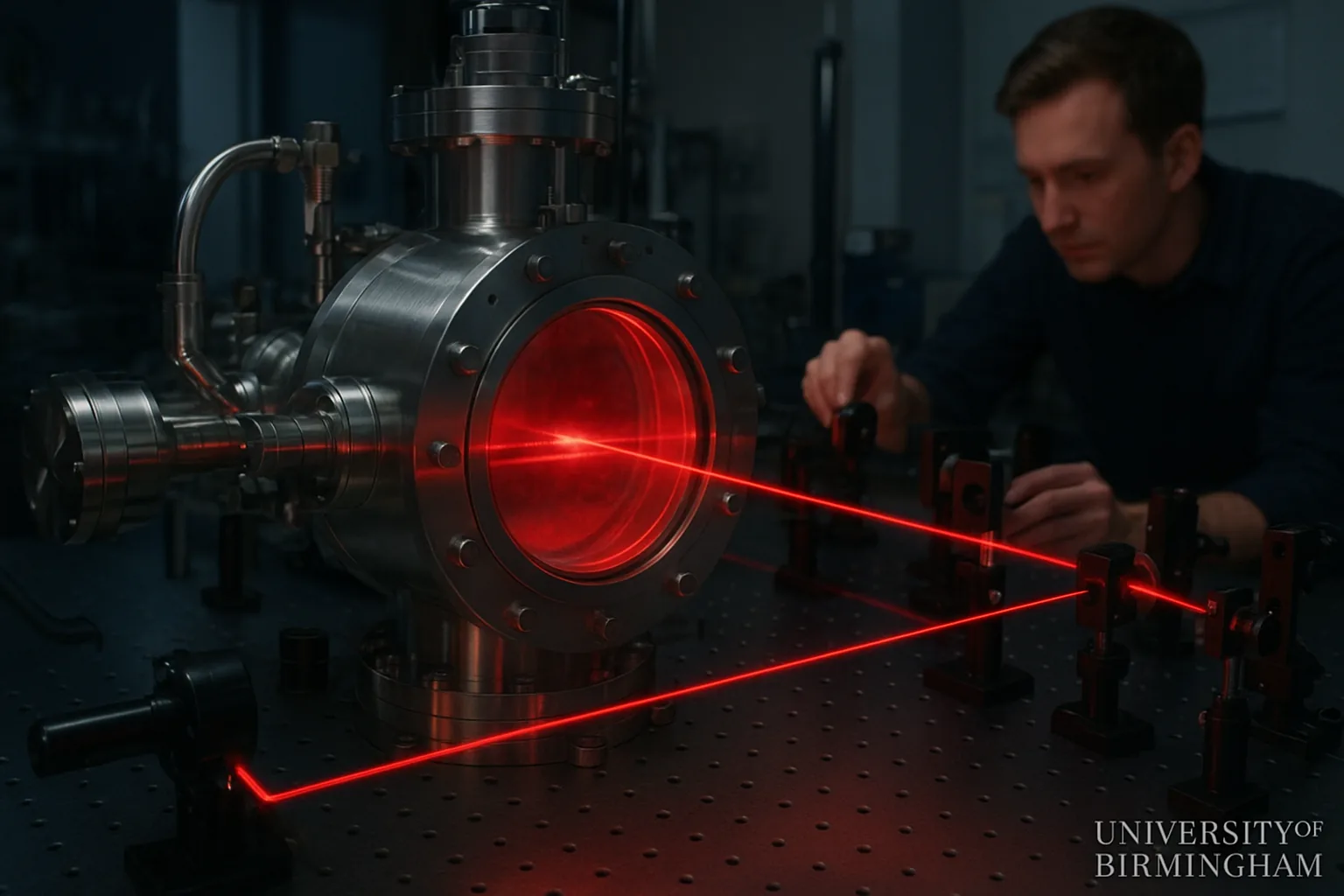
Barontini's group confined the rubidium atoms in an optical trap, cooling them until quantum behaviour dominated. Two laser beams carved a thin wall through the cloud, creating a “bright” region the researchers could observe directly and a “dark” sector hidden from view. The bright side would periodically expand and contract, mimicking the cyclical cosmology of a universe that reverses its expansion. Because the entire system was isolated from the outside environment, the only way to reconstruct a timeline of events was to infer it from the atom distributions inside.
The researchers chose 24,000 atoms deliberately. Fewer, and the statistical signal from entropy changes would be too noisy. More, and the computational overhead would become unmanageable. At this scale, the cloud behaved like a simplified universe large enough to exhibit thermodynamic irreversibility but small enough to simulate on a classical computer. Each cycle lasted roughly a tenth of a second, and the team tracked hundreds of cycles to establish that the entropic time they defined didn't just drift — it progressed reliably and in one direction, even as the bright region contracted.
Entropic time: how the 24,000-atom mini universe generates its own clock
The idea behind entropic time is disarmingly simple: if nothing changes, no time passes. The researchers linked the passage of time to changes in the system's Shannon entropy, a measure of how spread out the atoms were. When the bright and dark regions exchanged particles, entropy shifted, and according to their formulation, time advanced. When the distribution of atoms settled into a steady state, time stood still — even if the underlying quantum wavefunction continued to evolve in a way that, under conventional time, would look dynamic.
Barontini's team observed that this entropic time always pointed forward, even during the contraction phase that, in a real cosmos, would represent a Big Crunch. It never reversed, even though the underlying physics was time-symmetric. “In some theories of the universe, especially quantum gravity, time doesn't appear as a built-in feature,” Barontini said. “Yet in everyday life, time flows from past to future. Why is this so, when most basic laws of physics work the same way forwards and backwards?” The experiment suggests an answer: the arrow emerges from entropy growth alone, not from a fundamental clock.
The pace of entropic time, moreover, could speed up or slow down depending on how fast entropy changed. During rapid expansion, when atoms poured from the bright region into the dark one, entropic time ticked faster. During slow contractions, it slowed. This is not merely philosophical sleight of hand. The team rewrote the Schrödinger equation — the central equation of quantum mechanics — using entropic time as the evolution parameter. They found that the evolution of the atomic cloud's probability distribution remained consistent with standard quantum predictions, just with a time parameter defined by disorder rather than a laboratory stopwatch.
What a 24,000-atom mini universe means for quantum gravity
The work opens a rare experimental window on ideas that have largely been confined to blackboard calculations. Quantum gravity theories often struggle with time because general relativity treats time as dynamic, while quantum mechanics demands a fixed background clock. If time can emerge from entropy in a controlled laboratory setting, it lends credence to models in which the early universe's arrow of time arose not from a primordial clock but from the rapid increase in entropy after the Big Bang.
Barontini's setup is not the first to explore entropic time, but it is among the first to demonstrate it in a quantum many-body system that can be monitored cycle after cycle. Previous proposals relied on abstract thought experiments or cosmological observations that cannot be repeated. Here, the team could reset the system and watch the arrow re-emerge, always pointing forward. “It offers new insight into the nature of time in quantum gravity,” Barontini said. “It could be used to describe dynamics just as effectively as conventional time.”
The platform also bridges two communities that rarely interact: cold-atom experimentalists and theorists of quantum gravity. The same optical-trap technology that powers the best atomic clocks might now be repurposed to probe the very nature of time. This is not about building a better clock; it is about asking whether clocks are necessary at all.
From chalkboards to lab benches: testing the untestable
For decades, questions about the emergence of time sat squarely in the realm of theoretical physics. The Birmingham experiment shows that at least one version of these questions is now experimentally addressable. By tweaking the laser barrier or the number of atoms, researchers could simulate different cosmological scenarios, from accelerating expansions to heat-death-like final states. Barontini suggested the platform might eventually be used to investigate black hole analogues or to simulate the conditions of the early universe, where quantum and gravitational effects coexist.
Of course, a 24,000-atom gas is a far cry from a real universe. The system is non-relativistic, and gravity plays no role. The entropic time defined here is an effective parameter, not a fundamental field. Critics may argue that the experiment simply substitutes one operational definition of time for another, without proving that time is truly emergent. But the Birmingham team never claimed to have settled the debate; they demonstrated that, if you accept entropy as the clock, quantum mechanics remains consistent and the arrow of time persists. That is a necessary condition — not a sufficient one — for entropic time to be physically meaningful.
A laboratory universe without a master clock
The broader implication is that time may not be as fundamental as we assume. In everyday life, we rely on clocks — cesium fountains, quartz oscillators, the rotation of the Earth — to synchronise events. But at the deepest level, the universe might not come with a built-in metronome. The experience of a flowing present could be a macroscopic illusion arising from the relentless increase of disorder. As the atoms shuffled between bright and dark regions in Barontini's chamber, they were not measuring time; they were generating it.
The experiment lands at a curious moment for fundamental physics in Europe. CERN's Future Circular Collider studies compete for billions, while national labs struggle to keep ultracold-atom platforms running. Barontini's work, funded through standard UK research grants, cost a fraction of a big collider experiment but touches on questions just as deep. It is a reminder that the most profound puzzles sometimes fit on an optical table.
The team plans to probe more complex systems, including those with entanglement, to see whether entropic time holds up under the full weirdness of quantum mechanics. If it does, the notion of a universal clock may slowly retreat from the laws of physics — replaced, perhaps, by nothing more than the irreversible spreading of atoms.
For now, the 24,000 atoms in that Birmingham trap have done something quietly remarkable: they’ve shown that a universe can run on change alone. No clock required. But whether this entropic time can ultimately unseat the conventional time used in every physics textbook is still an open question. The atoms have made their case. The rest is up to the theorists — and, as always, to the next grant cycle.
Sources
- Physical Review Research (research paper on entropic time in a 24,000-atom quantum system)
- University of Birmingham press materials
- EurekAlert multimedia (images of ultracold rubidium trap)




Comments
No comments yet. Be the first!