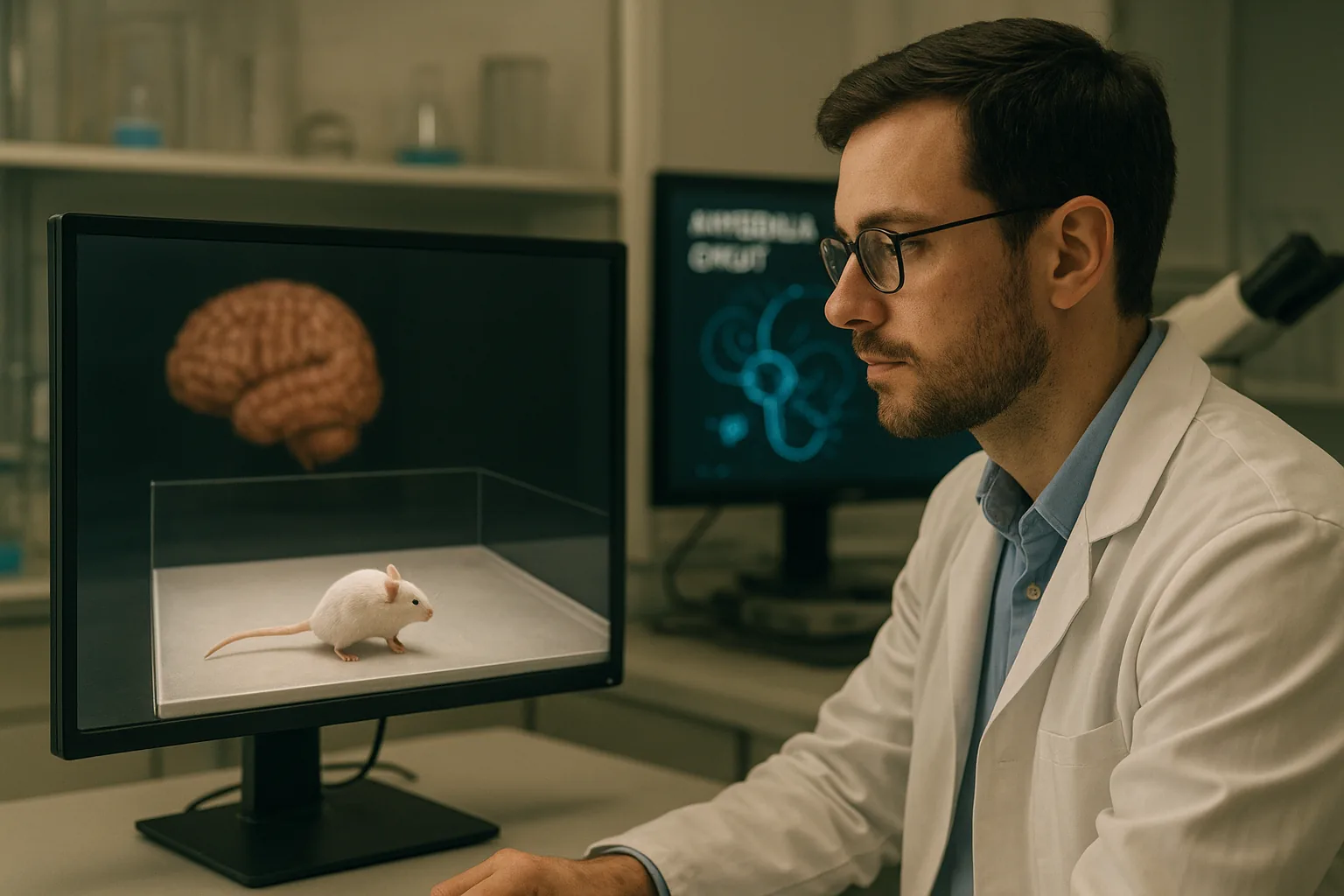
A mouse that froze at the arena edge suddenly walked into the centre — and that sudden calm told scientists just discovered brain 'switch' might be real
It happened in a lab in Valencia: a mouse that had cowered at the edge of an open field test, avoiding light and strangers, paused when researchers adjusted an activity imbalance in a tiny cluster of neurons. Moments later it wandered into the centre like a different animal. That single scene, repeated across dozens of trials, is part of why scientists just discovered brain circuits that behave like literal on/off switches for anxiety.
Over the last year several teams — working independently at institutions from Spain to Utah and La Jolla — have published mouse experiments showing that very specific cell populations can either produce pathological anxiety or prevent it. The experiments use different tools — genetics, cell transplants and optogenetics — but the headline is the same: anxiety-like states often depend on the balance in one small circuit, not the whole brain going haywire.
scientists just discovered brain switch in the basolateral amygdala — the nerve-level story
Juan Lerma’s group at the Universidad Miguel Hernández de Elche focused on the basolateral amygdala, a region already famous for fear and threat processing. They worked with mice engineered to over-express Grik4, a gene that increases GluK4 glutamate receptors. Too many of these receptors made the basolateral amygdala hyper‑excitable and the animals developed avoidance, social withdrawal and behaviours researchers equate with anxiety and depression.
Crucially, Lerma’s team could restore balance in that microcircuit and reverse the behaviours. That’s the mechanism at its simplest: change the excitation/inhibition ratio in a defined set of neurons and you flip a behavioural state. In practical terms, the switch here is a shift in neuronal excitability — not a single enzyme to block or a single drug already in your cabinet.
That matters because it changes where scientists look for treatments. Instead of broadly shifting serotonin or dopamine across the whole brain, the idea is to target the local physiology of a tiny but influential node. The experiments are in mice, but the anatomy — amygdala microcircuits and glutamate receptors — is well conserved across mammals, which makes the result interesting for people as well as rodents.
scientists just discovered brain immune 'brake' and 'gas' — microglia as anxiety regulators
Those results came from a bold experiment: transplanting specific microglial types into mice that had been stripped of resident microglia altogether. The outcome demonstrates that brain immunity matters to emotion. In other words, an imbalance in the brain's own immune residents can push behaviour toward pathological anxiety.
How does the newly discovered brain 'switch' suppress anxiety?
Operationally that means suppression can be immediate (silencing a neuronal population with light or a blocker) or slower (replacing or reprogramming immune cells so circuits stop driving anxiety over days to weeks). Both approaches produced clear behavioural changes in mice, which is why neuroscientists are excited — but cautious — about clinical translation.
Two related 'off' buttons for pain and threat show how broad the concept is
These anxiety discoveries sit alongside parallel work on pain and threat. At the Salk Institute, researchers identified CGRP-expressing thalamic neurons that convert sensory pain into the suffering that makes pain disabling. In Philadelphia, another team found Y1R neurons in the parabrachial nucleus that can be shifted to reduce chronic pain states. Those studies show a theme: small, identifiable hubs can govern whole behavioural states, and flipping those hubs can change how an animal feels and behaves.
That broader trend helps explain why groups studying very different phenomena — appetite, pain, anxiety — are using the language of 'switches'. It does not mean these are magic single-molecule cures. Instead, it points to a new strategy: locate the node that amplifies a bad internal state and adjust it precisely.
Could these discoveries lead to new treatments for anxiety disorders?
Yes — but not overnight. The experiments establish plausibility: changing activity in a defined node reduces pathological behaviour in mice. That’s a vital first step. The next steps are harder: find a druggable target within the switch, show the same mechanism operates in human tissue or imaging studies, prove safety, and then run human trials.
Potential clinical routes include small molecules that stabilise glutamate receptor activity, immunotherapies that rebalance microglial populations, or neuromodulation (targeted stimulation or inhibition) that adjusts circuit excitability without systemic side effects. Some of those avenues already have partial precedents; CGRP blockers exist for migraine, for example, which gives scientists a translational blueprint.
What are the risks, side effects and ethical concerns of manipulating the brain's anxiety switch?
Tuning an emotional switch is different from treating a broken limb. Anxiety has an adaptive role — it warns us of danger — so bluntly removing it could leave someone reckless or unable to learn from threats. On the cellular level, altering microglia might impair infection response or brain repair. Targeting glutamate receptors could affect memory and cognition if done poorly.
There are also social and ethical questions. Who decides when to silence anxiety? Should treatments be available for transient stress or reserved for clinical disorders? These are not academic queries: history shows treatments that look attractive in the lab can cause harm when widely applied without careful controls.
From mice to medicine: when might this translate into clinical therapies?
Translation timelines vary. If an experiment points to an existing drug that can be repurposed, human trials could start in a few years. If the path requires new small molecules or cell therapies, it will likely be a decade or more. Many teams are pursuing intermediate options — for example, focused neuromodulation devices that target the amygdala or related nodes — which could reach patients sooner because they build on established technology.
Researchers emphasise that animal success often fails in human trials. That’s why the next phase must include human tissue studies, non-invasive imaging markers that correlate with the mouse findings, and cautious early-phase trials focused on safety and function rather than quick fixes.
What to watch for next
Expect three lines of follow-up work in the next 12–36 months: replication of the reported switches in different labs and species; identification of molecular handles that drug developers can target; and early neuromodulation trials that test circuit-level hypotheses in patients with treatment‑resistant anxiety. Regulators and ethicists will also be drawn into the debate sooner rather than later because these targets touch core personality and emotion.
These discoveries do not promise instant cures. They do, however, change the map. Instead of treating anxiety as a diffuse brain disorder, scientists now have candidate nodes to probe — neuronal ensembles, immune cells and thalamic relays — that behave like switches. If history is a guide, the real advance will be slow, iterative, and occasionally humbling. But the moment a mouse walked into the centre of an arena because of a carefully rebalanced circuit, it became impossible to ignore the possibility that anxiety, in some cases, can be turned down — maybe, one day, safely and precisely in people too.




Comments
No comments yet. Be the first!