NOAA declared El Niño formed on June 11 — nino here scientists fear it will be big
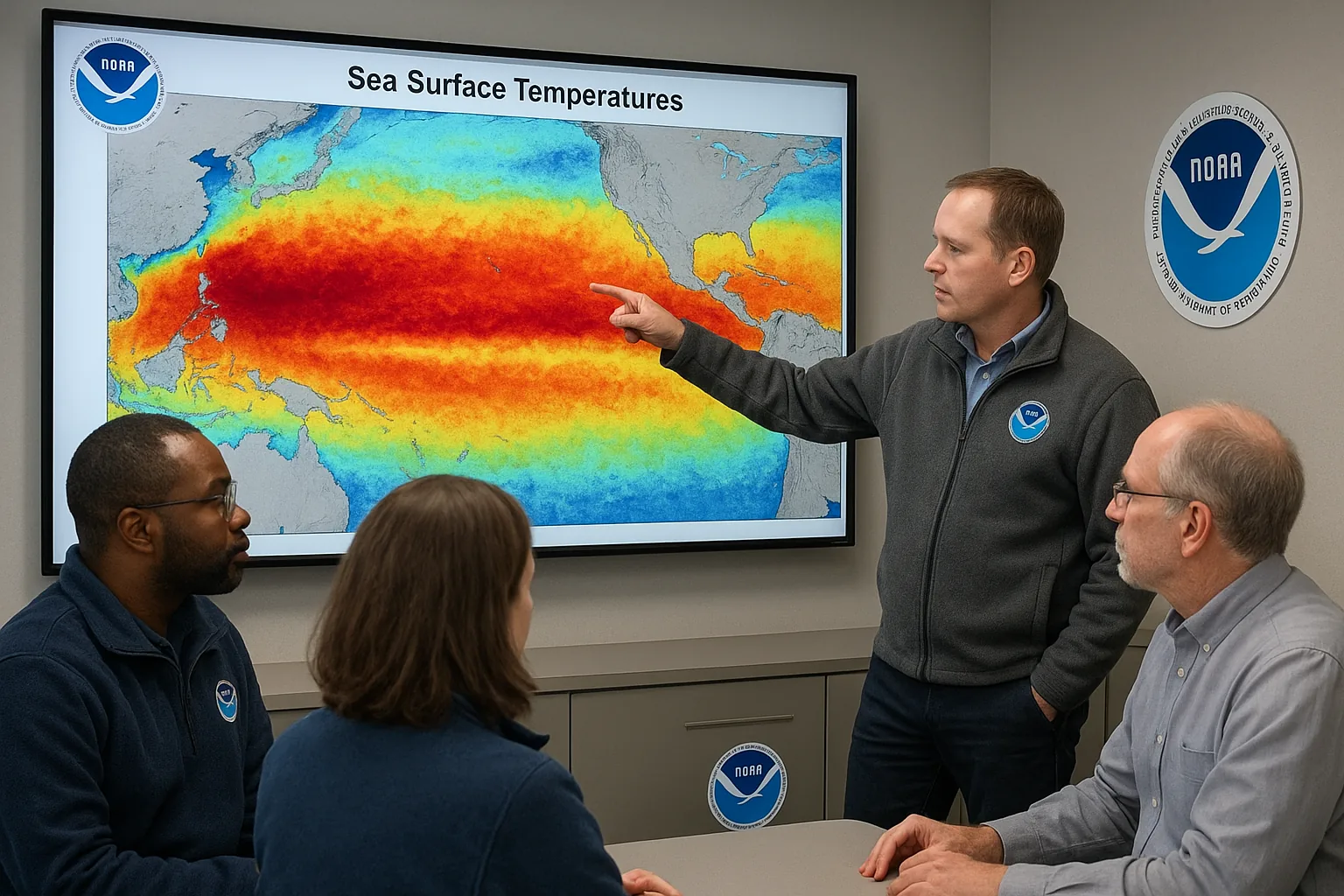
This morning (June 11, 2026) the U.S. National Oceanic and Atmospheric Administration formally announced that El Niño has formed in the equatorial Pacific, and forecasters warned the signal is unusually fast and pronounced. The gesture that will matter for cities, farmers and emergency managers is visible on satellites: an expanding swath of warmer-than-normal sea surface temperatures pushing east along the equator. nino here scientists fear this event could develop into one of the largest on record — NOAA puts the odds at roughly 63% that it will be “very strong” by late autumn and early winter — and that timing makes it a major wild card for global weather into 2027.
nino here scientists fear: why forecasters are unusually confident
Most El Niños begin in late summer or fall and build gradually; this one is marching earlier. Several operational models and independent groups — from NOAA's Climate Prediction Center to teams at Princeton and Scripps — converged in recent weeks as warm subsurface water rose quickly to the surface. That alignment of models is rare at this lead time and is part of why forecasters have shifted from “watch” to “now in effect.”
There are two technical reasons to worry. First, the ocean has already exceeded standard El Niño thresholds in some indices, meaning the system is not just a surface blip but a deep, coherent warming. Second, the pattern of winds and atmospheric convection is matching the classic El Niño teleconnection, which makes the downstream impacts — storms shifted, monsoons altered, tropical cyclone activity reallocated — more likely. Taken together, these signs increase the probability this won't be a short, weak event but a prolonged, active one.
That said, forecasters still hedge. Predicting peak amplitude and exact regional impacts months ahead remains probabilistic: the models agree that an El Niño is underway, but disagree slightly on how strong it ultimately becomes and how long it will last. Early agreement raises confidence in a big event, but not a guarantee.
How El Niño changes weather: winners, losers and the mechanics
El Niño is a natural, repeating shift in the ocean–atmosphere system in the tropical Pacific. When the central and eastern equatorial Pacific warms, it rearranges where thunderstorms and heat are released into the atmosphere. Those changes ripple poleward and across longitudes, altering jet streams, storm tracks and monsoons. The mechanics are straightforward to state and fiendishly complex to map precisely to every region: more heat in the tropical Pacific shifts atmospheric circulation, and that shift modulates weather patterns across continents.
The result is a menu of regional winners and losers. The Atlantic hurricane season often quiets, while the eastern and central Pacific can become more active — a risk for Hawaii and Pacific islands. India and parts of Asia face an elevated risk of heat waves. Australia and parts of Southeast Asia typically see heightened drought and fire danger with El Niño. South America’s Pacific coast tends toward heavy rain and flood risk, while parts of East Africa may swing between drought and intense, damaging rain in quick succession.
That variability — sometimes called “hydrologic whiplash” — is one reason policymakers worry: a strong El Niño can produce both drought and flood extremes in places that lack the infrastructure or planning to absorb the swings.
California and the U.S.: more rain in the winter, not a guarantee
For California, El Niño traditionally raises the odds of a wetter winter in the southern part of the state and tends to warm and dry the Pacific Northwest during winter months. But that rule of thumb masks large year-to-year differences. How much rain falls, where atmospheric rivers set up, and whether storms hit populated watersheds or open mountains makes a huge difference.
Forecasters now assign a substantial chance that the November–January period will be very active. That would help reservoirs and drought-stressed basins, but it also raises the risk of damaging atmospheric rivers — narrow bands of tropical moisture that can unload catastrophic rain in hours or days. California’s recent memory includes episodes where a dry period flipped to flood-producing atmospheric rivers, producing billions in damages. A strong El Niño increases the probability of both beneficial water and costly floods and landslides; what communities get depends on timing and where storms track.
Importantly, water managers are already responding. In California, the State Water Resources Control Board has been challenging some reservoir temperature and operations plans to preserve cold-water pools for salmon habitat even as managers try to keep storage for potential stormwater capture. Downstream, Colorado River runoff deficits from a “snow drought” are compounding pressure on supplies irrespective of El Niño.
Heat, fires and food: cascading economic risks
Scientists who study the economy warn that El Niño’s added heat on top of long‑term warming can dent growth. Stanford climate economist Marshall Burke and others point out that higher average temperatures reduce productivity and output in heat-sensitive sectors; several groups now forecast that 2027 could be the hottest year on record because of the combined El Niño and background warming.
Agriculture sees mixed effects. Some U.S. grain regions — notably parts of the Midwest and the northern Plains — could have favorable growing conditions for certain crops like soybeans because of moderated summer rainfall patterns, while dairy and cattle operations face uncertain feed and heat-stress outcomes. Globally, countries dependent on monsoon timing or Andean rainfall face risks to staple crops; in 1997–98, a very strong El Niño contributed to multibillion-dollar agricultural losses in some regions.
Wildfire risk is another compounding factor. Warmer, drier conditions in the Southern Hemisphere and parts of the U.S. interior increase the length of fire seasons and raise the chance of large conflagrations that in turn change hydrology on mountain slopes — amplifying landslide risk when storms arrive.
Infrastructure and preparedness: what cities and utilities should do now
Communities have a short window to act. Emergency managers and utilities should review flood maps, test pump stations, and ensure urban drainage systems are clear. Reservoir operators face a familiar trade-off: keep storage low to leave room for a big winter storm, or hold water to guard against continuing drought. That decision is political and technical; the Bureau of Reclamation and state counterparts are already debating Shasta and other operations.
Practical steps include targeted pre-storm clearing, prioritising levee and dam inspections, pre-positioning sandbags and emergency crews, and updating public warnings about heat waves and poor air quality. For farmers, the near-term market reaction will mix crop hedging, shifting irrigation schedules, and local groundwater planning. Consumers should expect volatility in energy and food prices as extreme weather disrupts production and supply chains.
How big will this El Niño be and when will it end?
Model consensus points to a peak in late fall or early winter of 2026–27, though several teams suggest an earlier peak is possible because this El Niño developed unusually fast. NOAA’s current probabilistic forecast rates a 63% chance it becomes “very strong” during its peak months; AccuWeather gives roughly a 40% chance it could reach “super El Niño” magnitude — the category associated with the strongest historical events.
Historically, strong El Niños last into the following spring, but duration varies. When one begins early and strongly, it has a tendency to linger; that’s why several researchers say impacts could stretch through much of 2027 rather than ending abruptly. Predicting the end date exactly is still model-dependent, so contingency planning should assume a multi-season disruption.
Can El Niño cause heat waves, flooding, droughts, and wildfires?
Yes. El Niño can increase the odds of all of those extremes, but which one dominates a given region depends on the regional atmospheric response, local climate, and background warming. Heat waves are more likely where El Niño suppresses cloudiness and promotes warm air advection; drought and wildfires are amplified where El Niño reduces seasonal precipitation; floods occur where El Niño steers strong storm tracks and atmospheric rivers into vulnerable watersheds.
The key point is that El Niño acts like a climate-size amplifier sitting on top of an already warmer planet. Events that might once have been mild can tip into dangerous extremes because the baseline has shifted. That interaction is why United Nations officials called today’s El Niño an “urgent climate warning.”
How communities should prepare and who pays for the damages
Preparation is a mix of common sense and hard choices. Municipalities should update evacuation plans, shore up critical infrastructure, and coordinate with state and federal agencies for contingency funding. Insurance markets will likely reprice risk if the event strengthens; governments often shoulder much of the immediate fiscal burden after large disasters, but long-term adaptation requires upfront investment in resilient infrastructure and water management.
Economically, the impacts will be uneven. Richer regions can pre-position resources; poorer regions, particularly in low‑income countries facing altered monsoons or drought, will feel the most acute damage for longer. International aid, bilateral loans and national disaster funds will be part of the response, but those are politically fraught and often slow.
When should you expect news and what to watch next
Watch the NOAA Climate Prediction Center briefings and national weather services through the summer for updates on ocean indices and atmospheric patterns. Key indicators include the Niño3.4 sea-surface temperature index, subsurface heat content in the equatorial Pacific, and changes in Pacific trade winds and convection. If models continue to coalesce upward, expect more forceful regional advisories and early preparatory action from utilities and water managers.
On the policy side, pay attention to state reservoir orders, the Bureau of Reclamation’s operations decisions, and regional water boards’ responses — these bureaucratic moves determine who gets water, when, and at what environmental cost.
It’s tempting to treat El Niño as a single headline: wet or dry, boom or bust. The real story is a chain reaction: a warm patch in the Pacific triggering storms, crops, markets, and politics. Brace for the chain.
Sources
- National Oceanic and Atmospheric Administration (NOAA) — Climate Prediction Center / NOAA news releases
- Scripps Institution of Oceanography, University of California San Diego (research and expert commentary)
- Columbia University (El Niño expertise and regional impact analysis)
- Princeton University climate modelling groups
- State Water Resources Control Board and U.S. Bureau of Reclamation (California reservoir and operations guidance)




Comments
No comments yet. Be the first!