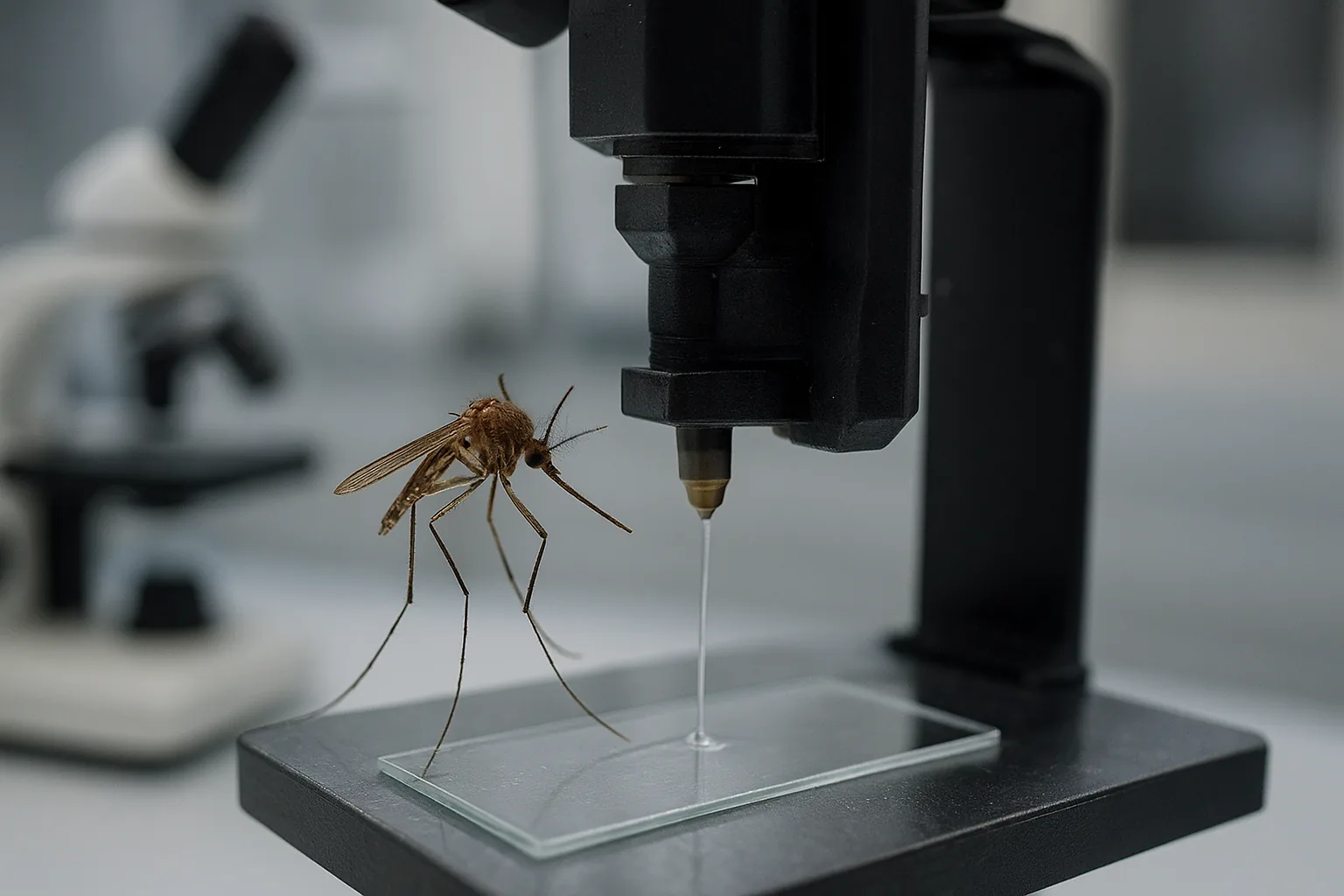
The mosquito sat dead under the microscope, its body already dissected. What remained—the needle-like proboscis—was about to become the most precise 3D printer nozzle available for less than a dime. This is 3D necroprinting: scientists harnessed the power of the dead to solve a persistent problem in micro-scale fabrication.
Harnessing the dead: from mosquito mouth to micro-nozzle
Necroprinting is not about grinding cadavers into ink. It is the direct use of deceased biological structures as functional components in a fabrication process. In this case, researchers removed the proboscis from female mosquitoes—the same rigid, hypodermic appendage that lets them draw blood unnoticed. The proboscis is naturally stiff, almost perfectly straight, and can pierce skin and vessels with micrometre accuracy. Those mechanical properties made it an ideal candidate to replace glass-pulled dispense tips, the gold standard for high-resolution extrusion printing.
To turn a dead mosquito into a durable printer part, the team first detached the proboscis from the head, then extracted the inner core—a bundle of sensory and feeding structures—leaving behind the hollow outer cuticle. They coated this sheath with an ultraviolet-curable resin, which, once hardened, turned the fragile biological tube into a stiff, chemically resistant nozzle. Finally, they glued the coated proboscis to a custom 3D-printed adapter that could be screwed into a standard printer head.
The result: a biologic nozzle that could withstand extrusion pressures of 60 kilopascals—roughly 9 pounds per square inch—and print a range of viscous materials without fracturing. When benchmarked, the mosquito nozzle produced line widths down to 20 µm, on par with commercial glass tips that cost $26 apiece.
The cost of harnessing the dead: mosquito farming versus glass supply chains
That price difference is the story’s industrial gut punch. A single glass-pulled dispense tip runs about $26, while the raw materials and labour for a mosquito proboscis nozzle are estimated at $0.08. That’s a factor of 325 lower. For a biomedical lab running dozens of high-resolution prints per week, the savings add up quickly—enough to fund an extra postdoc or keep a fume hood running.
Europe’s research ecosystem, which still relies heavily on imported consumables for microfluidics and bioprinting, might find this especially attractive. The bloc has long fretted about “labware sovereignty”—a somewhat bureaucratic term for the quiet dependency on offshore pipette tips, chips, and other plastic consumables. Necroprinting does not fix that over a weekend, but it hints at a future where the most high-tech tools are literally home-grown.
What necroprinting means for disease modelling—and mosquito farms
The researchers did not stop at proving the nozzle could extrude. They printed actual bioscaffolds: micro-scale architectures designed to house red blood cells and cancer cells. In one print, a lattice of resin surrounded individual red blood cells, holding them in place as if they were in a capillary bed. In another, cancer cells were immobilised inside a gel-like cage that could be used to test drug responses.
These demonstrations point toward a practical role for necroprinting in disease modelling and specimen preparation. Instead of etching microfluidic channels into glass or plastic with expensive lithography, a necroprinter could lay down biocompatible barriers directly where cells need them, using the mosquito nozzle’s fine control to avoid damaging fragile living cargo. Because the nozzle itself is a biological structure coated in a non-toxic resin, the risk of leachable contaminants is low—a persistent headache with metal or polymer tips.
But the method’s future hinges on whether anyone is willing to farm mosquitoes at scale. Entomologists already rear the insects for vaccine research and sterilisation programmes. A single facility can produce millions per week. The challenge is not biology but bureaucracy: insect mass-rearing is regulated in most jurisdictions, and public perception of a “mosquito factory” is poor. Still, the financial incentive is sharp. If a lab needs 5,000 precision nozzles per year, the glass-tip bill sits at $130,000; a mosquito farm producing the same number costs under $400 in materials, plus labour and electricity. Even with overhead, the margin is wide enough to make compliance worth navigating.
Where necroprinting fits in the bioprinting landscape
Necroprinting could also extend beyond mosquitoes. Other insects, such as bees, wasps, and even butterflies, possess proboscides or ovipositors with different geometries and stiffnesses. The concept of “harvesting” dead biological structures for fabrication is broadly applicable, provided the tissue can be stabilised with a polymer coating. This opens a door to a catalogue of nature-made micro-tools, each adapted to a specific fluid-dynamics problem.
Ethical questions: when dead tissue meets the printer
Any technique with “necro” in its name invites ethical scrutiny. Using insect cadavers sits at the less troublesome end of the spectrum—the mosquito’s public image is unlikely to attract animal-rights litigation. But the principle is scalable. What if a lab wanted to use a mouse whisker as a tactile sensor? Or a porcine cornea as an optical lens? Once the dead become a raw material for manufacturing, we enter a zone where biosafety, informed consent (for donated human tissue), and commercial exploitation require frameworks that do not yet exist.
The road ahead: from lab trick to lab staple
The 2025 Science Advances paper is a proof of concept. Scaling up will require standardising the mosquito harvesting and coating process, which currently involves painstaking manual dissection under a microscope. Automation is possible—robotic micromanipulators already exist—but integration into a clean workflow demands engineering effort and, crucially, money. Funding bodies like the European Research Council or Germany’s DFG have not traditionally earmarked grants for insect-as-nozzle research, but the cost argument could sway the next round of calls for “bioinspired manufacturing” or “low-cost microfluidics.”
In the meantime, the images of a mosquito proboscis faithfully extruding a scaffold for cancer cells will linger in the minds of biomedical engineers. They embody a simple, unsettling fact: one of nature’s most hated creatures, after death, may become a precision tool that saves lives. The mosquito remains the deadliest animal on Earth—not just for the diseases it spreads, but now for the manufacturing precision it offers once it’s dead. Europe’s labs, always keen to squeeze out overhead, may find that the cheapest upgrade comes from a bug zapper.
Sources
- Science Advances (research paper on mosquito proboscis necroprinting, 2025)




Comments
No comments yet. Be the first!