The Day That Changed Everything
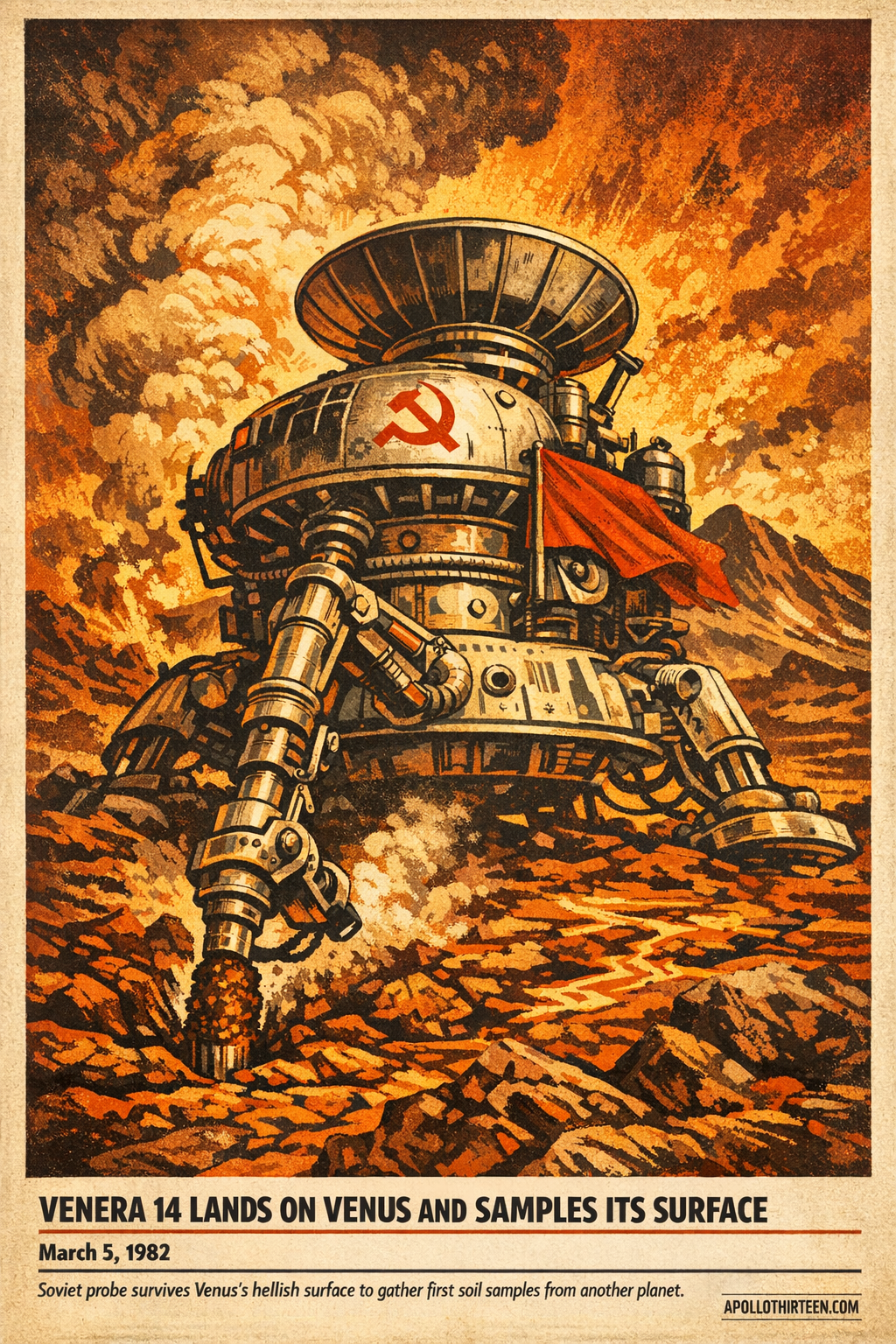
Forty-four years ago today, in the cold predawn over the Crimean steppe and beneath the hush of a Soviet control room, a small, squat machine breathed its last and told the story of a world that could have been Earth turned inside out. At roughly 06:00 UTC on March 5, 1982, Venera 14 settled onto a plain of basalt near the eastern flank of Phoebe Regio and began to speak for an alien planet. For 57 minutes it endured a hellish atmosphere of crushing pressure and furnace heat, unspooling a steady stream of pictures, chemical assays and strange, tactile measurements of Venusian soil. Then, as predicted by engineers but heavy with pathos for everyone who had watched it struggle, the signals died. The Soviet lander—one more battered, heroic instrument in a long parade across the Solar System—had survived longer on Venus than anyone had dared to hope.
The images and data it returned were not just numbers; they were the first tactile fingerprints from a world that had always been known by its clouds. They confirmed, with a small mechanical hand and a camera blinked closed by heat, that Venus’s surface was volcanic basalt, strewn with rocks and dust that compressed under the bite of a spring-loaded arm much like damp sand on an Earth beach. They made real an abstraction: that Venus, wrapped in acid and superheated air, was also a place of geologic character—plains and boulders, hard rock and softer regolith. In those minutes the lander bridged a yawning distance between human curiosity and the harsh, immediate reality of another planet.
This was no triumph of a lone genius; it was a Soviet achievement forged by teams of engineers and scientists working under pressure in a geopolitical era when space victories carried the weight of national prestige. It was also a triumph of design: an armored capsule plated to resist the atmospheric furnace long enough to gather and send a payload of carefully chosen instruments—cameras, spectrometers, and a mechanical mole that sampled the soil and tried to tell us what Venus was made of.
Forty-four years on, the words and images from Venera 14 still resonate. They are the last human-made voices we heard from the surface of Venus for decades, and they remain essential clues to the planet’s past—and to futures here on Earth that climate scientists watch with uneasy eyes.
What Actually Happened
Venera 14 began its voyage not with a dramatic interplanetary burn but with a workmanlike Proton-K rocket lift-off from Baikonur at 05:31 UTC on November 4, 1981. For 120 days the probe coasted sunward, an inert promise wrapped in solar panels and redundant systems, until it met the thick sky of Venus. Entry was brutal: the lander’s heat shield took the first shock, burning through the upper atmosphere where temperatures and pressures rose with breath-stealing speed.
At roughly 50 kilometers altitude a parachute deployed to arrest the fall, slowing the descent through the churning, sulfuric clouds. It was a temporary mercy. The parachute was released well above the surface, and an aerodynamic shield and the lander’s own descent package completed what engineers called an “airbraking” phase—an insertion into a frenetic, last-minute sequence of decelerations, jolts and sensor checks. Then, softly by interplanetary standards, Venera 14 touched down at coordinates 13.25°S, 310°E on a basaltic plain near the eastern flank of Phoebe Regio—approximately 950 kilometers southwest of where its twin, Venera 13, had made landfall a few days earlier.
Inside the cabin, a battery of instruments began to work. Two cameras pivoted and stared, then began returning panoramic images in color—a remarkable achievement considering the bulb-oven temperatures and acidic clouds beating at the lander’s seals. The pictures were curiously skewed: the lander had settled on uneven ground, so one camera’s view came almost at ground level, almost touching the horizon, and a wind—or the lander’s own movement—had nudged a small rock into the sampler’s path. Whether that object was a piece of lens cap, a pebble dislodged by the camera’s contact with the ground, or a fragment of pyroclastic platter, the result was the same: the mechanical sampling arm recorded soil that behaved more like a compacted, damp sand than an intact bedrock.
The lander’s spring-loaded mechanical arm measured the compressibility of the upper soil, pushing and scraping; a small drill could have shaved off the topmost dust. A gamma-ray spectrometer and associated chemistry instruments analyzed the elemental make-up of the sample, showing a basaltic signature with elevated levels of silicon, magnesium and potassium—ingredients consistent with volcanic rock. The atmosphere was probed during descent and on the surface: carbon dioxide dominated, with traces of nitrogen and the ubiquitous, corrosive sulfur compounds that form Venus’s cloud decks. The pressure at the landing site read out at roughly 90 Earth atmospheres; temperatures climbed above 450°C—conditions so extreme that the lander’s designers had expected survival measured in minutes, not hours.
There were other feats inside those 57 minutes. The lander’s upgraded SNEG-2M3 gamma-ray spectrometer detected high-energy events en route and offered improved thresholds for burst detection. Instruments charted the descent through stratified cloud layers, helping refine models of atmospheric structure. The lander’s brief lifetime, though short in human terms, returned the last direct, high-resolution photos from the Venusian surface for decades.
When the signals faded, they did so not with a single catastrophic flash but with the creeping failure of systems overwhelmed by heat and corrosion. Batteries lost juice; electronics succumbed to the sulfuric environment; the final photons of a world’s sunlight through a thick orange haze were replaced by silence on Earth. For 57 minutes the lander had turned Venus from folklore to texture and then went quiet, leaving behind a small patch of planet, a scattering of basalt, and a handful of packets of data that would be decoded, debated and revered.
The People Behind It
Venera 14 was less a machine than a monument to collective expertise. It was shaped at NPO Lavochkin, the Soviet union’s principal planetary spacecraft builder, where design teams took lessons from earlier Venera successes and failures and folded them into a new, more robust lander. The project was overseen by chief designer Venera P. Makarov, who led the 4V-1 lander series that included Venera 13 and 14. Makarov’s work was the product of institutional knowledge—decades of adaptations of earlier Venera models, repeated trials against a planet that could not be simulated easily on Earth.
Scientific oversight came from Moscow’s Space Research Institute (IKI), directed at the time by figures such as Roald Sagdeev, who championed ambitious diagnostics and integrated experiments that married chemistry, plasma physics and atmospheric science. Ionopheric and electrostatic measurements drew on the experience of K. I. Gringauz, while imaging and spectrometry instrumentation saw contributions from specialists at what is today the Vernadsky Institute. The gamma-ray spectrometer suite—vital for reading elemental composition—was the product of persistent refinement, one more step in a long Soviet program of in-situ planetary analysis.
Launch operations at Baikonur were handled by experienced teams of technicians and engineers, people like Vitaly Fedorchuk and others who choreographed complex countdowns and don’t-ask-luck sequences under conditions where a single miswired connector could end an interplanetary dream. Mission control for the Venera series operated through the Deep Space Communications Center in Yevpatoria, Crimea—a place of long nights and blinking consoles where scientists and operators watched telemetry, argued over anomalies, and parsed the first grainy pixels as if they were news dispatches from a far frontier.
There were human dramas of a quieter sort. Teams worked in shifts: engineers tuned the thermal blankets and plumbing that circulated liquid cooling; technicians packaged the gold-plated disks that would reflect infrared and buy the instruments minutes of life; analysts translated streaming analog voltages into readable charts. In a way that’s easy to romanticize, the success of Venera 14 was as much about bureaucratic persistence and institutional memory as it was about engineering ingenuity.
And there were quieter actors whose names are less celebrated: the radio astronomers who listened for faint beacons across millions of kilometers, the image processors who later cleaned and enhanced the photographs for public release, and the public outreach officers who prepared the planetariums and press bulletins that would shape how the nation—already weary and in need of symbolic victories—perceived the flight.
Why the World Reacted the Way It Did
In March 1982 the Cold War still framed much of the public conversation about space. Soviet triumphs and American triumphs were framed in stark terms: not only technological achievement, but geopolitical standing. The Soviet Union’s ability to design machines that could survive and collect data under Venusian conditions was therefore a point of national pride, and it was treated as such in state media. TASS and Pravda described Venera 14 as yet another demonstration of the Soviet Union’s prowess in space, and television and planetariums in Moscow highlighted the newly returned color images to lift a mood dulled by economic stagnation and political rigidity.
But reaction abroad was not merely reflexive. Western scientific communities registered respect for what had been accomplished. Newspapers like The New York Times reported the images with sober admiration, noting the technical challenge of landing on Venus and the importance of the soil analyses. For planetary researchers, the Venera 13/14 pair offered fresh empirical anchors for theories that until then had depended on remote radar and spectroscopy. Radar missions such as the U.S. Pioneer Venus and subsequent analyses had already hinted at volcanic resurfacing and broad basaltic plains; Venera 14 gave hands-on evidence.
Politically, the mission’s success underscored the ongoing importance of planetary exploration in national agendas. It became part of a backlog of data that would feed into international scientific exchanges—COSPAR and other venues where Cold War antagonists shared measurements because, for all the rivalry, science required more than one set of ears. There was a pragmatic edge to these moments: exchange of data from the Venera missions helped refine atmospheric and planetary models that benefited researchers everywhere.
For the Soviet public, Venera 14’s arrival in the news cycle was one of the few undisputed celebrations of the era—technical, tangible, and immediate. Planetariums showcased the photographs; schoolchildren learned that their country once again had put an instrument into another world’s soil. For Western commentators, the mission was a reminder that Soviet space capabilities could still reach beyond Earth when political energy and expertise were marshaled.
Beyond geopolitics, the mission fed a deeper human fascination. The pictures—panoramas of a close-up alien shoreline of rock—satisfy an appetite older than nations: the craving to look upon something wholly other and to know it. Venera 14’s brief but rich broadcast satisfied that itch in a way radar maps could not; it was literal, tactile knowledge, and that is why the world leaned in to listen.
What We Know Now
The Venera missions sit in the history of planetary science as both foundation stones and intriguing footnotes. Before Venera 14, humans had confirmed Venus’s hellish conditions in broad strokes—thick CO2 atmospheres, surface temperatures high enough to melt lead under prolonged exposure, and a crushing pressure that would flatten a submarine hull. But direct chemical fingerprints from the ground were sparse. Venera 14’s data added specificity: the surface at that landing site was basaltic, indicating volcanic origins and materials similar in many respects to basaltic lavas on Earth.
Its soil compressibility measurements—taken by a spring-driven probe pushing into a sample—indicated sediment that deformed more easily than a solid rock slab, suggesting a layer of broken, weathered material. That’s a small but important clue: Venus’s surface is not uniformly hard and veneered. Some regions appear rough and rocky; others are covered in loose regolith that behaves, under extreme pressure, like damp sand on an Earth beach. Those differences in terrain were later corroborated at a planetary scale by radar mapping missions such as Magellan, which in the 1990s revealed an entire planet reshaped by volcanism and tectonics, with vast lava plains, highlands and a scarce number of very ancient impact craters.
The elemental fingerprints Venera 14 returned—higher levels of silicon, magnesium and potassium—were consistent with basaltic volcanism. This fit with growing interpretations that Venus had experienced extensive volcanic resurfacing in its past and possibly even in geologically recent times. The Magellan radar images, combined with Venera 13/14 surface chemistry, strengthened a picture of Venus as a planet that had undergone global-scale volcanic changes, possibly erasing older landscapes in episodes now thought to be hundreds of millions of years ago.
Other data—measurements of atmospheric layers during descent, spectrometer readings and radiation counts—helped refine models of the Venusian atmosphere’s structure and dynamics. The SNEG-2M3 spectrometer’s updated thresholds improved understanding of high-energy events encountered en route and on the surface. For planetary scientists, these datasets were precious calibration points: ground truth against which radar, infrared and ultraviolet remote sensing could be tested.
Decades after Venera 14, researchers returned to the mission’s photographs and readings with new techniques. Image reprocessing—some of it performed by later enthusiasts and specialists such as Ted Stryk—yielded richer color balances and visual interpretations that hinted at subtle mineralogic variations. The lander’s color palette—ochres, browns and muted grays—suggested surface oxidation similar to iron-bearing basalts altered in a unique Venusian chemistry.
Modern missions and proposals are, in part, descendants of the Venera program’s findings. NASA’s DAVINCI+ and VERITAS and ESA’s EnVision are motivated by questions that Venera 13 and 14 helped shape: how volcanic is Venus today? How did Venus’s climate run away into a near-inferno while Earth remained habitable? How uniform is the planet’s crust, and could there be localized compositions that tell a more nuanced geological history?
Put simply: Venera 14 helped transform Venus from a hot mystery cloaked in acid to a planet with concrete regions, rock types and atmospheric layers. It did not solve the big questions—why Venus took such a different climate path than Earth—but it provided ground-level data essential to building the next layer of inquiry.
Legacy — How It Shaped Science Today
The Venera 14 lander’s brief life on the surface left a long shadow. Its instruments returned the last close-up photographs from Venus for more than four decades, creating a time capsule that future missions would treat as a baseline. The mission tested survivability strategies—thick shielding, gold-coated cooling surfaces, liquid-nitrogen thermal protection—that have informed designs for extreme-environment probes. It demonstrated that, with clever engineering, human-made devices could buy minutes of life in the most hostile places.
Venera 14 also did something less technical but perhaps even more consequential: it taught scientists to expect diversity on Venus. If two near-twin landers, Venera 13 and 14, could hit sites 950 kilometers apart and find different textures—one site stony and bulbous, another more yielding—then the planet’s geology must be Varied. That heterogeneity reshaped planetary hypotheses: Venus might have localized volcanic provinces, depositions from outflow channels, or ancient terrains preserved under plains in a patchwork rather than as a global sameness.
Politically and culturally, the Venera missions became part of a narrative of what space exploration can achieve in the service of national pride and universal knowledge. They were reminders that planetary science is cumulative: each probe layers itself on predecessors’ data and moves the field from speculation to informed models. The Venera program’s successes set the stage for the international foreign policy of space science, where rival nations would trade data and collaborate on missions, and where shared questions about planetary climates could be handled with a common language of measurement.
Today, as NASA’s Davinci+ and Veritas, ESA’s EnVision and other missions plan returning to Venus in the 2020s and 2030s, they do so carrying the expectations that Venera 14 helped create. These newer missions will probe with more sophisticated instruments, will measure isotopes and map with unprecedented resolution, but they will also rely on the fundamental lessons Venera gave us: that landing on Venus is possible, that few minutes can yield transformative data, and that the planet’s surface hides stories of volcanism and climate that are key to understanding both planetary evolution and the delicate balance that keeps Earth habitable.
There is a quieter legacy as well. The human story of Venera 14—the engineers, the long nights at Yevpatoria, the celebratory planetarium crowds in Moscow—reminds us that planetary exploration is not just technology. It is craft, continuity and stubborn curiosity. The photographs of a tilted horizon and a small, unprepossessing rock on a foreign plain carry the same emotional weight as the first human footprints on the Moon: intimate proof that humanity’s reach can cross the yawning gulf between worlds.
Fast Facts
- Launch: November 4, 1981, Proton-K rocket from Baikonur Cosmodrome
- Landing: March 5, 1982, approximately 06:00 UTC at 13.25°S, 310°E (Phoebe Regio basaltic plain)
- Transit time: About 120 days from Earth to Venus
- Surface lifetime: 57 minutes of telemetry from the surface before systems failed due to heat and pressure
- Environment at surface: ~450°C and ~90 Earth atmospheres of pressure; CO2-dominated atmosphere with sulfuric compounds
- Key payloads: Twin cameras (color panoramas), spring-loaded soil compressibility arm, gamma-ray spectrometer SNEG-2M3, atmospheric sensors
- Notable findings: Basaltic soil composition (elevated Si, Mg, K), compressible regolith (behaving like wet sand), detailed atmospheric vertical profiles from descent
- Proximity to twin lander: Venera 13 landed about 950 km northeast of Venera 14 (March 1, 1982)
- Legacy missions inspired: Data informed later radar mapping (Magellan) and influenced planning for modern missions DAVINCI+, VERITAS (NASA), and EnVision (ESA)
- Interesting tidbit: A small object—interpreted variously as a lens cap fragment or pebble—interfered with the soil sampler, leading to curious readings that required careful interpretation
Forty-four years later, those images still look poetic: a horizon low and lopsided, a landscape rendered in sepia tones, rocks at once alien and familiar. The last human-made audio from that place was a staccato series of engineered commands and measured replies—a machine reading its instruments aloud before the environment closed the conversation.
Venera 14 did not answer every question about Venus. It famously did not tell us why its atmosphere had gone into runaway greenhouse. But by touching the ground, sampling the soil, and sending back the raw textures of an alien plain, it moved Venus from celestial mythology into the realm of geological fact. The mission gave scientists the kind of data you can pick up with your fingers—a compressed scoop of regolith, a gamma-ray count, a color pixel—and those basic human-scale pieces have proved invaluable.
As the next generation of orbiters and probes prepare to return to Venus, they will do so with the memory of Venera 14 at their backs: a small, brave machine that touched a hot, pressurized world, reported what it could, and in doing so, nudged our understanding of planetary evolution forward. Forty-four years on, the lander’s short life remains an enduring lesson in design, dedication and the stubborn human desire to touch the unknown.



Comments
No comments yet. Be the first!