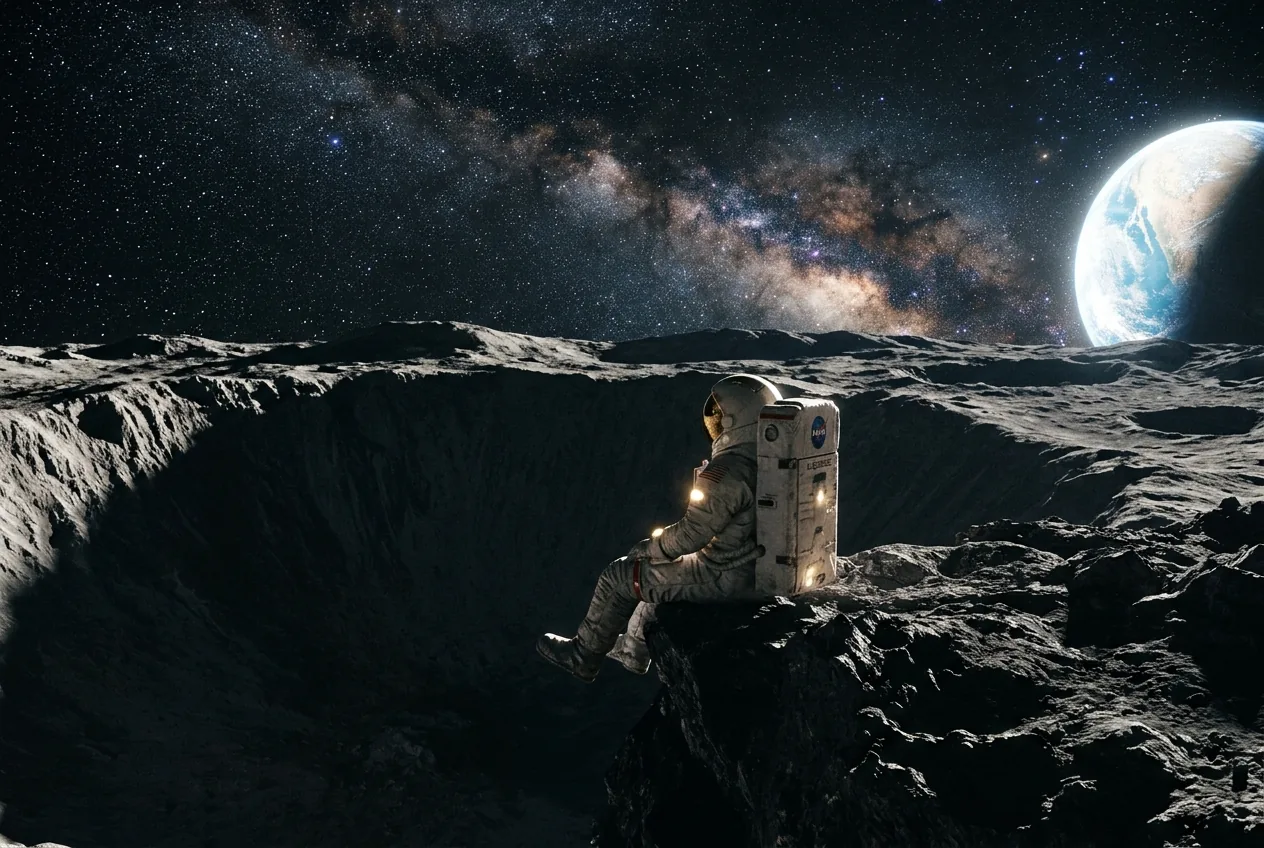
Enrico Fermi sat in the Los Alamos laboratory cafeteria in 1950 and asked a three-word question that still haunts the people who build rockets: "Where is everybody?" He wasn’t being philosophical. He was doing the math. The universe is 13.8 billion years old, the Milky Way contains up to 400 billion stars, and even at the sluggish pace of our current chemical rockets, a single determined species could colonise the entire galaxy in a few tens of millions of years.
That is a geological eyeblink. If anyone else had been out there, they should have been here already. Seventy-five years later, we have pointed our most sensitive radio dishes at the stars, catalogued thousands of exoplanets, and sniffed the atmospheres of distant worlds for the chemical stench of industry. The result is a total, crushing silence.
There are plenty of fancy ways to explain this away. We have the Zoo Hypothesis, where aliens are politely watching us from behind a cosmic curtain. We have the Dark Forest theory, which suggests everyone is hiding for fear of being vaporised. But there is a simpler answer that fits the data perfectly, even if it makes for a terrible pitch to venture capitalists: we are alone.
The business of cosmic mythology
The space industry is built on a foundation of manifest destiny. From Elon Musk’s Martian city to the romantic imagery of NASA’s posters, the underlying narrative is that the universe is a playground waiting for us to show up. It is a story of contact, of joining a "galactic community," or at the very least, finding a second home among the stars that isn't quite as empty as it looks.
This mythology is not just for show; it is an economic engine. It attracts the brightest engineers who grew up on Star Trek and sustains political will for multi-billion dollar missions. If you admit that the universe is a vast, sterile graveyard, the vibe changes instantly. Exploring a dead galaxy feels less like a grand adventure and more like a lonely custodial duty.
While the Artemis II crew was parading through the halls of Congress in May, bringing the glamour of human exploration to the seats of power, NASA’s science directorate was staring down a 47% budget cut. This is the tension at the heart of modern space: we fund the story of humans in pods, but we squeeze the science that actually looks at the data. We are prioritising the actors over the script.
Geology is the ultimate gatekeeper
A 2024 update to the Drake Equation—the famous formula for estimating how many civilisations are out there—provided a cold shower for the optimists. Researchers found that adding plate tectonics as a mandatory factor drastically slashes the number of potential neighbours. It turns out that on Earth, the constant churning of our crust didn’t just create mountains; it likely accelerated the evolution of complex life by circulating essential nutrients and maintaining a stable climate.
Consider Venus. We recently discovered that a 3,700-mile-long bank of sulfuric acid clouds has been racing around the planet for decades. For years, people speculated about exotic atmospheric life or strange chemistry. It turns out the explanation is "kitchen-sink physics" scaled up to a planetary level—specifically, Kelvin-Helmholtz waves, the same ripples you see in a river. It is beautiful, but it is just physics. No intent, no biology, just the mindless machinery of the universe.
The terrifying logic of the Great Filter
If we accept that the universe looks dead because it is dead, we have to deal with the Great Filter. This is the idea that there is a wall that almost no civilisation survives. The only question is which side of the wall we are on. If the filter is behind us—perhaps the jump from single-celled life to complex organisms is the hard part—then we are the winners of the cosmic lottery.
But if the filter is ahead of us, we are in trouble. This version suggests that every civilisation that reaches our level of technology eventually triggers its own deletion. Nuclear war, runaway AI, or climate collapse might be the standard exit ramp for intelligent life. In this scenario, the silence of the stars isn't a mystery; it's a warning. It’s the silence of a hundred million civilisations that hit a wall they couldn't climb.
Nick Bostrom, the Oxford philosopher, famously argued that finding microbial life on Mars would be the worst news in human history. If life is common enough to start twice in one solar system, then the Great Filter cannot be behind us. It must be in front of us. If we find a fossilised bacteria on the Red Planet, it implies that getting started is easy, but finishing the race is nearly impossible.
Trading the stars for satellite infrastructure
The industry is already quietly pivoting away from the "alien frontier" and toward a more utilitarian reality. Look at Cowboy Space, the new venture from Robinhood co-founder Baiju Bhatt. He isn't looking for little green men; he just filed plans for 20,000 satellites. The bet here isn't on the romance of the void. It's a bet that Earth’s power grids and AI infrastructure are so broken that we need to put our data centres in orbit.
This is the future of space: not a voyage to meet our equals, but a massive expansion of our own terrestrial server rooms. We are building a shell of silicon around our world because the grid on the ground can’t handle the heat. Space is becoming an infrastructure play. It is less about "where is everybody?" and more about "how do we keep the internet running?"
This shift reflects a growing, if unspoken, realisation that we are on our own. If there were alien civilisations nearby, we wouldn't be worrying about satellite interconnect queues and orbital power relays; we'd be trying to figure out how to talk to them. Instead, we are treating the solar system like a vacant lot next to our house. We’re moving in because we ran out of space in the living room.
The crushing weight of being first
There is a peculiar loneliness that comes with competence. In our own lives, the most capable people often end up isolated because they’ve learned to handle every crisis themselves long before they realised they were doing it alone. Humanity is currently in that position on a cosmic scale. We are the only ones at the table, and we are starting to realise that no one is coming to help us with the bill.
If we are the sole curators of consciousness in the observable universe, the stakes of our survival change. We aren't just one thread in a cosmic tapestry. We are the only thread. If we screw this up—if we let our tech outrun our wisdom—the light of intelligence goes out everywhere, possibly forever. That is a vertiginous thought to hold while you're trying to write a quarterly earnings report.
The space industry doesn't want to talk about this because "solitude" is a hard sell. It’s much easier to sell the idea of a populated universe that wants to meet us. But the silence is data. The 75 years of empty radio waves and the geologically dead rocks we keep finding are telling us the truth. We are the anomaly. We are the fluke that made it past the hurdles of plate tectonics and biological complexity.
Fermi asked where everyone was, and the most honest answer is that they didn't make it. They hit the filter, or they never got the geological lucky break we did. This doesn't make space less important; it makes it more urgent. If we are the only minds in the dark, then every rocket we launch is a flare in a graveyard. We aren't looking for neighbours. We are trying to keep the only fire in the universe from going out.



Comments
No comments yet. Be the first!