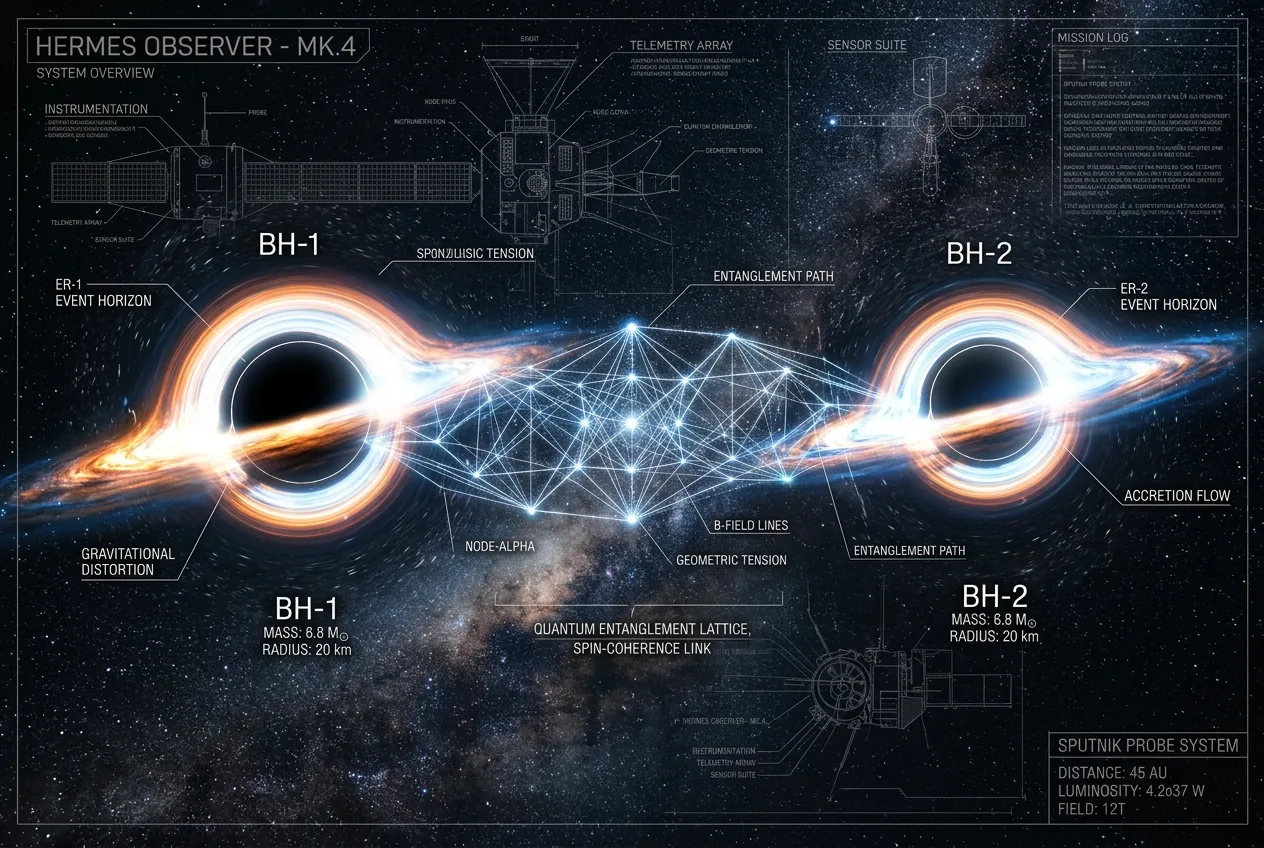
In the quiet corridors of the Max Planck Institute for Gravitational Physics in Potsdam, the distance between a mathematical proof and a functioning machine is usually measured in decades, if not centuries. The recent buzz surrounding interstellar object 3I/ATLAS—a body currently exhibiting non-gravitational acceleration that has sent the Minor Planet Center into a procurement frenzy—has reignited a perennial obsession in the physics community: the possibility of sending information where a physical probe cannot go. While the European Space Agency (ESA) mulls over a mission that wouldn't even intercept 3I/ATLAS until 2085, theorists are looking for a shortcut that doesn't involve waiting sixty years for a rendezvous. They are looking at the tesseract, or more specifically, the quantum plumbing of black holes.
The Quantum Teleportation Bottleneck
To understand why this isn't yet a viable alternative to the ESA’s sluggish comet-chasing schedule, one has to look at the mechanics of quantum teleportation. In a standard laboratory setup—the kind being refined at the QuTech facilities in Delft—teleporting a quantum state requires a "classical" channel. You send the quantum information instantly, but you need to call the recipient on a regular phone line to tell them how to decode it. This classical speed limit is what prevents us from using entanglement to beat the speed of light or send yesterday’s winning lottery numbers to our younger selves.
The trade-off is, as always, energy. To keep a wormhole from snapping shut the moment a single photon enters it, you need matter with negative energy density. In the lab, we can produce tiny amounts of this via the Casimir effect—the weird pressure that exists between two very close uncharged metal plates. But to keep a macroscopic wormhole open for a text message, you would need more negative energy than the total mass-energy of Jupiter. For a continent currently struggling to coordinate a unified semiconductor supply chain under the EU Chips Act, the procurement of a gas giant's worth of exotic matter remains a low priority on the 2030 strategic roadmap.
The 3I/ATLAS Anomaly and the Search for Signals
While the theorists play with black holes, the observational community is busy arguing over the data coming back from 3I/ATLAS. The object, our third confirmed interstellar visitor, is behaving badly. It has changed color twice in the last six months and is accelerating away from the Sun faster than gravity alone can explain. This "non-gravitational acceleration" is the same phenomenon that turned 'Oumuamua into a tabloid star, leading to fringe claims of alien light sails.
A recent paper from the SETI Institute has been forced to play the role of the designated adult, pointing out that 3I/ATLAS is almost certainly outgassing hydrogen—a natural, if invisible, rocket engine. Yet, the timing of the discovery has created a curious tension. If we are developing the math to send messages through time using entangled singularities, should we be looking at objects like 3I/ATLAS not as alien spacecraft, but as potential benchmarks for non-local physics? The acceleration is real, the data is messy, and the European industrial base is already looking at how to capitalize on the detection tech, even if the "aliens" turn out to be a slightly unusual block of frozen nitrogen.
The ESA’s proposed 2085 intercept mission highlights the absurdity of our current technological ceiling. We can calculate the exact spin required for a traversable wormhole to facilitate temporal messaging, but we cannot build a chemical rocket that can catch a comet in under half a century. It is a recurring theme in European science policy: we possess the finest theoretical architects in the world, yet we are still waiting for the carpenters to invent a better hammer.
Sovereignty in the Quantum Realm
Why does the European Commission care about the abstract mathematics of black holes and time-delayed messaging? The answer lies in the EuroQCI (European Quantum Communication Infrastructure). Brussels is currently pouring billions into a plan to create a continent-wide quantum-encrypted network. The goal is "quantum sovereignty"—a system that is fundamentally unhackable because any attempt to eavesdrop would collapse the quantum state of the message.
If the ER=EPR conjecture holds, and entanglement is indeed the fundamental glue of spacetime, then quantum encryption isn't just a security protocol; it's a manipulation of the fabric of reality itself. Understanding how information moves across entangled bridges is essential for building the routers of 2050. We might not be sending messages back to the 1990s to stop the dot-com bubble, but we are trying to ensure that a secure message sent from Berlin to Lisbon can't be intercepted by a quantum computer in Maryland or Beijing. The "Interstellar" math provides the boundary conditions for what is possible in data transmission, even if the time-travel aspects remain a convenient hook for securing Horizon Europe funding.
The engineering reality, however, remains stubbornly grounded. At the Garching research center, engineers working on high-vacuum systems and cryogenics are more concerned with the thermal noise in a qubit than the Hawking radiation of a black hole. To them, the talk of temporal messaging is a distraction from the immediate problem of decoherence. You cannot send a message to the past if your quantum state survives for less than a microsecond in the present.
The Negative Energy Constraint
Every discussion of traversable wormholes eventually hits the same wall: the Null Energy Condition. In general relativity, energy is always positive. To get around this, you need to invoke quantum field theory, which allows for local pockets of negative energy. This isn't just a mathematical trick; it's a requirement for any kind of FTL (faster-than-light) travel or temporal messaging. The problem is one of scale and stability.
Even if we could harness the Casimir effect on an industrial scale, the resulting negative energy is incredibly fragile. The moment you try to use it to prop open a wormhole, the back-reaction of the spacetime geometry tends to produce a "firewall"—a region of infinite energy density that would incinerate any information attempting to pass through. It’s a cosmic censorship mechanism that seems designed to keep the timeline intact. The universe, it appears, has a very strict anti-spam filter for messages from the future.
This leaves us in a familiar position. We have the equations that suggest a loophole, and we have the interstellar anomalies that spark our imagination, but we lack the industrial capacity to bridge the two. The 3I/ATLAS mission, if it ever launches, will be a testament to our persistence. It will be a chemical-fueled, slow-motion chase through the dark, using technology that would look primitive to anyone capable of actually manipulating entanglement for messaging. We are still the sailors of the 15th century, looking at the stars and dreaming of flight, while trying to figure out why our wooden hulls are rotting.
Europe has the engineers to build the sensors for 3I/ATLAS. It just hasn't decided which country gets to pay for the negative energy. For now, the only way to send a message to the future is the old-fashioned way: write it down and wait. The math for the shortcut exists, but the plumbing is a nightmare.




Comments
No comments yet. Be the first!