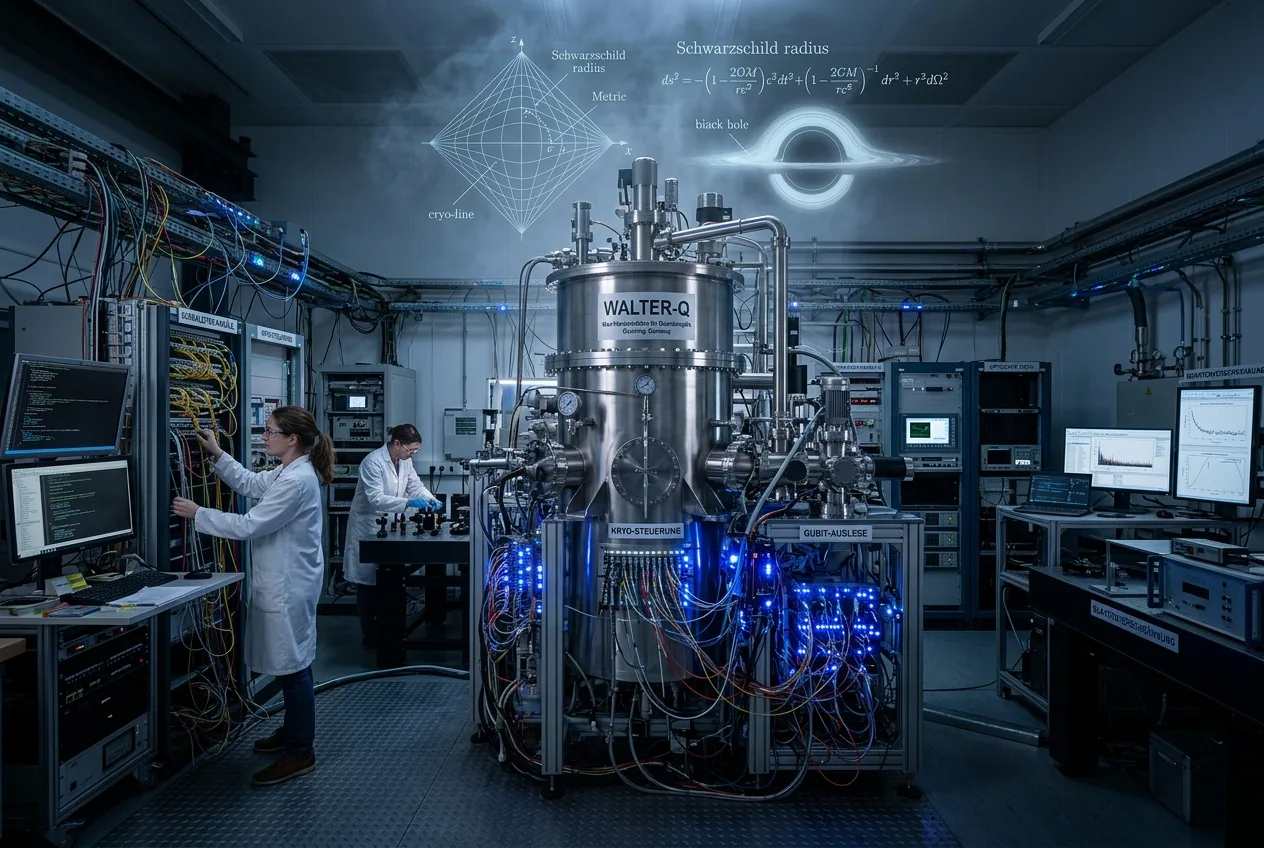
In a basement laboratory at the Max Planck Institute for Quantum Optics, the temperature is kept closer to absolute zero than anywhere in the known universe. Here, researchers do not talk about time travel; they talk about coherence times, error correction, and the agonizingly slow progress of the European Quantum Flagship’s billion-euro roadmap. Yet, a recent theoretical paper has reignited a debate that sounds more like a Christopher Nolan script than a German industrial policy meeting: the possibility that quantum entanglement, paired with the extreme physics of black holes, could facilitate a "chronological back-channel" for information.
The premise relies on the bridge between two of the most uncomfortable concepts in physics: Einstein-Rosen bridges (wormholes) and the non-local connection of entangled particles, a duality often shorthanded as ER=EPR. While the physics community has long dismissed the idea of physical time travel as a mathematical artifact of General Relativity that Nature would never permit, the quantum version is more insidious. It suggests that while you cannot go back and prevent a disaster, you might be able to send a very small, very fragile set of qubits back to warn someone about it. In the context of the film Interstellar, this is the tesseract behind the bookshelf; in the context of Brussels and Bonn, it is a procurement nightmare that challenges our understanding of causality and the fundamental limits of the Silicon-based economy.
The Post-Selection Loophole in Causality
To understand why this is suddenly being discussed in serious circles, one must look at the specific mechanism of quantum post-selection. In standard quantum mechanics, you cannot send information faster than light because the results of quantum measurements are fundamentally random. If you and I share a pair of entangled photons, my measurement tells me something about yours instantly, but I cannot control my result to send you a specific signal. This is the "No-Communication Theorem," and it is the primary reason why quantum physics hasn't already upended the global telecommunications industry.
The Interstellar Messenger Problem
While the theorists debate whether these loops are a feature or a bug of the universe, the observational community is busy hunting for physical messengers from outside our solar system that might test our understanding of extreme physics. The recent obsession with the interstellar object 3I/ATLAS highlights the gap between what we can model and what we can actually reach. Discovered just months ago, 3I/ATLAS is only the third confirmed visitor from another star system, and it has already displayed the kind of non-gravitational acceleration that sets the SETI (Search for Extraterrestrial Intelligence) community on fire.
A recent SETI Institute analysis has pushed back against claims that 3I/ATLAS might be an alien probe using exotic propulsion. The data suggests a more mundane, though still fascinating, explanation: outgassing of hydrogen or other volatiles that act as a natural thruster. This is the recurring tension in modern science—the struggle between the "revolutionary" explanation and the "non-gravitational" reality. If 3I/ATLAS were a technological artifact, it would be the ultimate testbed for checking if its home civilization had mastered the quantum back-channels currently being theorized. Instead, it appears to be a very lonely, very fast rock, changing color as it reacts to our Sun’s radiation, reminding us that interstellar travel is currently a matter of chemistry and ballistics, not wormholes.
Brussels and the Quantum Sovereignty Gap
For European policymakers, the debate over quantum time-signaling isn't just an academic exercise; it’s a matter of industrial sovereignty. The EU’s EuroQCI (Quantum Communication Infrastructure) project is currently spending millions to secure the continent's data against future quantum computers. If the theoretical possibility of "probabilistic" time travel via quantum entanglement ever moved from a blackboard to a lab, it would render our current understanding of data security obsolete. If an adversary can post-select their way into a consistent state that includes your future decryption keys, the "secure" in secure communication becomes a relative term.
This is where the German industrial lens becomes particularly focused. Germany’s strength in precision manufacturing and cryogenics makes it the natural hub for the hardware required to test these theories. However, the German Ministry of Education and Research (BMBF) is notoriously conservative. Funding a project that even hints at "time travel" is a quick way to lose a budget line. Consequently, the research is often presented under the guise of "quantum simulation of extreme gravitational environments." We are building the tesseract, but we are calling it a high-pressure vacuum chamber for semiconductor testing.
The 2085 Intercept and the Reality of Scale
There is also the matter of energy. To create the kind of spacetime curvature necessary for a functional CTC—even at a microscopic scale—requires energy densities that far exceed anything the Large Hadron Collider could dream of. We are talking about the mass-energy equivalent of a small moon compressed into the size of a proton. Even the most optimistic proponents of the ER=EPR bridge acknowledge that we are likely centuries away from generating such a field. The hardware doesn't exist, the funding isn't in the current EU budget cycle, and the physics might still forbid it once we move from 2D models to 3D reality.
Can We Trust a Message from the Future?
If we assume, for a moment, that the post-selection math holds up and a message could be sent back, we face a philosophical and engineering problem: the signal-to-noise ratio. In these quantum models, the probability of a successful "backwards" message is often vanishingly small. You might have to run the experiment a trillion times to get one consistent loop. For a 21st-century observer, the "message" from the future would be indistinguishable from a random fluctuation in a quantum sensor.
This brings us back to the Max Planck cryostats. The engineers working there know that the universe is noisy. Quantum systems collapse if you look at them too hard, let alone if you try to drag them through a hole in the fabric of time. The ambition to communicate across the fourth dimension is a testament to human curiosity, but the reality is that we are still trying to figure out how to make a 50-qubit processor that doesn't overheat. We are looking for the bookshelf in the black hole, but we haven't even finished building the library.
The study of 3I/ATLAS and the theoretical exploration of quantum time-signaling are two sides of the same coin: our desperate need to find a shortcut through the vastness of the universe. Whether it's a shortcut in space or a shortcut in time, the results keep pointing toward the same conclusion. Nature is willing to show us the math for a shortcut, but it charges a price in energy and complexity that we cannot yet pay. Europe will continue to fund the sensors and the cryostats, and the theorists will continue to refine the ER=EPR bridges, but for now, the only way to send a message to the future is the old-fashioned way: writing it down and waiting.
Brussels has the roadmap. Germany has the cryostats. But the universe hasn't yet provided the exit ramp from the present.



Comments
No comments yet. Be the first!