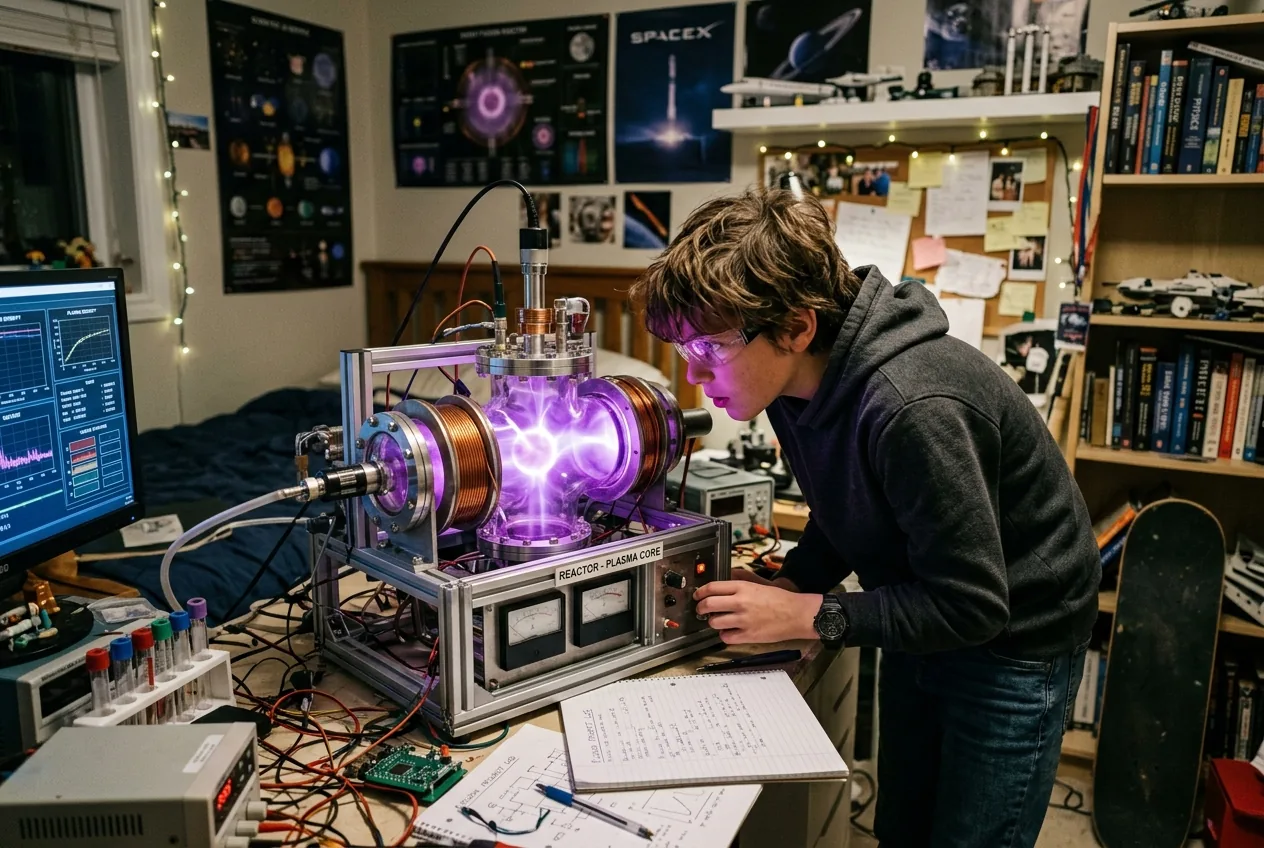
The purple glow inside the heavy-duty vacuum chamber wasn't a nightlight or a fancy LED strip. It was plasma, burning at temperatures that would make the surface of the sun look like a chilly day in Manchester. In a suburban house in Dallas, twelve-year-old Aiden McMillan sat back and watched as his four-year obsession finally began to cook. He wasn't playing Minecraft or scrolling TikTok; he was slamming atoms together to see if they’d stick.
Most kids get a bike for their eighth birthday. Aiden McMillan asked for a vacuum pump and a high-voltage transformer. While his peers were learning long division, Aiden was scouring eBay for second-hand scientific components and reading up on the mechanics of Inertial Electrostatic Confinement (IEC). Four years later, he has officially joined the 'Fusioneers'—an elite, underground community of hobbyists who have achieved nuclear fusion in their spare rooms. It is a feat of engineering that most PhD students wouldn't touch without a massive grant and a team of technicians.
To be clear, Aiden hasn't solved the world's energy crisis over a weekend. This isn't a power plant that can run the neighborhood. In fact, it's a massive energy hog, sucking more electricity from the wall than it could ever hope to produce. But that is missing the point. To achieve the conditions necessary for fusion—the same process that powers every star in the visible universe—inside a residential zip code is a staggering display of technical grit.
Vacuum pumps and pocket money
Building a nuclear reactor isn't as simple as following a LEGO manual. The core of Aiden’s project is a Farnsworth-Hirsch Fusor. If that sounds like something out of a 1950s sci-fi comic, it’s because the technology was actually patented by Philo Farnsworth, the same man who invented the television. Unlike the massive, multi-billion-dollar tokamaks being built by international consortiums, a fusor is a relatively simple device that uses high-voltage electric fields to shove ions together until they fuse.
The real challenge isn't just owning the parts; it's making them talk to each other. Vacuum leaks are the enemy of the fusioneer. A single microscopic gap in a seal will ruin the experiment, turning your high-tech reactor into an expensive paperweight. Aiden had to learn the dark arts of pipe-fitting, electrical engineering, and radiation shielding before he even attempted a 'hot' run. It is a masterclass in patience that most adults would fail within the first six months.
Why he isn’t the next ‘Radioactive Boy Scout’
Mention a kid building a reactor and people immediately think of David Hahn. In the 1990s, Hahn—famously dubbed the 'Radioactive Boy Scout'—tried to build a breeder reactor in his shed using americium from smoke detectors and thorium from camping lanterns. He ended up creating a Superfund site, radiating his neighborhood and eventually being shut down by the EPA. But there is a fundamental difference between what Hahn did and what Aiden McMillan has achieved: Fission versus Fusion.
Hahn was messing with fission—splitting heavy, unstable atoms. It’s dirty, it’s radioactive, and it’s incredibly dangerous for a novice because you can't easily turn it off. Aiden is doing fusion. He is taking heavy isotopes of hydrogen—specifically deuterium—and forcing them to combine into helium. Fusion doesn't involve the long-lived, nasty radioactive waste associated with uranium or plutonium. When Aiden flips the switch off, the reaction stops. It is inherently safer, though not without its own set of 'don't-try-this-at-home' hazards.
The primary risks in a fusor aren't a nuclear meltdown, but the high voltage and the X-rays produced during the process. When those ions start zipping around the chamber, they hit the walls and release radiation. Aiden had to build lead shielding to ensure that his hobby didn't result in his family receiving a lifetime's worth of dental X-rays in a single afternoon. It is this level of safety consciousness that separates a legitimate young scientist from a reckless tinkerer.
The certificate of atomic achievement
Aiden is now part of a very short list of people who have achieved this before hitting puberty. He follows in the footsteps of Jackson Oswalt, who in 2018 became the youngest person to achieve fusion at age 12. These kids are operating in a space where age is irrelevant. In the Fusioneer forums, your data is your currency. If your neutron counts are solid, nobody cares if you still have a bedtime.
This community represents a fascinating shift in how science is done. For decades, nuclear physics was the sole domain of massive government labs like Los Alamos or CERN. Today, thanks to the internet and the availability of surplus industrial gear, a twelve-year-old can replicate the work that once required a Manhattan Project. It is the democratization of big science, happening one playroom at a time.
Is a star in a jar actually useful?
There is a cynical corner of the internet that asks, 'What’s the point?' Since these DIY reactors consume thousands of times more energy than they produce, they aren't going to charge your iPhone or save the climate. Critics argue that it’s just a very expensive, very dangerous science project. But that perspective ignores the secondary value of what Aiden has done. We are currently in a global race to master commercial fusion, with billions of dollars being poured into companies like Helion Energy and Commonwealth Fusion Systems.
The people who will eventually solve the 'net gain' problem—getting more energy out of fusion than we put in—are exactly like Aiden. They are the ones who spent their childhoods obsessed with vacuum pressures and ion grids. By building a reactor at twelve, Aiden has gained a functional understanding of plasma physics that most engineering graduates won't have until they’re 25. He isn't just playing with high-voltage toys; he’s training for a career in the industry that might actually save civilization.
Moreover, these small-scale fusors do have practical uses. They are excellent neutron sources. In a professional setting, they can be used for medical isotope production or for testing the radiation hardness of satellite components destined for deep space. While Aiden's home version is a proof-of-concept, it is the fundamental building block of some of the most sophisticated technology on the planet.
The parents behind the plasma
Perhaps the most unsung heroes of this story are Aiden’s parents. It takes a specific kind of nerves to let your child pipe 30,000 volts of electricity through a vacuum chamber in a room that probably still has a toy chest in the corner. Most parents draw the line at chemistry sets that might stain the carpet. The McMillans had to trust their son’s research and his commitment to safety protocols that would baffle most adults.
Their support highlights a tension in modern education. We talk a lot about STEM (Science, Technology, Engineering, and Math), but the actual school curriculum rarely allows for this kind of high-stakes, hands-on experimentation. Aiden’s reactor is a testament to what happens when a curious mind is given the space, the resources, and the trust to fail—and eventually succeed—outside the confines of a classroom.
As the purple glow fades and the vacuum pumps spin down, Aiden is already looking at his next upgrade. He wants to make the reaction more efficient, to increase the neutron yield, and to refine the grid design. He isn't satisfied with just having built it; he wants to optimize it. For a twelve-year-old in Dallas, the sky isn't the limit—the stars are. And he’s already got one in his room.




Comments
No comments yet. Be the first!