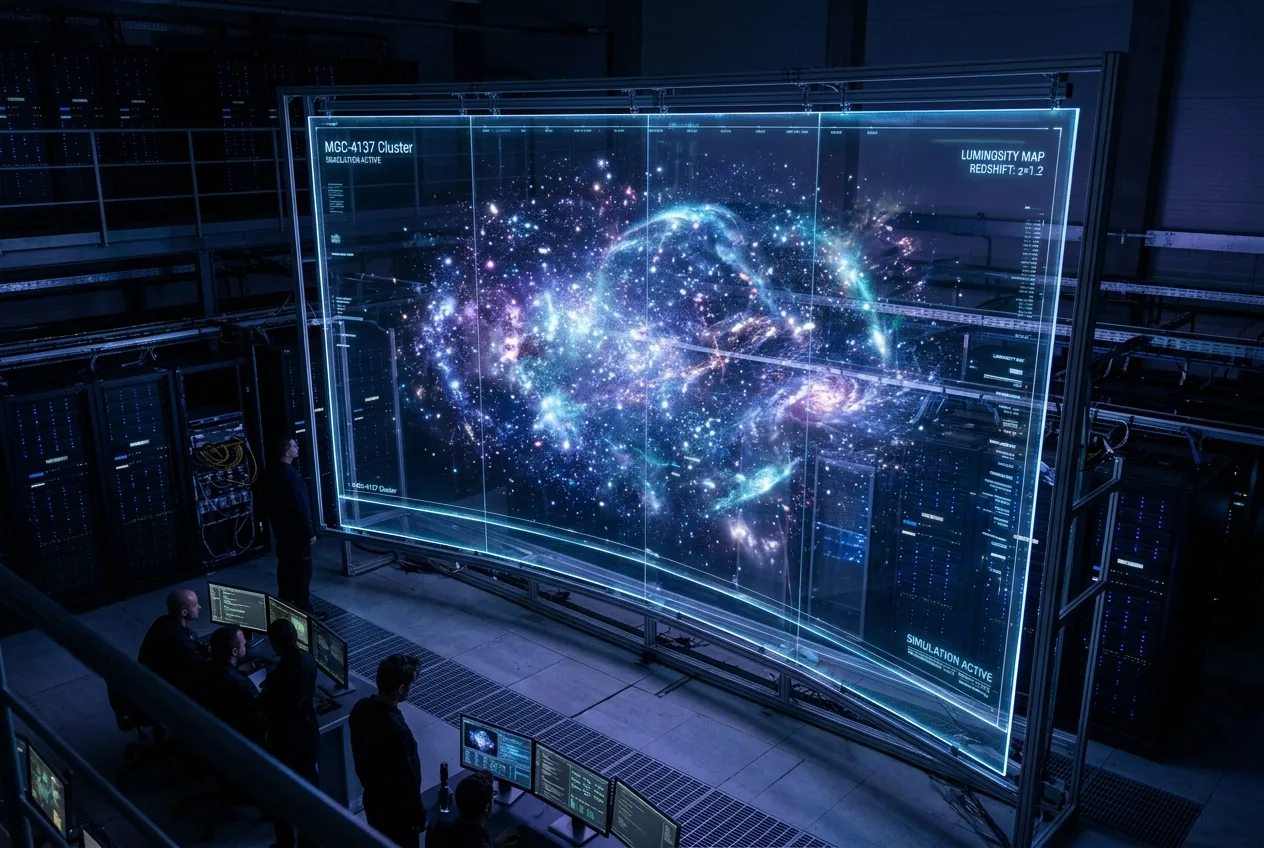
For seventy-two million hours, a supercomputer in a quiet corner of Northern England chewed through the laws of physics until it spat out a ghost. It wasn’t a glitch or a random sequence of numbers, but a reflection: a synthetic universe so precise that its creators claim it is indistinguishable from the one we actually inhabit. When the images finally flickered onto monitors at Durham University, the researchers weren’t looking at grainy approximations; they were looking at galaxies that shared the exact luminosities, colours, and clusters of the stars we see through the most powerful telescopes in existence.
This wasn’t a project born out of a desire to play God. It was a desperate attempt to save the current version of reality. For the last couple of years, the world of cosmology has been in a state of quiet panic. Data coming back from the James Webb Space Telescope (JWST) has been behaving badly, showing us ancient galaxies that are far too big and far too bright for our current theories to explain. Some physicists had started whispering that our "standard model" of the universe was broken beyond repair. The COLIBRE project—the result of a ten-year international grind—was built to find out if the math still holds water or if we need to tear up the rulebook and start again.
The sheer scale of the number-crunching involved is difficult to grasp without a pint and a calculator. To run the largest version of this simulation, the COSMA8 supercomputer worked for the equivalent of 8,219 years of a single processor’s life. If you tried to do this on your high-end gaming laptop, the machine would likely melt into a puddle of silicon before it finished a single billionth of the work. This massive investment of digital energy was required because the team decided to stop taking shortcuts that have plagued space simulations for decades.
The ten-thousand-degree wall
To understand why this simulation is different, you have to understand why previous ones were essentially cartoons. Space is big, but it is also messy. Until now, astronomers struggled to model "cold" gases—anything below about 10,000 degrees Fahrenheit. While that sounds like a blast furnace to a human, in cosmic terms, it is practically freezing. Because these cold gases and the dust clouds they carry behave in incredibly complex, turbulent ways, earlier simulations simply cut them out. They set a hard floor at 10,000 degrees and hoped the missing data didn't matter too much.
Carlos Frenk, a physicist at Durham University and one of the project’s lead architects, described the moment of completion as "exhilarating." It is one thing to have a theory on paper; it is another to watch a machine follow that theory and build a galaxy that looks exactly like the one you see when you point a telescope at the sky. If the simulation had produced something else—blobs of matter that didn't clump or stars that burned out too fast—it would have been the final nail in the coffin for our understanding of the cosmos.
Why physics was facing a mid-life crisis
The tension driving this project comes from a specific set of observations that have been haunting the halls of NASA. When the JWST launched, it started seeing things it shouldn't have: massive galaxies in the very early universe. According to the standard model, these galaxies shouldn't have had enough time to get that big. It was like walking into a nursery and finding a newborn who was six feet tall and capable of reciting Shakespeare. It didn't make sense, and it led to a flurry of headlines suggesting that the Big Bang never happened or that gravity works differently than we thought.
However, the simulation didn't just offer comfort. It also highlighted a glaring, ruby-coloured problem that physicists are still struggling to explain. Even with 72 million hours of supercomputing power, the model still can't quite account for the "Little Red Dots." These are a class of incredibly bright, compact objects discovered by JWST that existed when the universe was less than a billion years old. They look like galaxies, but they are far too dense, and they seem to disappear as the universe gets older. They are the cosmic equivalent of a ghost story—there one minute, gone the next, and refusing to follow the rules.
The trade-offs of playing virtual god
Every simulation is a compromise between accuracy and scale. Even with the power of COSMA8, the researchers had to make choices. They can model a massive volume of the universe, but they can't see every individual pebble or asteroid. They are looking at the "macro" scale—the way dark matter pulls on gas, the way black holes at the centres of galaxies blow material back into space, and how these forces balance out over billions of years. This is a game of cosmic accounting, and for the first time, the books finally seem to balance.
The real value of COLIBRE isn't just in proving that we are right; it’s in giving us a playground to test where we might be wrong. If we want to know what happens if dark matter is "warm" instead of "cold," or if we want to see how a different type of black hole growth affects the shape of a spiral galaxy, we don't have to wait billions of years for a real-world experiment. We just change a line of code and run the simulation again. It’s a laboratory where the sample is the entire universe.
There is also a human cost to this kind of work that often goes unmentioned. A decade of a scientist's life is a heavy price to pay for a piece of software. The team at Durham and their international partners spent years perfecting the "sub-grid" physics—the tiny, granular details that dictate how stars ignite and die. It is a grind of debugging, testing, and failing, all to produce a result that, if it works perfectly, looks exactly like what we already know. It is the ultimate paradox of science: you work for ten years just to prove that the world is exactly as you suspected it was.
A universe made of math
One of the most profound takeaways from the COLIBRE project is the confirmation that our universe is fundamentally mathematical. There is something deeply unsettling—and perhaps slightly comforting—about the fact that you can feed basic equations of gravity, thermodynamics, and fluid dynamics into a machine and get a "universe" out the other side. It suggests that the complexity we see when we look at the Milky Way isn't a fluke or a miracle; it's an inevitability. If you have the right ingredients and the right rules, the stars have no choice but to form.
For now, the standard model lives to fight another day. It survived the first contact with the James Webb Space Telescope, thanks in large part to the heavy lifting done in that Durham basement. We might live in a universe that is messy, cold, and filled with dust, but at least we can finally say we know how the dust settles. And as for the things the simulation still can't explain? Those are the parts that make the next seventy-two million hours worth the wait.




Comments
No comments yet. Be the first!