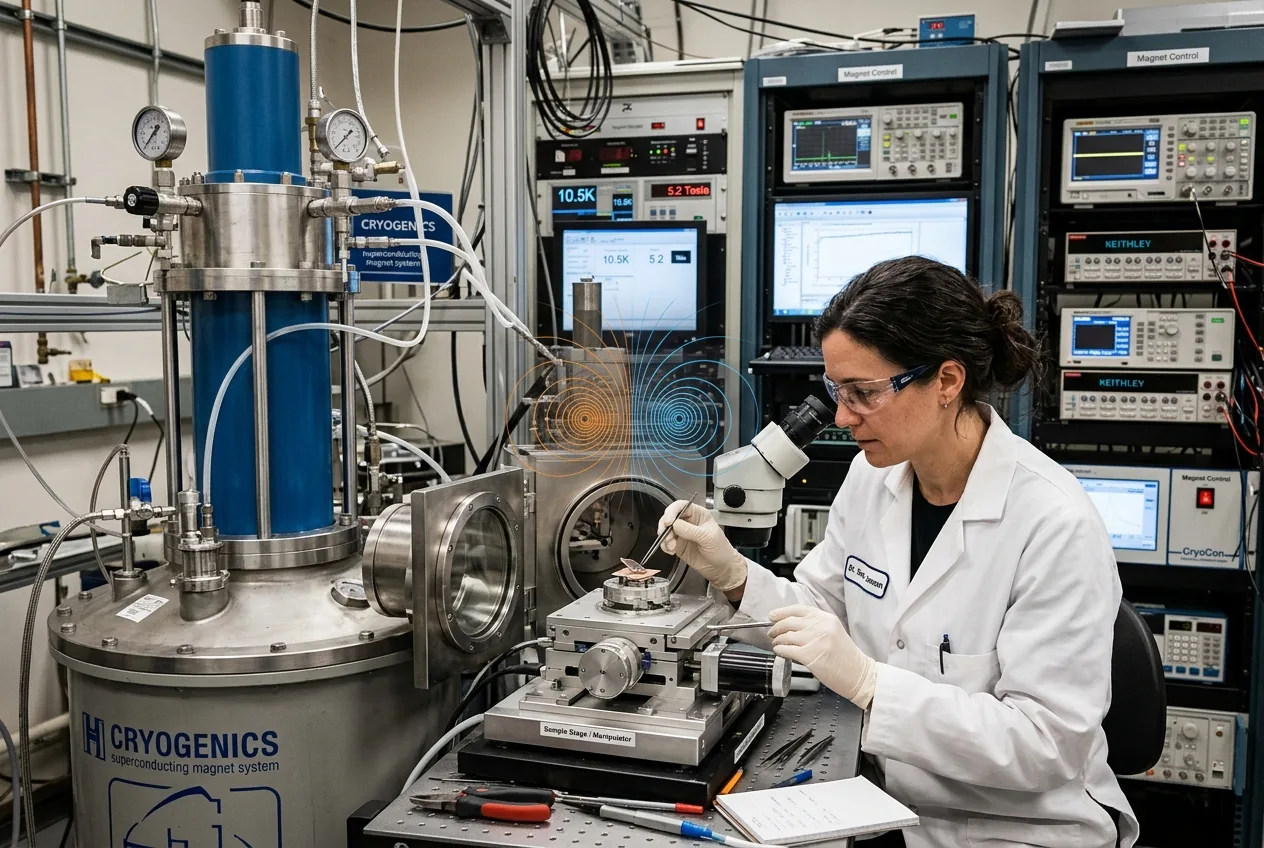
Inside a vacuum chamber at the University of Texas at Austin, physicists took a single layer of nickel phosphorus trisulfide (NiPS3) and dropped the temperature until the magnetic noise froze. What emerged was a 'six-state clock phase' — a microscopic landscape where atomic spins locked into six discrete directions, pinning theoretical magnetic vortices into ordered geometric patterns.
This is the first direct material observation of a Berezinskii-Kosterlitz-Thouless (BKT) transition, a phenomenon predicted in the 1970s that argues two-dimensional magnets behave fundamentally differently to 3D ones. For fifty years, it was a mathematical curiosity. Today, it represents a highly prized mechanical property for the semiconductor industry, offering a physical roadmap for spintronic memory chips that could compute without the massive heat generation of traditional electronics.
The 50-year hunt for a flat magnet
In the 1970s, theoretical physicists proved that a conventional magnetic phase transition cannot happen in a perfectly two-dimensional continuous spin system. Instead, the mathematics suggested that a 2D system would support vortices — microscopic magnetic swirls that bind and unbind as temperatures change.
The problem was finding a material clean enough to test the math. Real-world magnets live in three dimensions, riddled with structural defects, stray interactions, and noisy out-of-plane couplings. To actually see BKT physics, researchers needed an isolated, atomically flat magnet and extreme cryogenic control.
The UT Austin team managed to capture the entire predicted sequence in their NiPS3 monolayer. At higher temperatures, the material displayed a vortex-antivortex fluid. As the equipment cooled further, it snapped into the rigid six-state clock phase, finally tying an abstract mathematical equation to an engineered material that device teams can manipulate.
Shifting the heat out of data centres
The commercial appeal of topological magnetic textures comes down to power consumption. Conventional silicon electronics move electrical charge through resistive materials, generating immense heat. Spintronics proposes using the electron's spin instead, executing logic operations with near-zero Joule heating.
Magnetic vortices are particularly valuable here because they are topologically protected, making them highly stable against local defects and thermal noise. If data can be encoded into these stable swirls and steered by spin currents, the energy overhead for memory and computation drops drastically.
But the engineering caveat is steep. The UT Austin demonstration relies on extreme cold and delicate, ultra-clean van der Waals heterostructures. Materials groups are already arguing over whether different magnetic combinations might achieve similar stability at room temperature, which remains the absolute baseline for commercial chip design.
Wafer-scale ambitions and the fabrication gap
For European industrial policy, any advance in low-power computing hardware is closely watched. Brussels and Berlin have tied billions in state aid to advanced semiconductor sovereignty, specifically eyeing spintronics as a way to curb the escalating power draw of regional data centres and quantum-hybrid systems.
The structural problem for Europe is that its core industrial strength does not lie in scaling exotic van der Waals nanosheets. The continent dominates in precision lithography, equipment manufacturing, and systems integration, but often lags in pioneering novel material production.
If BKT vortices are to move from a Texas cryostat to commercial logic chips, it will require a transatlantic split of labour. Specialised labs will likely continue to map the material platforms, while European toolmakers figure out how to integrate those delicate atomic layers into standard silicon workflows. Brussels can draft the sovereign supply chain directives. Someone else will have to figure out the cryogenics.
Sources
- University of Texas at Austin




Comments
No comments yet. Be the first!