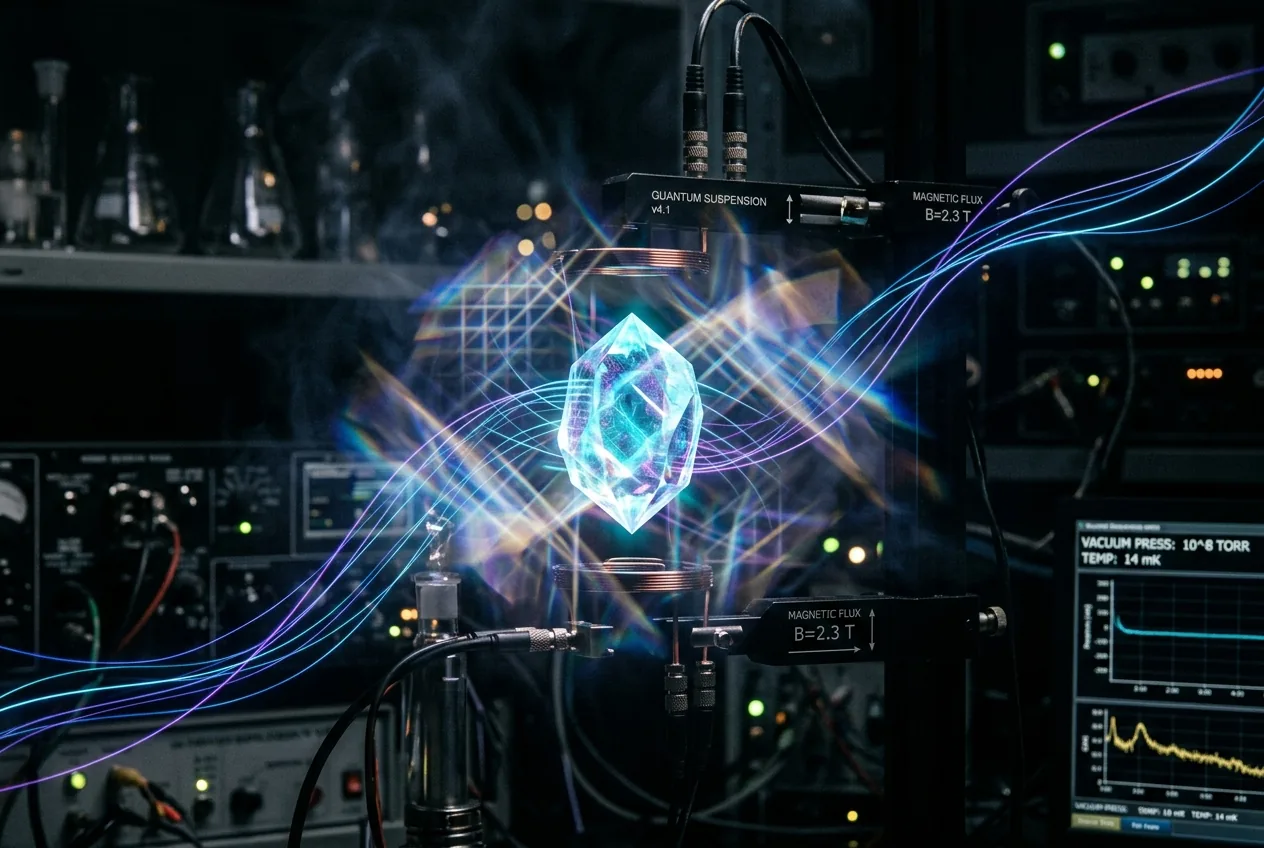
The tension here lies in the fragility of our current technology. We are currently trying to build quantum computers using materials that are notoriously temperamental. If a stray heat molecule so much as glances at a quantum bit, or qubit, the whole system collapses. By creating these exotic, time-dependent states, Powell and his student researcher Louis Buchalter have found a way to make quantum systems significantly more stable. It turns out that if you keep matter in a state of constant, rhythmic change, it becomes harder for external noise to break it.
The strobe light effect for the quantum world
To understand what Powell and Buchalter achieved, you have to stop thinking of matter as a solid, unmoving thing. At the quantum level, everything is a vibration. Usually, these vibrations settle into a predictable groove. Floquet engineering is essentially the process of hitting a material with a "strobe light" of energy—in this case, a shifting magnetic field—to force those vibrations into a new, exotic pattern. It is like taking a pile of sand and vibrating the floor so specifically that the sand grains don't just sit there, but hover in the shape of a cathedral.
The Cal Poly team used a process they called "Flux-Switching Floquet Engineering." It sounds like something pulled from a mid-nineties sci-fi reboot, but the mechanics are grounded in a mathematical organizing principle that mirrors higher-dimensional systems. By driving the system with timed magnetic shifts, they unlocked quantum phases that are "topologically protected." In plain English, this means the state of the matter is locked in by its own geometry. You can’t easily break it because the very shape of its existence prevents it from unraveling.
This is a massive deal for the future of computing. One of the biggest hurdles to a functional quantum computer is "noise"—the environmental interference that causes errors. If we can build qubits out of these driven, exotic states, we aren't just making them faster; we are making them robust. We are moving from building computers out of glass to building them out of reinforced steel. But the trade-off is energy. You have to keep the system "driven" to keep the matter existing. The moment you stop the flicker, the magic trick ends, and the matter vanishes back into its boring, static self.
Why does this crystal have ghost photons inside?
A quantum spin liquid is a bit of a misnomer. It isn't wet. Instead, the "liquid" refers to the magnetic moments—the spins—of the atoms inside the crystal. In a normal magnet, like the one on your fridge, these spins all point in the same direction or follow a neat pattern. In a quantum spin liquid, the spins are in a state of total, frantic disorder even at absolute zero. They are "frustrated," meaning they can never find a comfortable place to settle down. Because they are constantly moving and entangled, they create "ghost" particles—excitations that behave exactly like light, but only exist within the confines of the material.
Can we actually use matter that refuses to follow the rules?
The common thread between the flickering matter at Cal Poly and the ghost photons at Rice is a total rejection of classical physics. We are entering an era where we no longer ask what a material *is*, but what it can *do* when pushed to the edge. This extends to graphene, too. Researchers recently observed electrons in graphene flowing like a nearly frictionless liquid, defying a fundamental law of physics that says electrons should zip around like individual pinballs. Instead, they’re moving like honey—if honey could flow through a pipe at the speed of light without ever getting stuck.
Then there are the quasicrystals. For 40 years, we’ve struggled to understand these materials that look like they have a pattern but never actually repeat themselves. They are the mosaics of the quantum world—beautiful, complex, and seemingly impossible. Scientists at the University of Michigan finally cracked the code on how these grow, revealing that they straddle the line between order and chaos. Like the Floquet states, quasicrystals represent a middle ground that shouldn't exist, providing a bridge between the predictable world of a salt crystal and the total randomness of a gas.
The industrial implications are staggering, but we have to be realistic. We aren't going to have Floquet-powered smartphones next year. Ian Powell is the first to admit that the most direct relevance is to quantum simulation and research. The path from a lab at Cal Poly to a manufacturing plant in Shenzhen is long and paved with failed experiments. But the conceptual wall has been kicked down. We now know that if we can’t find the material we need for a specific technology, we might be able to simply vibrate it into existence using magnetic fields.
Is the future of tech just a well-timed vibration?
If you’re sitting on the bus reading this, you’re likely holding a device made of silicon, copper, and plastic—materials we’ve understood for over a century. The next leap won't be a better version of those materials. It will be something that feels like sorcery. We are looking at a world where our hardware is "driven" by time-dependent fields, where our energy moves through crystals via ghost particles, and where our computers are built from states of matter that technically don't exist when the power is off.
There is a certain irony in the fact that the more we learn about the fundamental building blocks of the universe, the more we realize how little we’ve been using. We’ve been playing the piano using only three keys. Floquet engineering and the discovery of 3D spin liquids are like someone finally opening the lid and showing us the other 85. It’s messy, it’s complicated, and it breaks most of the rules we thought were set in stone. But as Louis Buchalter noted after his time in the lab, research is rarely a straightforward process. It’s about persistence and the willingness to look at a magnetic field and wonder what happens if you flick the switch faster than anyone thought you should.
The next decade of physics won't be about discovering new elements at the end of the periodic table. It will be about the weird, flickering, frustrated, and frictionless states we can create in the gaps between them. We are no longer just observers of the physical world. We are its editors, rewriting the code of matter in real-time, one magnetic pulse at a time. The rules of physics haven't changed, but our ability to bypass them certainly has. And in that gap between what is and what could be, the next technological revolution is currently being vibrated into life.




Comments
No comments yet. Be the first!