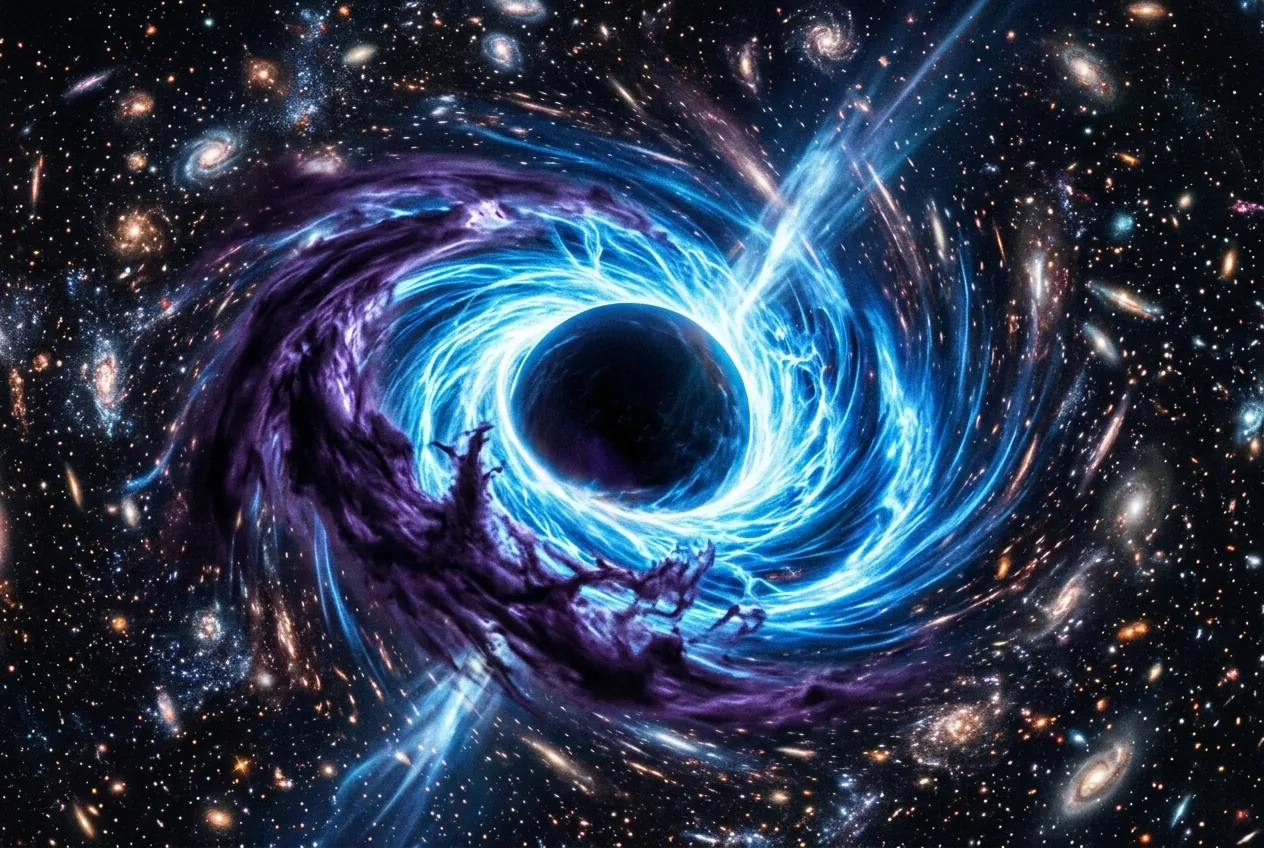
In the first trillionth of a second after the Big Bang, the universe was essentially a suicide pact. For every scrap of matter that flickered into existence, an identical twin of antimatter appeared alongside it, ready to touch and instantly vanish in a burst of pure energy. By all the laws of known physics, the cosmos should have been a short-lived firework display that left behind nothing but empty light. We simply shouldn't be here.
Physics calls this the baryon asymmetry problem. It is the ultimate cosmic accounting error. If matter and antimatter were created in equal amounts, they should have annihilated each other completely, leaving a universe with no stars, no planets, and certainly no people to wonder why the lights were out. Yet, here we are, sitting in a world made almost entirely of matter, with the antimatter twin nowhere to be found.
Nikodem Poplawski, a theoretical physicist at the University of New Haven, believes he has found the culprit behind this cosmic heist. He suggests that the missing antimatter didn’t just vanish into thin air; it was eaten. Specifically, it was hoovered up by a swarm of primordial black holes that formed in the extreme, high-density chaos of the very early universe, leaving regular matter to inherit the Earth.
The universe’s missing half is not just a philosophical curiosity. If you were to shake hands with your antimatter double, the resulting explosion would dwarf the largest nuclear weapon ever built. This inherent instability means that any imbalance, however slight, would determine the fate of everything. Poplawski’s theory hinges on a specific, subtle difference in how these two types of particles behave under the crushing grip of gravity.
Primordial black holes are the ghosts of the early cosmos. Unlike the black holes we see today, which form from collapsing stars, these objects would have been forged directly from the soup of the Big Bang itself. They have been a staple of theoretical physics since Stephen Hawking first proposed them in the 1970s, though they have remained frustratingly invisible to our telescopes.
Poplawski argues that these tiny, ancient gravity wells had a preference. In the high-energy environment of the early universe, antimatter particles might have been slightly more massive or moved differently than their matter counterparts. This isn't just a guess; recent experiments have shown that certain particles, like mesons, decay differently than their antimatter versions. If antimatter was "heavier" or slower, it became an easier target.
Gravity is a patient hunter, but it prefers slow-moving prey. If antimatter particles were indeed more massive than matter particles during the early pair-production phase, they would have travelled at lower speeds. As any orbital mechanic will tell you, the slower an object moves, the more likely it is to be captured by a gravitational pull.
Poplawski suggests that these primordial black holes acted as cosmic filters. They captured the slower antimatter at significantly higher rates than the faster-moving matter. Once an antimatter particle crosses the event horizon, it is gone from our observable universe forever. What remained outside the holes was a slight surplus of matter.
This theory does more than just explain why we exist; it might solve a headache currently plaguing NASA’s James Webb Space Telescope (JWST) teams. Since it began looking back at the dawn of time, the JWST has been spotting supermassive black holes that are far larger than they have any right to be. Some of these monsters, billions of times the mass of our sun, appear just 500 million years after the Big Bang.
Poplawski’s antimatter-eating theory provides a neat shortcut. If primordial black holes were busy devouring massive amounts of heavy antimatter in the first moments of the universe, they would have received a massive head start. They didn't start as small seeds; they started as engorged gluttons. By eating the universe’s antimatter twin, they grew fast enough to become the supermassive anchors of the first galaxies.
The tension here lies in the fact that we are still working with Einstein’s map of the universe, and black holes are where that map starts to tear. General relativity describes black holes as singularities—points of infinite density where the laws of physics break down. Most physicists, including Poplawski, suspect this is a sign that Einstein’s theory is incomplete.
If black holes are not infinite points of doom but objects with internal structure, their ability to store and process matter (or antimatter) changes the game. There is a growing sense in the physics community that as our images of black holes become more detailed, we will find that Einstein’s recipe for gravity needs a rewrite. We are looking for a bridge between the giant world of gravity and the tiny world of quantum particles.
Poplawski’s model avoids many of the "new physics" traps that other theories fall into. Many explanations for the matter-antimatter imbalance require inventing entirely new particles or forces that have never been seen in a lab. Poplawski’s idea uses the ingredients we already have—black holes and gravity—and just tweaks the timing and the appetite.
The difficulty, as always with the Big Bang, is proving it. We cannot go back to the first second of time to watch these black holes feed. However, we are getting better at listening to the universe. Gravitational waves—ripples in the fabric of space-time caused by massive collisions—could provide the evidence Poplawski needs.
If the early universe was filled with primordial black holes, they would have left a specific signature in the gravitational wave background. Similarly, neutrinos—ghostly particles that pass through almost everything—could carry information from that era that light cannot. These particles act as cosmic archaeologists, bringing back data from a time when the universe was too opaque for telescopes to see.
There is also the possibility of testing this in our own backyard. If matter and antimatter really do have slightly different masses or gravitational responses at high densities, future particle accelerator experiments might be able to detect it. We are currently probing densities and distances that were unimaginable a decade ago.
Accepting this theory requires a shift in how we view our place in the cosmos. Usually, we think of black holes as the destroyers of worlds—the dark drains at the centre of galaxies where light goes to die. But in Poplawski’s version of events, they are the reason the party started in the first place.
Without these ancient, invisible vacuum cleaners, the matter that makes up your DNA would have been annihilated before it ever had the chance to become an atom. It is a strange thought: we might owe our lives to the very objects that we usually associate with the end of everything. If the universe has a bias, it seems it’s a bias for the survivors of a black hole’s dinner.
For now, the theory remains a compelling piece of mathematical detective work. It fits the data we have from the JWST and addresses the biggest mystery in cosmology without needing to invent a whole new set of rules. But until we catch a glimpse of a primordial black hole or detect the ring of their early feeding frenzy, we are left with a universe that is a beautiful, accidental byproduct of a prehistoric cosmic meal.



Comments
No comments yet. Be the first!