A few months ago, the LIGO-Virgo-KAGRA collaboration—a multi-billion-euro exercise in measuring the infinitesimal—spotted something that technically should not exist. It was a gravitational wave signal from a collision involving an object significantly lighter than our Sun. According to the standard model of stellar evolution, no star can collapse into a black hole that small. You either get a neutron star or you get nothing at all. Yet, there it was: a dark, compact object weighing in at a fraction of a solar mass, mocking the textbooks and the procurement committees who funded them.
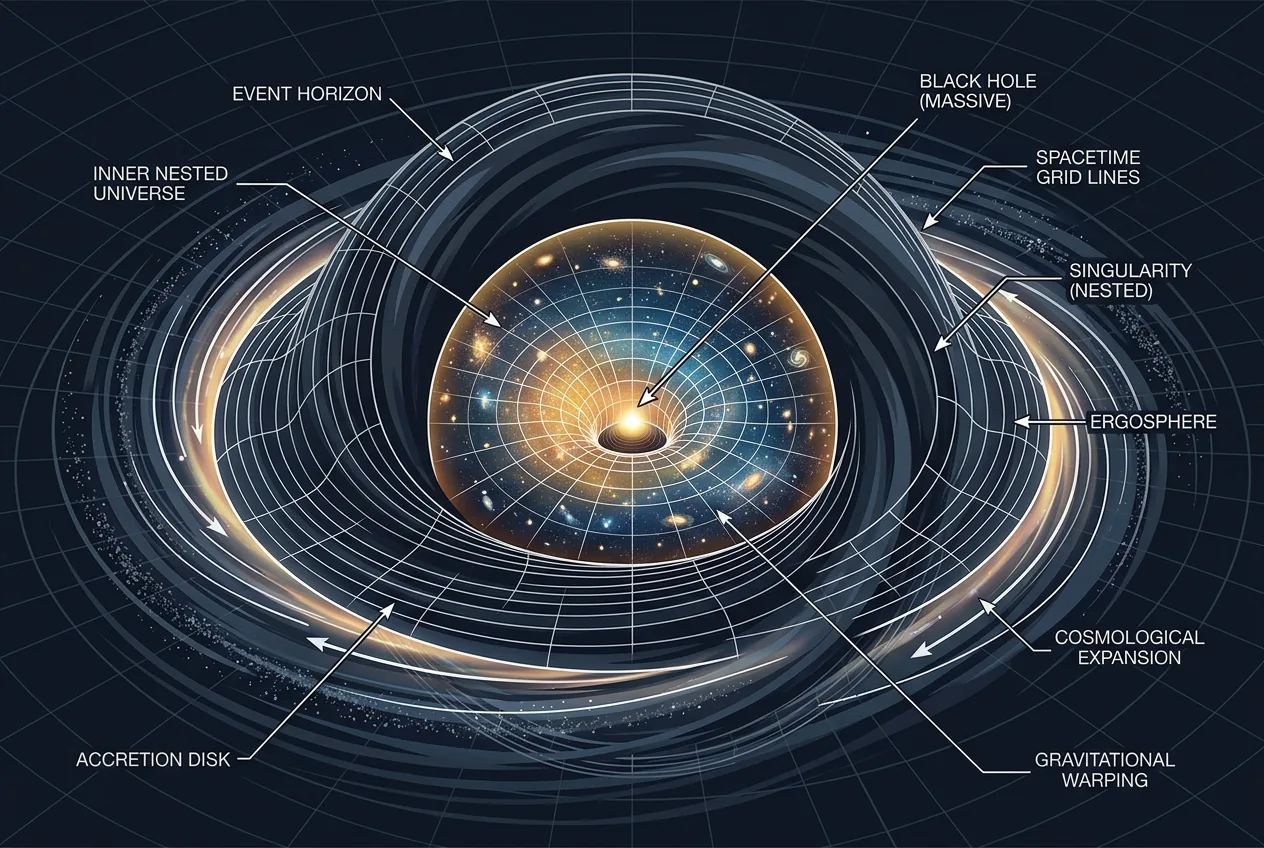
This anomaly is not just a headache for stellar physicists in Garching or Bonn; it is a crack in the door for a theory that was once relegated to the fringe of the coffee room. If black holes can form in ways we don't understand, and if their internal physics defies the terminal 'singularity' we’ve been taught to expect, then the math starts pointing toward a localized, uncomfortable conclusion. Our entire observable universe might be the interior of a black hole existing in a much larger 'parent' cosmos.
The end of the singularity and the rise of the 'bounce'
For decades, the Big Bang has been sold as a moment of infinite density—a singularity where the laws of physics simply gave up and went home. But for an engineer or a data-driven physicist, 'infinite' is usually just a polite way of saying your model has failed. If you replace Einstein’s General Relativity with models that include 'torsion'—a physical property where spacetime twists as well as curves—the singularity disappears. In its place, you get a 'Big Bounce.'
In this framework, when a massive star in a parent universe collapses into a black hole, the matter doesn't crush down into a mathematical point. Instead, it reaches a state of such extreme density that the 'torsion' becomes a repulsive force. The collapse stops, reverses, and expands. But it doesn't expand back out into the parent universe; it expands into a new region of spacetime created by the collapse itself. To an observer inside that expansion, it looks exactly like a Big Bang. To an observer in the parent universe, it looks like a standard, if somewhat persistent, black hole.
This isn't just a poetic metaphor for cosmic nesting dolls. It addresses a fundamental procurement problem in physics: where did all the matter come from? If we are the 'daughter' of a black hole, the matter in our universe is simply the recycled remains of the star that collapsed in the universe next door. It’s a closed-loop system that would satisfy even the most stringent EU circular-economy directive.
Can seven dimensions solve the Hawking paradox?
The primary objection to living inside a black hole has always been the 'Information Paradox.' Stephen Hawking famously argued that black holes eventually evaporate, and when they do, any information that fell into them—be it a star or a stray library book—is deleted from the universe. This violates the laws of quantum mechanics, which insist that information can never truly be destroyed. If our universe is a black hole, and black holes destroy information, then our reality is built on a logical impossibility.
European research institutions, particularly those tied to the Max Planck Institute, have been quietly scrutinizing these multi-dimensional models. The trade-off is significant. To save the law of information, we have to accept a reality that is far more complex than our senses suggest. It turns the 'Matrix' comparison from a pop-culture trope into a technical necessity. If the information of our universe is actually stored on a 2D boundary of a 7D space, then our 3D experience is effectively a holographic projection. It’s a brilliant piece of mathematical accounting, even if it leaves the average taxpayer wondering what exactly they are paying for at CERN.
The LIGO anomaly and the search for primordial ghosts
The existence of primordial black holes would do more than just validate the 'bounce' theory; it would provide a tidy candidate for dark matter. We have spent billions searching for WIMPs (Weakly Interacting Massive Particles) with zero results. If dark matter is actually just a vast population of sub-solar black holes, we don't need to invent new particles. We just need to improve our sensors. The European Space Agency’s (ESA) upcoming LISA mission—a space-based gravitational wave observatory—is designed to do exactly that. By moving the detectors into orbit, away from the seismic noise of Earth, LISA will be able to 'hear' the smaller, subtler hums of these primordial objects.
There is a certain irony in the fact that the more we try to look 'out' at the largest scales of the cosmos, the more we find ourselves looking 'in' at the physics of the smallest. The industrial strategy here is clear: the first bloc to definitively prove the nature of dark matter or the 'bounce' origin of the universe gains more than just a Nobel Prize. They gain the keys to the next century of fundamental physics, which dictates everything from quantum computing limits to potential energy extraction from the vacuum.
Bureaucracy and the limits of the observable
The challenge, as always in European 'Big Science,' is the gap between the blackboard and the budget. Proving we live inside a black hole requires observations that sit at the very edge of what current technology can achieve. It requires coordination between the LIGO-Virgo-KAGRA network and a dozen other agencies, each with their own national interests and reporting requirements. While the US and China are aggressively funding standalone projects, Europe’s strength remains its collaborative, multi-national infrastructure—provided the bureaucrats can agree on the data-sharing protocols.
Skeptics will point out that the 'Black Hole Universe' theory is currently unfalsifiable. Since we cannot step outside our own event horizon to look back at the 'parent' universe, we are essentially theorizing about a room we can never leave. However, that didn't stop us from mapping the atom or predicting the Higgs boson. The math often leads where the eyes cannot yet follow. If the seven-dimensional models continue to resolve the paradoxes that stymied Hawking, then the 'Black Hole Universe' moves from a speculative thought experiment to a leading candidate for the truth.
It is a humbling prospect. We like to think of our universe as a vast, independent expanse. To find out we are actually a sub-process of another universe—a cosmic recursive loop—is a blow to the species' collective ego. But in the world of high-stakes physics, ego is a secondary concern. The data suggests that the Big Bang wasn't a beginning, but a transition. We are living in the expanded wake of a star that died in a world we will never see.
The math is solid. The sensors are getting better. The only thing left to settle is which administrative body in Brussels gets to claim the discovery as a win for EU industrial policy.




Comments
No comments yet. Be the first!