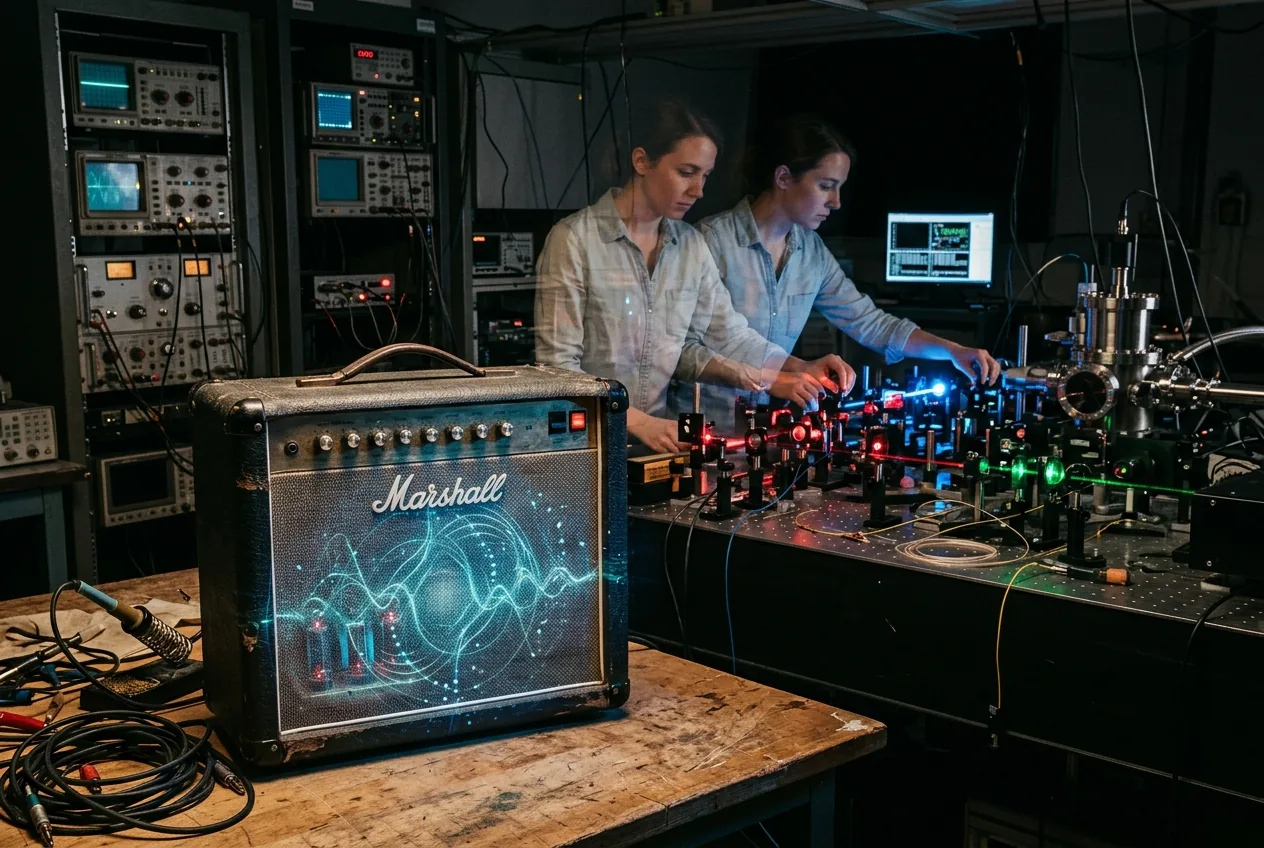
During a teenage rock performance that was supposed to be a career-defining moment, a young guitarist turned his amplifier up to ten, hoping for a wall of sound that would cement his local legend. Instead, the fuse blew. The silence that followed was not the profound kind; it was the embarrassing kind that accompanies technical failure under spotlights. For years, that musician—who grew up to be Oxford physicist Vlatko Vedral—wondered if he had simply been cast into an “unlucky” version of the universe. In the world of classical physics, a fuse blows or it doesn’t. In the quantum world, Vedral now argues, the story is far more crowded.
The standard narrative of quantum mechanics, often taught as a series of strange but settled paradoxes, usually places the human observer at the centre of the stage. We are told that particles exist in a hazy state of many possibilities—superposition—until a person looks at them, at which point the wave function “collapses” into a single, boring reality. Vedral, a professor of quantum information science at Oxford, is part of a growing contingent that finds this anthropocentric view not just messy, but likely wrong. His argument flips the script: it is not the human who collapses reality, but reality that entangles the human, branching them into multiple versions that may still, under very specific conditions, whisper to one another across the void of the multiverse.
The Myth of the Privileged Observer
The “observer effect” has long been the darling of metaphysical speculators and New Age writers who claim that human consciousness creates the world. For a physicist grounded in the rigorous mathematics of information theory, this is a source of constant frustration. The problem with the standard Copenhagen interpretation—the idea that observation causes collapse—is that it never defines what an “observer” actually is. Does it require a PhD? A brain? A single-celled amoeba? A silicon sensor?
This is more than just a philosophical preference. It represents a shift from seeing the observer as a “controller” of events to seeing the observer as a component within a larger, deterministic system. In the European research landscape, where the Quantum Flagship programme is pouring billions into the development of quantum sensors and clocks, this distinction matters. If we assume the observer is a magical external entity, we miss the engineering reality: every piece of a quantum computer is “observing” every other piece, leading to the rapid decay of quantum information known as decoherence. The struggle of modern physics isn't just about making things small; it’s about keeping them from “seeing” the rest of the room.
How Many Versions of Bob Does it Take to See a Photon?
To ground this in the physical, Vedral uses the example of a man named Bob. When a photon strikes Bob’s sunglasses, it exists in a superposition. The mechanical interaction between the photon and the molecules of the glass, and subsequently the neurons in Bob’s retina, creates a chain of entanglement. This is what physicists call a “von Neumann chain.” The state of the photon is now tied to the state of the eye, which is tied to the state of the brain.
Crucially, Vedral argues that this chain doesn't stop at the skull. It extends to the environment. The reason we don’t feel like we are branching into multiple versions every second is because of the sheer complexity of these interactions. Once the information about that photon leak into the air molecules and the floorboards, the different versions of “Bob” become so distinct that they can no longer interact. They lose “coherence.”
However, the mathematical heart of Vedral’s argument is that these branches are not entirely disconnected. In a highly controlled environment—one that looks more like a dilution refrigerator in a lab in Garching than a rock concert in London—it is theoretically possible for these branches to interfere with each other. This is the phenomenon of quantum interference, where two paths of a particle can cancel each other out or reinforce each other. Vedral suggests that if this applies to particles, it must, in principle, apply to the versions of “you” that are entangled with them.
The Alice Experiment and the Erasure of Memory
The most controversial aspect of this theory involves the possibility of reversing these interactions. Imagine a second observer, Alice, who has the ability to manipulate Bob and the photon as if they were a single quantum system. If Alice can perfectly reverse the entanglement between Bob and the light, she could effectively “undo” Bob’s observation. From Bob’s perspective, he would have no memory of the event, but the underlying quantum math suggests that both possible realities had to exist for the reversal to be successful.
This is essentially a macroscopic version of Wigner’s Friend, a thought experiment that has recently been tested in small-scale laboratory settings. Experiments at the University of Edinburgh and elsewhere have shown that two different observers can actually disagree on the “fact” of whether an event occurred, and both can be mathematically correct. This isn't just a failure of communication; it’s a fundamental feature of the quantum landscape.
For industrial policy, this is where the theoretical rubber meets the road. European investment in quantum communications—such as the EuroQCI initiative—relies on the principle that quantum information cannot be copied or observed without being changed. If Vedral is right, and “observation” is just a specific type of entanglement that could, in theory, be manipulated or even bypassed by higher-order observers, our current assumptions about the absolute security of quantum networks might one day need a second look. If you can undo the observer, can you undo the security?
The Reality of the Unlucky Universe
The skepticism toward Vedral’s “many-mes” model often comes from the experimentalists. In the corridors of the Max Planck Institute or the cleanrooms of Bosch, the focus is on mitigating noise, not contemplating the interference of alternate selves. The universe is incredibly “lumpy” and noisy. The probability of a version of you from a “lucky universe” where the amp didn't blow actually affecting your current physical state is so vanishingly small that it requires several orders of magnitude more zeros than there are atoms in the visible world.
Yet, Vedral maintains that ignoring these branches is a mistake of logic. Just because we cannot easily measure the other branches doesn't mean they aren't part of the functional description of reality. He views the universe as a giant computer—a perspective shared by his Oxford colleague David Deutsch. In this “Constructor Theory” adjacent view, physics isn't about what happens, but about what transformations are possible and why. If a version of you exists where you made a different choice, that possibility is baked into the initial conditions of the universe.
There is an inherent tension here between the British school of theoretical physics, which often leans toward these vast, all-encompassing interpretations of reality, and the more pragmatic, engineering-focused approach of the Rhine-Ruhr quantum hubs. While Oxford ponders if Bob’s brain is a quantum wave function, German engineers are busy trying to ensure that a quantum bit can stay stable for more than a few microseconds at four Kelvin. Both are necessary, but they speak different languages.
Vedral’s rock band anecdote serves as a reminder that science often begins with a personal sense of injustice—the feeling that things should have gone differently. Quantum mechanics, in his telling, is the only branch of science that actually allows for that “differently” to exist. It suggests that reality is not a single path through a forest, but the entire forest itself, and we are just too busy looking at our own feet to see the other versions of us walking among the trees.
Ultimately, the idea that another version of you is shaping your reality remains an unproven, and perhaps unprovable, hypothesis. It sits on the edge of what we can call science, precisely because the “other versions” are, by definition, inaccessible. However, as we move closer to building large-scale quantum systems that involve millions of entangled particles, we may find that the line between a “lab experiment” and a “version of reality” begins to blur. For now, the fuse remains blown. Oxford has the theory, but the rest of the world is still waiting for a version of the experiment that actually works.



Comments
No comments yet. Be the first!