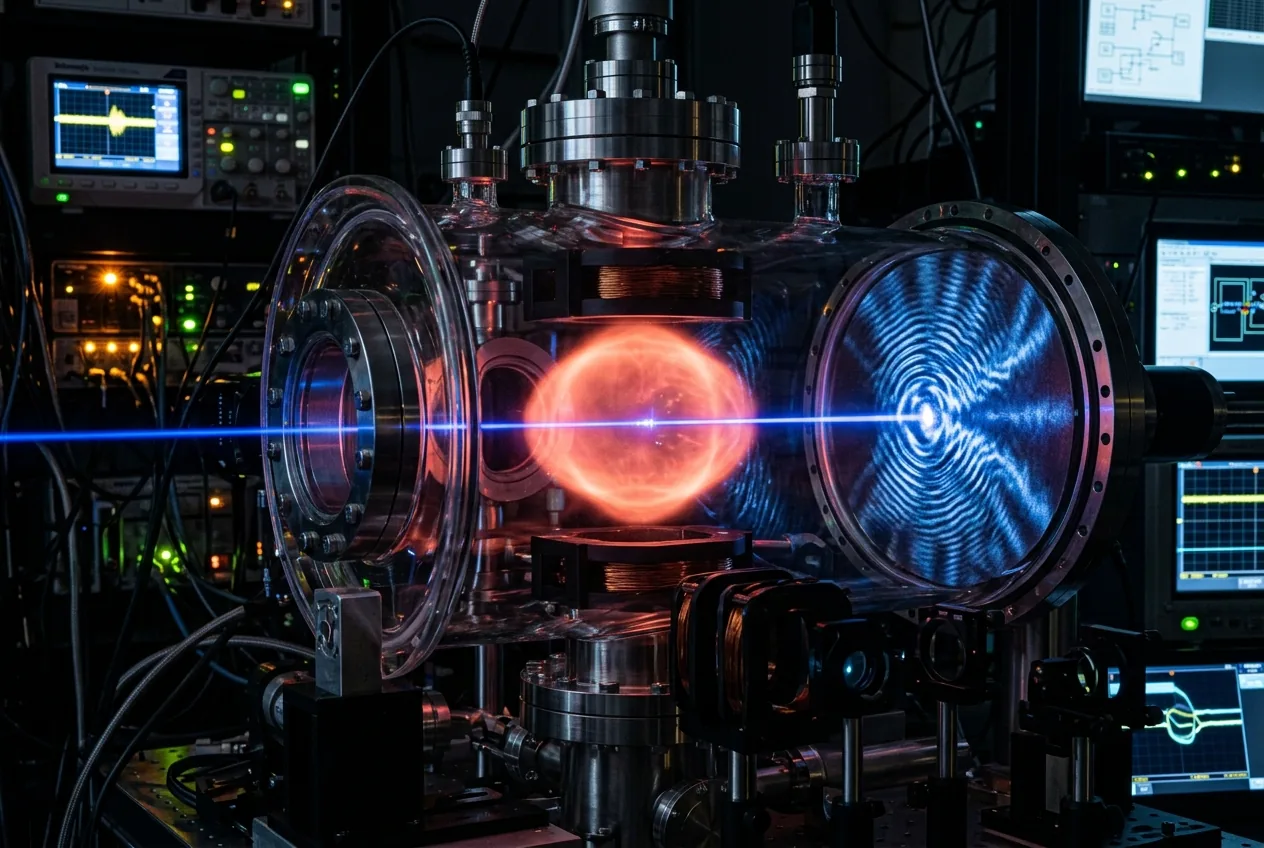
A photon walks into a cloud of rubidium atoms and exits before it even finishes entering. It sounds like the setup for a high-brow physics joke, but inside a laboratory vacuum chamber, the punchline is a measurable reality. Physicists have effectively observed "negative time," a phenomenon where quantum particles seem to spend a duration of less than zero interacting with matter. While it sounds like the death knell for causality, the truth is even stranger: time is not a single, straight line, and at the quantum level, it can actually run in reverse without breaking the universe.
Josiah Sinclair and his team at the University of Toronto didn’t set out to build a TARDIS. They were investigating a long-standing mystery involving the way light interacts with atoms. When a photon passes through a medium, it can be absorbed, exciting the electrons in the atoms to a higher energy state. Usually, there is a delay—a tiny, fractional pause—before that energy is re-emitted as a new photon. For decades, physicists have argued about how long that pause actually lasts. In Sinclair’s experiment, the answer turned out to be a negative number.
To the human brain, which processes time as a series of "nows" stacked like Lego bricks, negative time is an impossibility. If you spend negative five minutes in a shop, you should have arrived home before you left. But in the quantum realm, particles don't have definite positions or timings; they exist as clouds of probability. When these researchers fired photons through a frigid cloud of rubidium atoms, they found that in certain instances, the atoms were excited and then returned to their ground state before the photon had even completed its journey through the cloud. The stopwatch didn't just stop; it wound itself backward.
The rubidium trap and the stopwatch that lied
The experiment relied on a technique known as "weak measurement." In the delicate world of quantum mechanics, looking too closely at a particle usually destroys the very behavior you’re trying to observe. If you try to pin down exactly where a photon is, you’ll knock it off course. To get around this, the team used a second laser beam to probe the rubidium atoms without disturbing the photons passing through. They weren't measuring the photon itself; they were measuring the "atomic excitation"—the physical footprint the light left behind.
What they found was a statistical anomaly that refused to go away. The rubidium atoms were reacting as if the photons had already passed through, even when the bulk of the light pulse was still on the approach. It wasn't an error in the equipment or a smudge on the lens. The photons were effectively spending a negative amount of time inside the atoms. This suggests that under specific conditions, the time of interaction is not just zero, but a value that subtracts from the total travel time of the particle.
This isn't the first time science has flirted with the idea of light breaking the time barrier. In 1993, a famous experiment suggested that photons could tunnel through a barrier at "superluminal" speeds—faster than light. Back then, the scientific community largely dismissed the results as an artifact of how we measure waves. They argued that only the very front edge of a light pulse was being detected, creating the illusion of speed. Sinclair’s work, however, proves that negative time is a tangible, physical property of the interaction itself, not just a trick of the light.
Why the universe isn't breaking
If particles can move through negative time, the immediate question is whether we can send a text message to our past selves. The short answer is no, and the reason lies in the distinction between "group velocity" and "signal velocity." While a single photon might appear to skip through time, you cannot use this effect to transmit actual information faster than the speed of light. The universe has a built-in cosmic speed limit that protects the sequence of cause and effect.
Think of a light pulse as a long train. The "negative time" observed in the rubidium cloud is like the front of the train arriving at the station before the back has even left. However, you can't put a passenger (information) on that "negative" portion of the trip. The information—the actual message—is tied to the overall structure of the wave, which still obeys the laws of Einsteinian relativity. You can cheat the clock with a single particle, but you can’t cheat the narrative of the universe.
This creates a fascinating tension in modern physics. We are seeing evidence that at the smallest scales, time is "fuzzy." It doesn't flow like a river; it behaves more like a shimmering heat haze where the past and the future can briefly overlap. This doesn't mean causality is dead; it just means it's more flexible than we thought. The negative time measured in Toronto is a property of the quantum wave-function, a mathematical description of where a particle might be, rather than a physical object moving backward through a void.
The cost of borrowable seconds
Every breakthrough comes with a trade-off. In the case of negative time, the cost is the total uncertainty of the system. According to the Heisenberg Uncertainty Principle, you cannot know both the energy of a photon and the exact time it appears with perfect precision. By forcing the photon to interact with the rubidium atoms in a very specific way, the researchers introduced a level of uncertainty that allows for these negative values to exist mathematically and physically.
There is also a debate about what "time" even means in this context. Is time what the clock says, or is it the sequence of physical changes in the atoms? If the atoms return to their original state before the trigger has finished acting on them, has time actually reversed for those atoms? Some theorists argue that we are simply seeing the limits of our own language. We use words like "before" and "after" to describe a reality that doesn't actually use those concepts at a fundamental level.
This isn't just academic navel-gazing. Understanding negative time and quantum delays is crucial for the next generation of technology. As we build quantum computers that rely on the precise timing of individual photons, knowing how these particles "borrow" time from the future becomes a matter of engineering. If your quantum processor expects a signal at nanosecond X, but the particle decides to exit at nanosecond X minus one, your entire calculation could collapse.
Can we ever go back?
While Sinclair’s photons are performing a localized version of time travel, expanding this to human-sized objects remains the stuff of science fiction. The sheer complexity of maintaining a "quantum state" for anything larger than an atom is astronomical. To send a person back in time, you would need to keep every single atom in their body in a state of quantum superposition, shielded from the rest of the universe. The moment you stepped out of the time machine and touched a molecule of air, the state would collapse, and you’d likely end up as a cloud of very confused subatomic particles.
However, the existence of negative time does rewrite the rules for what is possible in deep-space communication and sensing. If we can manipulate these temporal delays, we could theoretically build sensors that are sensitive to events before they have fully manifested in our macro-reality. It is a form of "quantum precognition"—detecting the footprint of a particle before the particle itself has arrived.
For now, negative time remains a curiosity of the very small. It serves as a reminder that our human perception of the world—where clocks only tick forward and the past is set in stone—is just a surface-level illusion. Beneath the skin of reality, the universe is much more chaotic, much more interconnected, and significantly less concerned with the order of events than we are. We might not be able to visit 1955, but we have officially proven that the past isn't as out of reach as it looks.




Comments
No comments yet. Be the first!