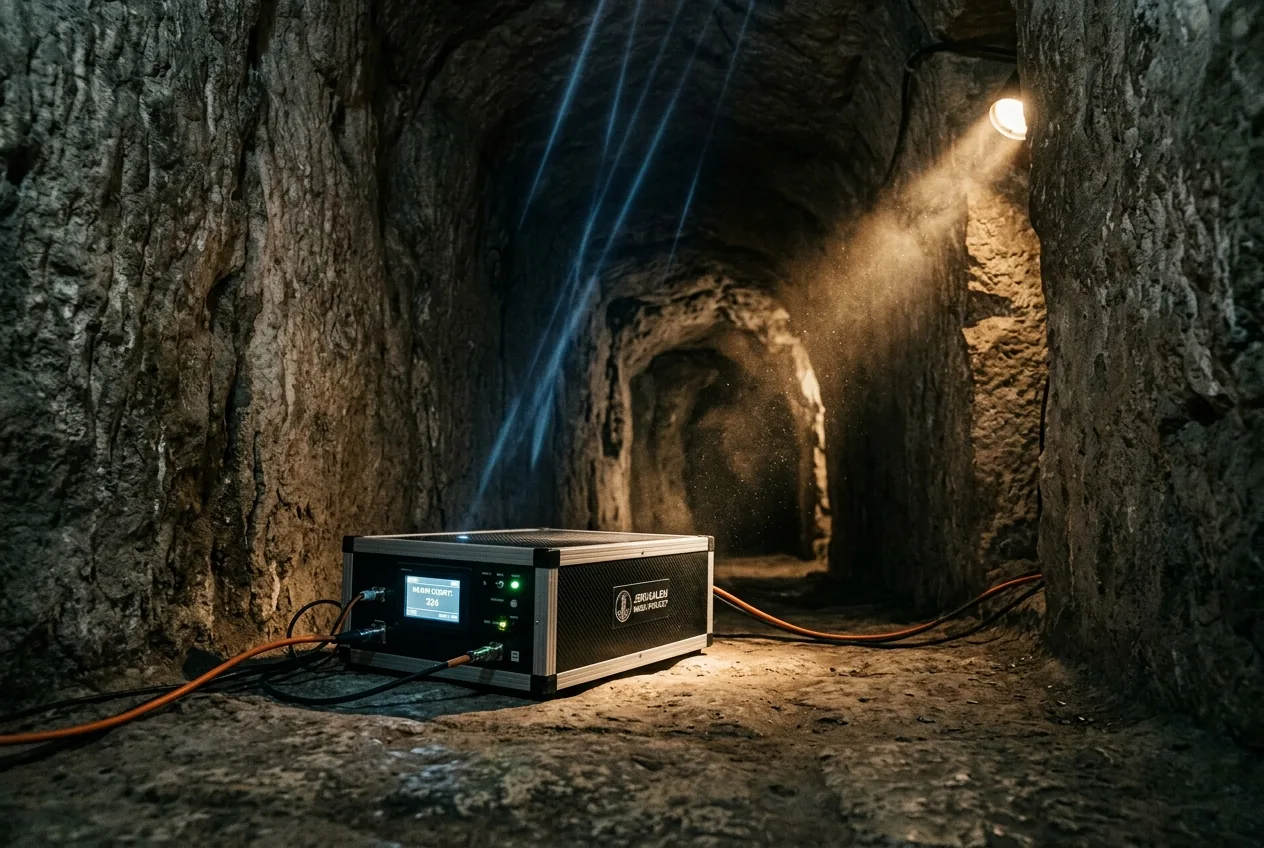
Deep inside a narrow, humid drainage tunnel dating back to the Second Temple period, a series of rectangular boxes sit in total silence. They do not hum, they do not emit radiation, and they certainly do not look like the future of archaeology. Yet, for months on end, these detectors have been silently counting the arrival of subatomic particles called muons—heavy cousins of the electron born from cosmic rays hitting the Earth's upper atmosphere. They are waiting for the sky to fall, or more specifically, for the parts of the sky that manage to filter through 20 meters of solid limestone and centuries of accumulated debris.
The project in Jerusalem’s City of David represents a convergence of high-energy physics and one of the most sensitive archaeological sites on the planet. In a city where moving a single stone can trigger a diplomatic incident or a localized riot, the ability to 'see' through the earth without breaking the surface is not just a scientific advantage; it is a bureaucratic necessity. By measuring the 'shadows' cast by dense rock versus the higher flux of particles passing through empty spaces, researchers are attempting to map the subterranean architecture of a city that has been built, destroyed, and buried a dozen times over.
Muon tomography—or muonography—is often sold as 'X-ray vision for the earth,' but the reality is far more tedious and technically demanding. Unlike a medical X-ray, which takes milliseconds, a muon scan of a historical site requires the patience of a geologist. The particles are rare enough that the detectors must sit for months to gather enough data to distinguish a true archaeological void from mere statistical noise. In Jerusalem, where the underground is a chaotic lattice of Byzantine cisterns, Herodian sewers, and natural karst caves, the challenge isn't just finding a hole—it's figuring out which century it belongs to.
The high-energy trade-off of the subatomic shovel
To understand why physicists are lugging particle detectors into ancient sewers, one must look at the limitations of standard geophysical tools. Ground-penetrating radar (GPR) is the industry workhorse, but it is notoriously fickle in urban environments. It struggles with highly conductive soils and rarely penetrates more than a few meters with any meaningful resolution. In Jerusalem, the targets of interest often lie 15 to 30 meters deep, encased in the heavy limestone of the Judean Hills.
Muons solve the depth problem through sheer kinetic energy. These particles are created when cosmic rays—mostly high-speed protons from outside our solar system—slam into nitrogen and oxygen molecules in the atmosphere. This collision creates a shower of secondary particles, including muons, which rain down on every square meter of the Earth's surface at a rate of roughly 10,000 per minute. Because they are 207 times heavier than electrons and move at near-light speeds, they do not interact strongly with matter. They can pass through hundreds of meters of rock, though they are gradually absorbed or deflected depending on the density of the material they encounter.
The European connection and the silicon supply chain
While the headlines focus on the biblical mystery, the hardware reveals an industrial story rooted in European high-energy physics. The detectors used in these surveys are direct descendants of the massive tracking chambers at CERN’s Large Hadron Collider in Geneva. Specifically, many of these portable units rely on 'Micromegas' (Micro-Mesh Gaseous Structure) detectors, a technology pioneered by French physicists at CEA Saclay. These devices are designed to detect the faint ionization trail left by a muon as it passes through a gas-filled chamber.
There is an irony in the supply chain: the same silicon and gas-handling technology used to hunt for the Higgs Boson is now being calibrated to find the missing corners of a 2,000-year-old fortification. For European industrial policy, this is a rare 'dual-use' success story. The development of high-precision, low-power particle detectors has applications far beyond archaeology, stretching into nuclear waste monitoring, volcanic eruption prediction, and even 'industrial scanning' of blast furnaces where engineers need to see through molten steel and refractory brick without shutting down the plant.
However, the transition from the laboratory to the drainage tunnel is rarely smooth. The City of David is a damp, thermally unstable environment—the literal opposite of a climate-controlled cleanroom. Engineering these detectors to survive the humidity and dust of an active archaeological dig without losing their calibration is where the real 'breakthrough' usually lies. It is less about the physics, which has been understood since the 1930s, and more about the ruggedization of sensitive electronics.
Why Jerusalem is the ultimate test of non-invasive tech
In most parts of the world, if an archaeologist wants to know what is under a hill, they get a permit and a shovel. In Jerusalem, the soil is thick with political and religious significance. The City of David, situated just south of the Temple Mount/Haram al-Sharif, is one of the most contested patches of dirt on Earth. Any traditional excavation here is scrutinized by international bodies, local residents, and religious authorities. The 'no-dig' constraint isn't just a preference; it’s a hard limit of the geopolitical reality.
This makes the region a perfect incubator for non-invasive technology. If muonography can prove its worth here, it can work anywhere. But the technique has its detractors. Skeptics in the archaeological community point out that while muons can find a 'void,' they cannot distinguish between a royal tomb and a natural limestone fissure. The resolution is currently measured in meters, not centimeters. You might find a room, but you won't find the inscriptions that tell you who was buried in it.
There is also the matter of the 'negative result.' In science, knowing there is nothing there is valuable. In the high-stakes world of Jerusalem archaeology, where funding often follows the promise of spectacular finds, a six-month muon scan that concludes 'the ground is solid' is a hard sell to donors and the public. The technology requires a shift in how archaeology is funded—moving away from the 'treasure hunt' model toward long-term, data-driven mapping of the subterranean landscape.
The gap between cosmic ambition and muddy reality
The use of muons in Jerusalem follows the high-profile success of the 'ScanPyramids' project in Egypt, which in 2017 identified a previously unknown 'big void' inside the Great Pyramid of Khufu. That discovery validated the technology in the eyes of the public, but it also highlighted the limitations. Years later, we still don't know exactly what that void is, because the very non-invasiveness that allowed its discovery prevents us from going inside to look.
In Jerusalem, the researchers are dealing with a much messier environment. Pyramids are largely consistent blocks of stone; Jerusalem is a hodgepodge of different materials. The physicists must account for the varying densities of fill-dirt, building stones, and the porous Judean limestone. This requires complex computer simulations—often using the 'Geant4' toolkit developed at CERN—to model how particles behave as they transit through the specific topography of the site.
The current data sets from the City of David are being processed, but the early indications suggest the technology is successfully identifying known structures, such as the famous Siloam Tunnel. The real test will be whether it can point to something unexpected—a hidden canal system or a structural anomaly that confirms or refutes existing historical theories about the city's ancient water management.
The Israel Antiquities Authority will likely get its maps, and the physicists will get their data points. Whether those maps will actually settle any of the city's ancient arguments is a different question entirely. Brussels provided the detector tech; Jerusalem will provide the ambiguity.




Comments
No comments yet. Be the first!