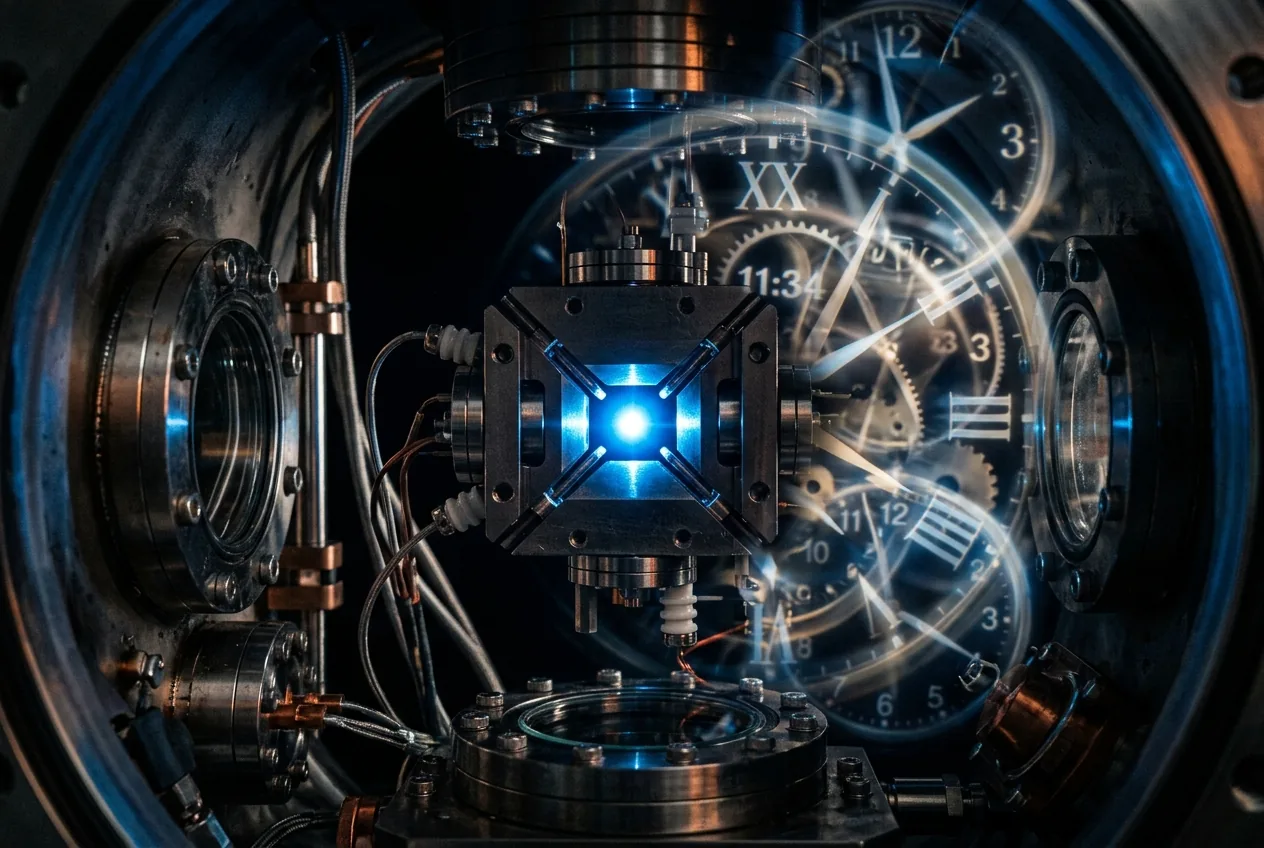
Inside a vacuum chamber at the National Institute of Standards and Technology in Colorado, a single aluminum ion hangs suspended in a magnetic trap, shivering at temperatures just a fraction of a degree above absolute zero. It is, for all intents and purposes, the most bored atom in the universe. But this tiny, frozen speck of matter is currently at the centre of a conceptual car crash that could dismantle everything we think we know about the steady flow of the afternoon.
For decades, we’ve been told time is a river. Einstein famously tweaked that, suggesting the river flows at different speeds depending on how fast you’re rowing or how close you are to a waterfall. But a new paper published in Physical Review Letters suggests the river isn't just variable—it’s glitching. According to a team led by Igor Pikovski at the Stevens Institute of Technology, time can actually exist in a state of superposition. That means, quite literally, a single clock can tick both faster and slower at the same time.
This isn't just a bit of mathematical gymnastics. It is a fundamental challenge to the way we perceive reality. If you’ve ever felt like a Monday was dragging while a Saturday vanished in a blink, you’re experiencing a psychological trick. What Pikovski and his colleagues are talking about is a physical reality where the universe itself hasn’t decided how old you are yet. It’s the "Twin Paradox" on a cocktail of quantum mechanics, and the technology to prove it is finally sitting on a laboratory bench.
The ghost of the twin paradox
To understand why this is breaking physicists' brains, you have to look at the old rules. Einstein’s special relativity gave us the Twin Paradox: send one twin on a rocket at near-light speed, and when he returns, he’s younger than the twin who stayed home. Time dilated. It stretched. It’s a proven fact, used every day to keep GPS satellites from drifting miles off course. But in Einstein’s world, the twin is always a specific age. He’s either 25 or 30. He isn't both.
Quantum mechanics, the rebellious teenager of physics, disagrees. In the quantum world, things don’t like to be just one thing. Particles can be in two places at once—a state called superposition—until someone looks at them. Pikovski’s team realized that if a clock is small enough and governed by quantum rules, the clock itself enters a superposition of motion. And because motion dictates the flow of time, the clock’s "proper time" enters a superposition too.
It’s like having a watch that shows both 12:00 and 12:05 simultaneously, and both are technically correct. We aren't talking about a broken watch; we are talking about a universe that hasn't made up its mind. For years, this was a theoretical "maybe" that lived in the back of notebooks. The problem was that the difference in time is so small—measured in attoseconds, or quintillionths of a second—that nothing we built could see it. Until now.
Squeezing the vacuum for answers
The leap forward comes from a technique that sounds like something out of a sci-fi heist: quantum squeezing. In the lab, researchers don’t just watch the atom; they manipulate the very vacuum surrounding it. By "squeezing" the uncertainty of a system, they can make one measurement incredibly precise at the cost of making another one wildly vague. It’s a trade-off dictated by Heisenberg’s Uncertainty Principle, but if you do it right, you can amplify the tiny, shivering signals of quantum time.
Gabriel Sorci, a doctoral candidate working on the project, points out that these atomic clocks are now so sensitive they can detect the time-altering effects of thermal vibrations at temperatures that would kill a human in seconds. But even if you strip away the heat and get down to absolute zero, the clock still won't tick perfectly. The quantum fluctuations of the universe itself—the "noise" of reality—will still kick the clock around. By using squeezed states, the team can link the motion of the clock to the way it ticks, creating an entanglement between time and matter.
This entanglement is the smoking gun. If the researchers can show that the clock’s internal state (its "tick") is inextricably linked to its quantum motion (its "shiver"), they will have proved that time is not a background stage upon which the universe performs. Instead, time is a player in the game, subject to the same fuzzy, uncertain rules as electrons and photons. It’s a messy realization that complicates our neat, linear view of existence.
Why the second is about to be redefined
But as we push for this level of precision, we hit a wall. If time itself is fundamentally quantum and "blurry" at these scales, how do you define a universal second? If a clock can tick at two speeds at once, which one goes on the official record? This isn't just a headache for the International Bureau of Weights and Measures; it’s a sign that our classical tools are reaching their limit. We are trying to measure a glitching reality with a ruler that assumes everything is solid.
The quest for a more accurate clock is inadvertently turning into a quest for the true nature of reality. Physicists are no longer just building timekeepers; they are building probes. These clocks are becoming sensors for the invisible, capable of detecting dark matter or the ripples of gravitational waves from across the cosmos. But the most shocking thing they might detect is the fact that time doesn't exist in the way we think it does.
Is time just a massive collective illusion?
There is a growing, somewhat uncomfortable debate in the physics community about whether time is "emergent." The idea is that at the most fundamental level, time doesn't exist at all. It’s just something that appears when a lot of quantum pieces get tangled together, much like how "temperature" isn't a thing for a single atom, but is a very real thing for a pot of boiling water. If time is emergent, then Pikovski’s superposition experiment is the first step toward seeing behind the curtain.
If we find that time can be in two states at once, it suggests that Einstein’s smooth, continuous spacetime is just a convenient approximation. It’s the low-resolution version of a much weirder, grainier reality. This is the holy grail of modern physics: the bridge between General Relativity (the big stuff) and Quantum Mechanics (the small stuff). We’ve spent a century trying to marry the two, and time might be the ring that binds them.
Einstein famously asked if the moon was still there when nobody was looking. He hated the idea that reality was dependent on an observer. But if time itself can be in a superposition "when nobody looks," then the moon isn't just there—it’s existing in a smear of different ages, waiting for a measurement to snap it into a single timeline. It’s a thought that makes the rigid, clock-watching world of the nine-to-five feel remarkably flimsy.
The laboratory is the new frontier
The most exciting part of this isn't the philosophy; it’s the fact that it’s actually happening. This isn't a theory that requires a particle accelerator the size of the solar system. It requires the ion traps and lasers already sitting in labs in Colorado and Germany. We are at the point where the hardware has caught up to the imagination. The experimental groups at Colorado State University and NIST are already charting the path to observe these effects for the first time.
We are entering an era where "clock precision" is no longer about making sure your train is on time. It’s about probing the friction between two versions of the universe. One version is Einstein’s, where everything is relative but certain. The other is the quantum version, where everything is possible but nothing is fixed. By forcing a single atom to live in both worlds, we are finally asking time what it really is when it’s not being watched.
When these experiments yield their first results, they won't just be a footnote in a physics journal. They will be a signal that the "arrow of time" is more of a suggestion than a rule. We might find that the universe is far less stable, and far more interesting, than the ticking of a clock would have us believe. For the guy scrolling on the bus, the takeaway is simple: the next time you feel like the day is never-ending, you might literally be right. You’re just waiting for the universe to decide which speed it wants to run at.




Comments
No comments yet. Be the first!