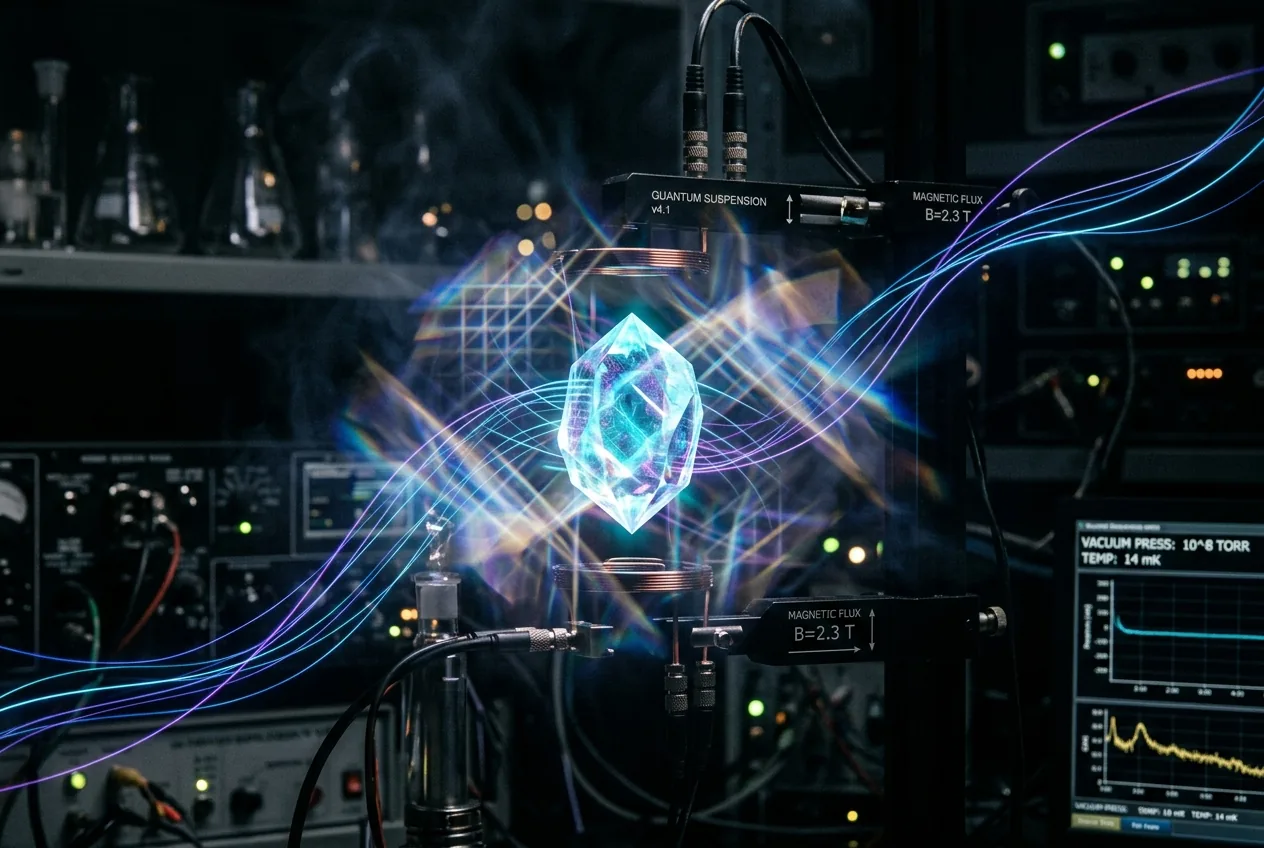
This isn't just lab-bench navel-gazing. For decades, the biggest hurdle in the race for a functional quantum computer has been "noise." Quantum bits, or qubits, are notoriously sensitive. If a stray vibration or a tiny heat spike touches them, they lose their data and the whole system crashes. Powell’s discovery of these "Floquet" states suggests we can create materials that are effectively immune to that chaos. By keeping the material in a constant state of rhythmic change, physicists are creating a brand of stability that static matter simply cannot provide.
The magnetic strobe light effect
To understand what Powell and his colleague Louis Buchalter achieved, you have to stop thinking of matter as a solid, unchanging lump. Normally, a crystal is like a still photograph. The atoms sit in their rows, the electrons zip around, and the whole thing stays put. But Powell’s team used a technique called Floquet engineering. Think of it like a strobe light in a dark club. When the light is off, you can't see the dancers. When it flickers at a specific frequency, the dancers appear to move in slow motion or even stand still in mid-air.
The beauty of this approach is control. In traditional materials science, if you want a different property, you have to find a different rock. You want something more conductive? Find some copper. You want something magnetic? Find some iron. With Floquet engineering, you don't change the rock; you change the beat. By tuning the frequency of the magnetic field, researchers can dial in specific quantum properties on the fly. It turns the material into a programmable canvas.
Mining the ghost of a photon
Inside a specific crystal called cerium zirconium oxide, Dai’s team observed something that sounds like science fiction: emergent photons. Usually, photons are the particles of light that travel through the vacuum of space. But here, they were popping out of a solid crystal. These aren't the photons coming from the sun; they are "ghostly" versions that emerge from the collective dance of the atoms inside the material.
This discovery confirms that we can create environments inside solids that mimic the fundamental laws of the entire universe. It’s like having a miniature version of the cosmos trapped inside a gemstone. For quantum computing, this is a goldmine. These emergent particles are "fractionalized," meaning they are pieces of an electron that have effectively broken apart. Because they are spread out across the material, they are incredibly hard to disturb. You can't break something that is already intentionally broken and spread across a thousand atoms.
When electrons quit their day jobs
The weirdness doesn't stop at magnetic pulses or ghost photons. In laboratories across the world, electrons are starting to behave in ways that defy every textbook in the building. For a century, we’ve treated electrons like tiny billiard balls zipping through wires. But new research into exotic matter shows that under the right conditions, electrons simply stop acting like particles altogether.
In certain quantum materials, electrons begin to flow like a frictionless liquid. In others, they lose their individual identity and act as a single, collective wave. This is a nightmare for classical physics but a dream for engineers. If an electron doesn't act like a particle, it doesn't bounce off things. If it doesn't bounce, it doesn't create heat. If it doesn't create heat, you can build a computer that doesn't need a cooling fan and never slows down.
The catch, as always, is the environment. Most of these states require temperatures colder than deep space or magnetic fields strong enough to lift a car. This is why Powell’s Floquet engineering is so vital. By using time-dependent fields to "drive" the matter, we might be able to trick these materials into staying in these exotic states at higher temperatures and under less extreme conditions. It is the difference between needing a liquid-nitrogen-cooled super-fridge and having a device that works on your desk.
The gold standard of cosmic violence
You might wonder why we’re obsessing over these fragile, flickering states of matter in a lab. The answer lies in the jewelry on your finger or the gold in your smartphone. For decades, we had a "nuclear mystery" regarding where heavy elements like gold actually come from. We knew they weren't made in the belly of stars like oxygen or carbon; the physics there isn't violent enough.
It turns out that gold is the result of the ultimate exotic matter experiment: the collision of neutron stars. A neutron star is essentially a giant atomic nucleus the size of a city. It is the most extreme form of matter in the observable universe. When two of them collide, they create conditions so bizarre that the rules of the periodic table are thrown out the window. In that chaos, neutrons are shoved into atoms at such a rate that heavy elements are forged in seconds.
The end of the static world
The shift we are seeing is from a "static" view of the universe to a "dynamic" one. For most of human history, we looked at a rock and saw a rock. Now, we look at a material and see a set of possibilities that can be unlocked with the right rhythm. Ian Powell’s work with Floquet engineering has shown that the "limitations" of matter are mostly just a lack of imagination. If a material doesn't have the property you need, you can vibrate it until it does.
Louis Buchalter, the student researcher who worked on the Cal Poly study, noted that research is rarely a straight line. It took persistence to map out the "topological phase diagram"—essentially a map of where these impossible states of matter live. This map is now a guide for the next generation of engineers. They won't be looking for new elements; they'll be looking for new ways to pulse energy through the ones we already have.
We are entering an era where the hardware of our technology will be as fluid as the software. Imagine a processor that changes its physical properties based on the task it's performing. Need to crunch numbers? The material shifts into a high-stability Floquet state. Need to transmit data? It flickers into a quantum spin liquid with emergent light. The matter itself becomes the machine. It sounds like magic, but as the lab results show, it's just physics with a better beat.
The quest for these exotic states isn't about proving a theory. It's about survival in the data age. As our demand for computing power hits the physical limits of silicon and copper, we have no choice but to start breaking the rules. We are conjuring matter that shouldn't exist because the matter that does exist can't keep up with us anymore. The ghosts in the machine are finally being put to work.




Comments
No comments yet. Be the first!