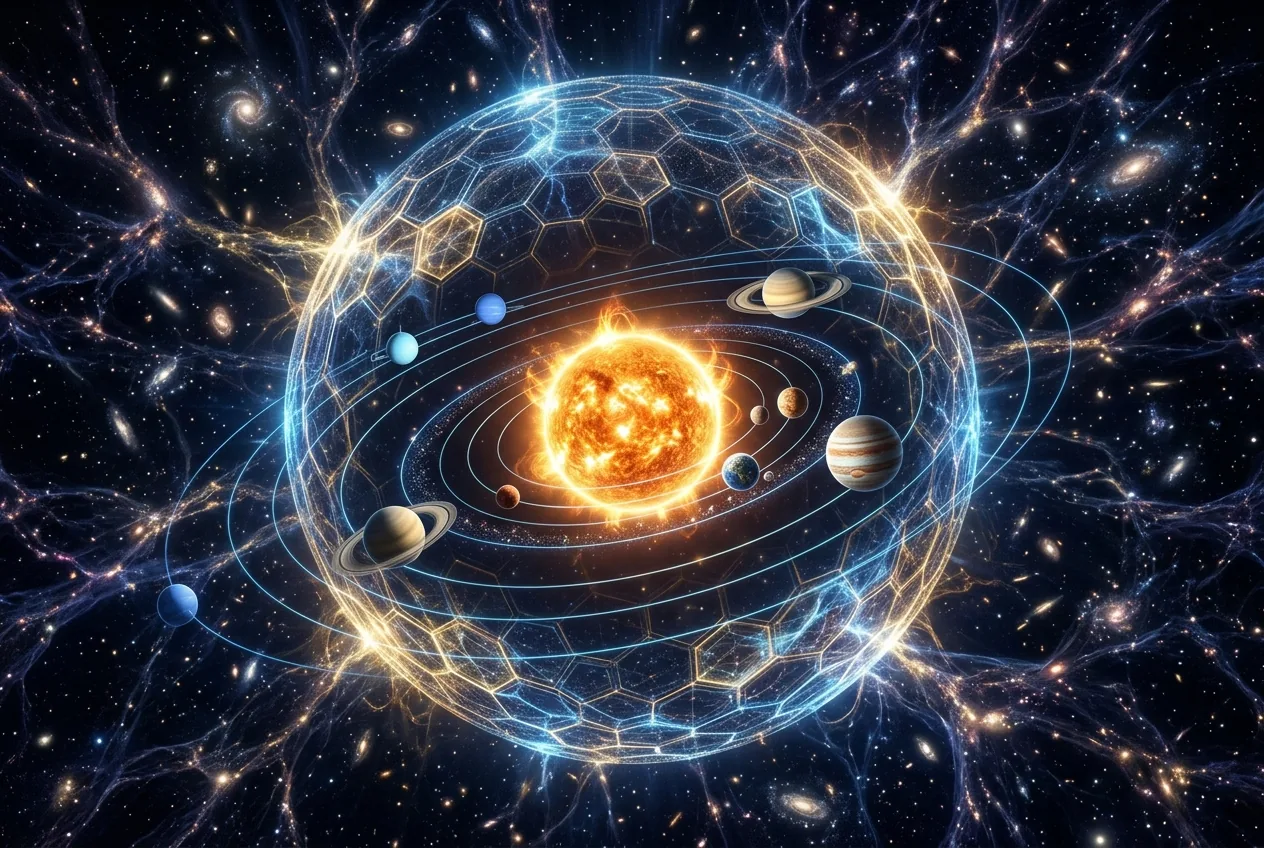
Every time we test Albert Einstein’s theory of general relativity in our own backyard, he passes with flying colours. From the way Mercury wobbles to the timing of radio signals bouncing off Mars, the math is essentially bulletproof. But out in the deep dark, the universe is playing a double game. Galaxies are flying away from each other faster than gravity should allow, pushed by a repulsive pressure we call dark energy. This massive mismatch between our local neighborhood and the rest of the cosmos has led physicists to a radical conclusion: there is a fifth force of nature hiding in plain sight, and our Sun is currently acting as its lead shield.
Slava Turyshev, a physicist at NASA’s Jet Propulsion Laboratory, has spent years digging into this cosmic contradiction. The problem is that while dark energy dominates about 70 percent of the universe, it appears to do absolutely nothing inside our solar system. It is as if the laws of physics change the moment you step into the suburbs of a star. Turyshev’s latest analysis suggests that this isn't because the fifth force doesn't exist here, but because the presence of matter—the Sun, the planets, even us—effectively shuts it down. This phenomenon, known as screening, creates a bubble of "normal" physics that masks the stranger reality beyond.
To understand why this matters, you have to look at the four forces we already know: gravity, electromagnetism, and the strong and weak nuclear forces. They are the rules of the game. If a fifth force exists, it could explain why the universe is expanding at an accelerating rate, a mystery that has baffled scientists since the late 1990s. If we could detect even a whisper of this force locally, it would be the biggest breakthrough in physics since the discovery of the Higgs boson. The catch is that the force seems to be a cosmic introvert, only showing itself when there is absolutely nothing else around.
The chameleon hiding in the sunlight
Imagine a sound that is deafening in an empty canyon but becomes a faint whisper in a crowded pub. The density of the atmosphere and the bodies around you simply absorb the energy. In the solar system, the Sun is the ultimate source of that density. Turyshev’s work indicates that the chameleon force might still be there, but it is squeezed into a thin outer shell near the edges of the Sun’s influence. This makes it incredibly difficult to spot with the kind of navigation sensors we currently use for deep-space probes.
This isn't just theoretical navel-gazing. If the chameleon effect is real, it means our current tests of gravity are only looking at the surface of a much deeper pool. Turyshev argues that while the force is suppressed, it isn't totally gone. It leaves behind a "weak remnant"—a tiny residue that could be detected if we knew exactly where to look. We aren't talking about a planet suddenly veering off course; we are talking about measuring a signal to a precision of one part in 100 quadrillion. It is the ultimate game of cosmic hide-and-seek.
A four-hundred-light-year dead zone
Calculations suggest the Sun’s Vainshtein radius extends out to roughly 400 light-years. To put that in perspective, the nearest star, Proxima Centauri, is only 4.2 light-years away. If this theory holds, we are living inside a massive dead zone where the most interesting physics in the universe is being silenced. Every probe we have ever launched, from Voyager to New Horizons, is still deep within this bubble. They are like fish trying to study the concept of fire while submerged at the bottom of the ocean.
The tension here is that we are trying to solve a universal mystery using local tools that are purposefully blinded to the answer. It creates a massive hurdle for experimentalists. If the Vainshtein radius is truly that large, we will never be able to send a probe far enough to see the force in its full, unscreened glory. Instead, we have to look for tiny cracks in the armor—minuscule departures from Einstein’s predictions that occur right here at home.
Why the Shapiro delay is our best shot
However, Turyshev suggests that a screened fifth force would cause a tiny, almost imperceptible deviation in that timing. He estimates that if we could measure a signal passing near the Sun to a precision of two to five parts per million, we might see the first signs of the screen failing. This is a level of accuracy that was impossible a decade ago, but we are starting to close the gap. It requires us to move beyond simple radio pings and toward ultra-precise laser links between spacecraft.
Atomic clocks and the search for residue
Beyond light timing, the next generation of physics experiments is moving into the realm of the incredibly small. Atom interferometers and optical lattice clocks are now so sensitive they can detect the difference in gravity between your head and your feet. These instruments could be the key to breaking the screening stalemate. If a fifth force exists, it might cause different types of matter to fall at slightly different rates—a violation of the Einstein Equivalence Principle.
Right now, we know that everything falls at the same speed in a vacuum, whether it’s a hammer or a feather. But a fifth force that couples to matter differently than gravity would break that rule. Turyshev forecasts that we could soon reach a sensitivity of one part in 100 quadrillion for these free-fall tests. At that level of precision, the "weak residue" of a screened force should theoretically become visible. It would manifest as a tiny oscillation or a mismatch in the frequency of linked optical clocks as they move through different parts of the Sun’s gravitational field.
This shifts the burden of proof onto the models themselves. We are no longer asking if the force exists, but rather how much residue it leaves behind. If we build these hyper-precise instruments and still find nothing, it will force physicists to abandon the idea of screening altogether. That would mean dark energy is even weirder than we thought, or that our understanding of gravity needs a much more violent rewrite than just adding a fifth force.
The cosmic surveys guiding the hunt
While we look for clues at home, massive international projects are surveying the rest of the universe to provide a roadmap. The European Space Agency’s Euclid telescope and the Dark Energy Spectroscopic Instrument (DESI) are currently building the largest 3D maps of the cosmos ever made. They are looking at the large-scale structure of the universe—the vast web of galaxies and gas that fills the void. This is where the fifth force should be acting most freely.
The real tension lies in the fact that we might be looking for something that is fundamentally designed to be invisible to us. The universe appears to have a built-in mechanism that protects us from the very forces that drive its evolution. Whether this is a fluke of physics or a fundamental law, the solar system is currently our only laboratory for testing the limits of Einstein's legacy. We are living in a quiet pocket of a very loud universe, and we are finally developing the ears to hear what’s happening outside.


Comments
No comments yet. Be the first!