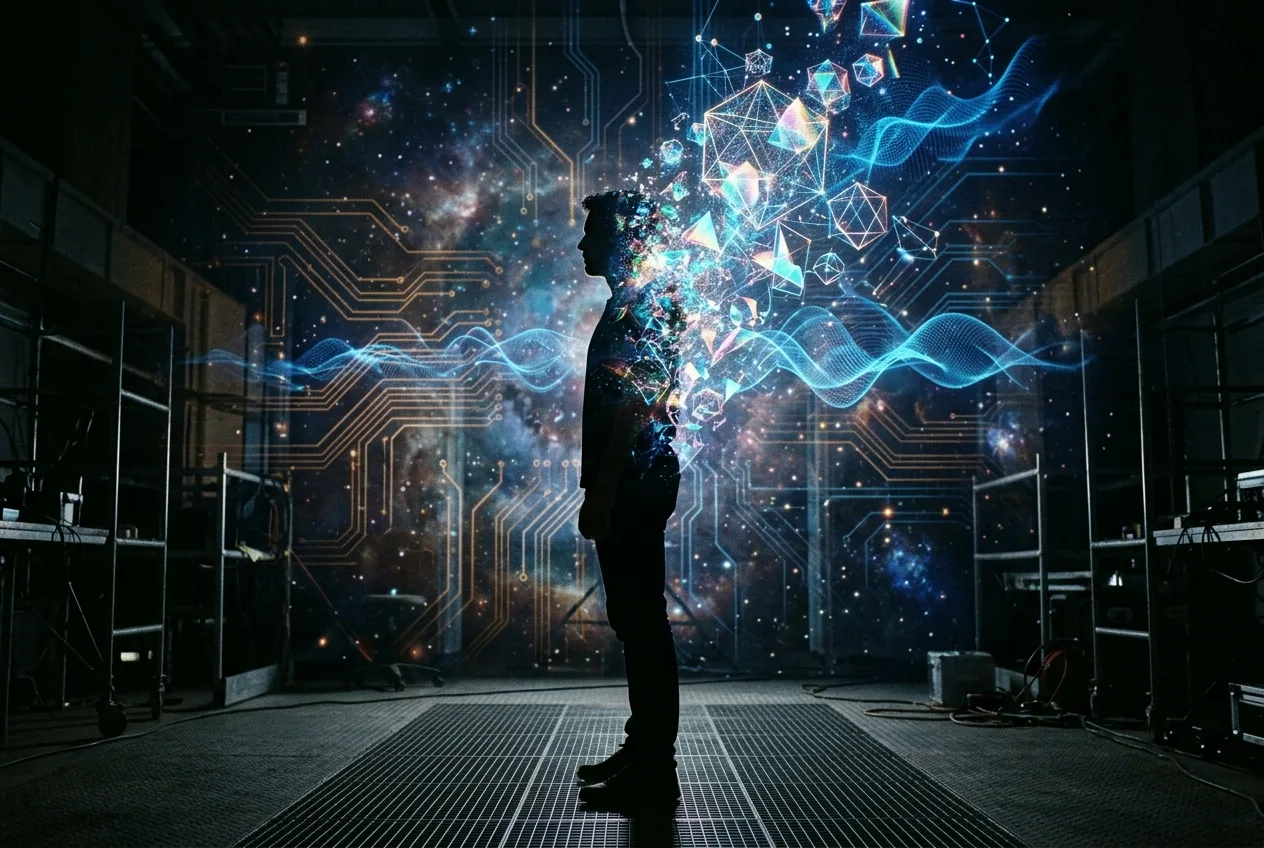
You are standing in the kitchen at 8:00 PM, staring into the fridge. For a split second, you are every version of yourself: the one who eats the leftover pasta, the one who orders a pizza, and the one who decides a bowl of cereal is a legitimate dinner. In the language of quantum physics, you are in a state of superposition. You are all those choices at once, a shimmering wave of potential. Then, your hand moves. You grab the pasta. The wave collapses. The decision is made. You are back to being a single, definite particle in a boring, linear world.
Vlatko Vedral, a professor of quantum information science at the University of Oxford, thinks this isn’t just a metaphor for a mid-week crisis. He argues that your brain is actually performing these quantum stunts every second of every day. In his view, the human mind operates like a massive, interconnected series of double-slit experiments. We aren't just processing data like a silicon computer; we are riding the line between being a wave and being a particle. The problem is that our biology is a bit of a letdown. We are designed to collapse those waves too quickly, trapping us in a narrow, three-dimensional slice of a much weirder reality.
Vedral’s theory suggests that we are currently hitting a biological ceiling. Our creativity, our flashes of genius, and our very sense of self might be the result of quantum processes happening in the wet, warm environment of our skulls. But because our brains are noisy and prone to interference, we only get glimpses of the 'true' universe. If we could find a way to stop the brain from constantly snapping back into a definite state, we might finally see the hidden layers of the world that have been sitting right in front of us since the Big Bang.
The biological glitch in your creativity
Most scientists treat the brain like a very sophisticated biological calculator. You take an input, you run an algorithm, and you produce an output. If that were true, artificial intelligence should be able to replicate the human experience perfectly. But as anyone who has spent ten minutes arguing with a chatbot knows, there is something missing. AI follows a rigid, logical path. It never has a 'eureka' moment that feels like it came from nowhere. It doesn't have a subconscious that wanders through impossible scenarios while it’s busy making coffee.
Vedral points to this 'flash of genius' as evidence of quantum interference. In a standard computer, a bit is either a 1 or a 0. In a quantum system, a qubit can be both until it's measured. Vedral believes our subconscious mind spends its time in that 'both' state, exploring a vast landscape of ideas simultaneously. When a new thought suddenly appears in your conscious mind, it’s because a quantum interference process has reached a definitive outcome. It’s the result of a thousand different paths being weighed and enfolded at once.
The tragedy of being human is that this period of 'quantum wandering' is incredibly brief. Our brains are essentially rigged to force us back into reality. We need to be certain to survive—you can't be in a superposition of 'running from a tiger' and 'petting the tiger' for very long. Vedral argues that our introspective nature—the constant checking-in of the conscious mind—acts like an observer in a physics experiment. By looking at our own thoughts, we force them to stop being waves and start being particles. We are the architects of our own mental limitations.
A hardware upgrade for the soul
If the brain is indeed a quantum machine, the next logical step isn't just understanding it—it's hacking it. Vedral envisions a future where we don't rely on drugs or meditation to expand our consciousness, but rather on quantum chips designed to interface directly with our neurons. This isn't about downloading Wikipedia into your visual cortex. It’s about building a 'shield' for the quantum states in your brain. These chips would essentially act as a noise-cancelling system for the soul, suppressing the biological interference that forces our thoughts to collapse into boring, linear logic.
This sounds like the plot of a late-night sci-fi flick, but the groundwork is already being laid in labs across the world. The challenge is finding where the quantum magic happens. For years, the scientific establishment laughed at the idea that the brain could be quantum. They argued that the brain is too 'warm and wet' for the delicate states of entanglement to survive. However, the British physicist Roger Penrose has long pointed to microtubules—tiny, structural tubes inside our cells—as the potential site for this quantum activity. If these structures are shielding quantum coherence, they are the hardware we need to tap into.
The myth of the empty vacuum
While Vedral focuses on the internal hardware, other researchers are finding evidence that the 'hidden layers' he talks about are very real and physically measurable. We tend to think of space as an empty stage where things happen. But recent experiments have shown that even 'empty' space is anything but. Physicists have recently succeeded in creating particles out of what appears to be nothingness, proving that the vacuum is actually a roiling sea of hidden activity.
This vacuum isn't just empty air; it’s filled with 'quark pairs' and fluctuating energy fields that shape how matter forms during high-energy collisions. This matches the broader 'hidden rules' theory proposed by another Oxford heavyweight, Tim Palmer. Palmer, a research professor in climate physics, argues that the universe isn't nearly as random as it looks. He suggests that what we perceive as 'luck' or 'randomness' is actually governed by a hidden geometry—specifically, a fractal structure he calls the 'invariant set.'
Is bad luck just bad geometry?
Palmer’s work takes this into a territory that feels uncomfortably like fate. If the universe follows these invariant set rules, then every event—from a car crash to a chance meeting—might be part of a rigid geometric path that is simply too complex for our current brains to map. He argues that our standard model of physics is missing this 'hidden variable' that explains why things happen the way they do. It’s not that the universe is chaotic; it’s that it’s more structured than we can imagine.
This creates a fascinating tension with Vedral’s idea of expanding consciousness. If we used quantum chips to see these hidden layers, would we find that we have more free will, or less? If we could see the fractal geometry of the universe, would we realize that our 'choices' were always just the inevitable collapse of a wave function dictated by the vacuum? Vedral remains the optimist. He suggests that by extending our 'wavelike' processing, we actually increase our creative power. We stop being slaves to the first definitive thought that pops into our heads and start operating on the same level as the universe itself.
The pushback to this is, predictably, intense. Most neuroscientists still believe that consciousness can be explained through classical chemistry and electricity. They see the 'quantum brain' theory as a solution in search of a problem. They argue that invoking quantum mechanics to explain the mind is just 'replacing one mystery with another.' But as we get better at building quantum computers, the gap between 'biological' and 'quantum' processing is narrowing. We have already built sound lasers and created matter from the vacuum. The idea of a quantum brain is no longer the fringe theory it was in the nineties.
The cost of seeing too much
If you remove that limitation, the concept of 'you' starts to dissolve. This was the warning Aldous Huxley gave when he experimented with mescaline; he saw the 'mind at large,' but he also realized that the human brain acts as a reducing valve, protecting us from being crushed by the sheer volume of information in the universe. Vedral’s quantum chip would essentially be a way to turn that valve wide open. It would be the ultimate high, but it might also be the end of the human experience as we know it.
For now, we remain trapped in our biological shells, wondering why we chose the pasta instead of the pizza. But the work coming out of Oxford suggests that the fridge, the kitchen, and the person standing in it are all much more mysterious than they appear. We are quantum systems living in a classical world, waiting for the technology that finally lets us see the rest of the map. Whether that happens through a chip in the brain or a new understanding of the vacuum, the message is clear: what you see is definitely not what you get.



Comments
No comments yet. Be the first!