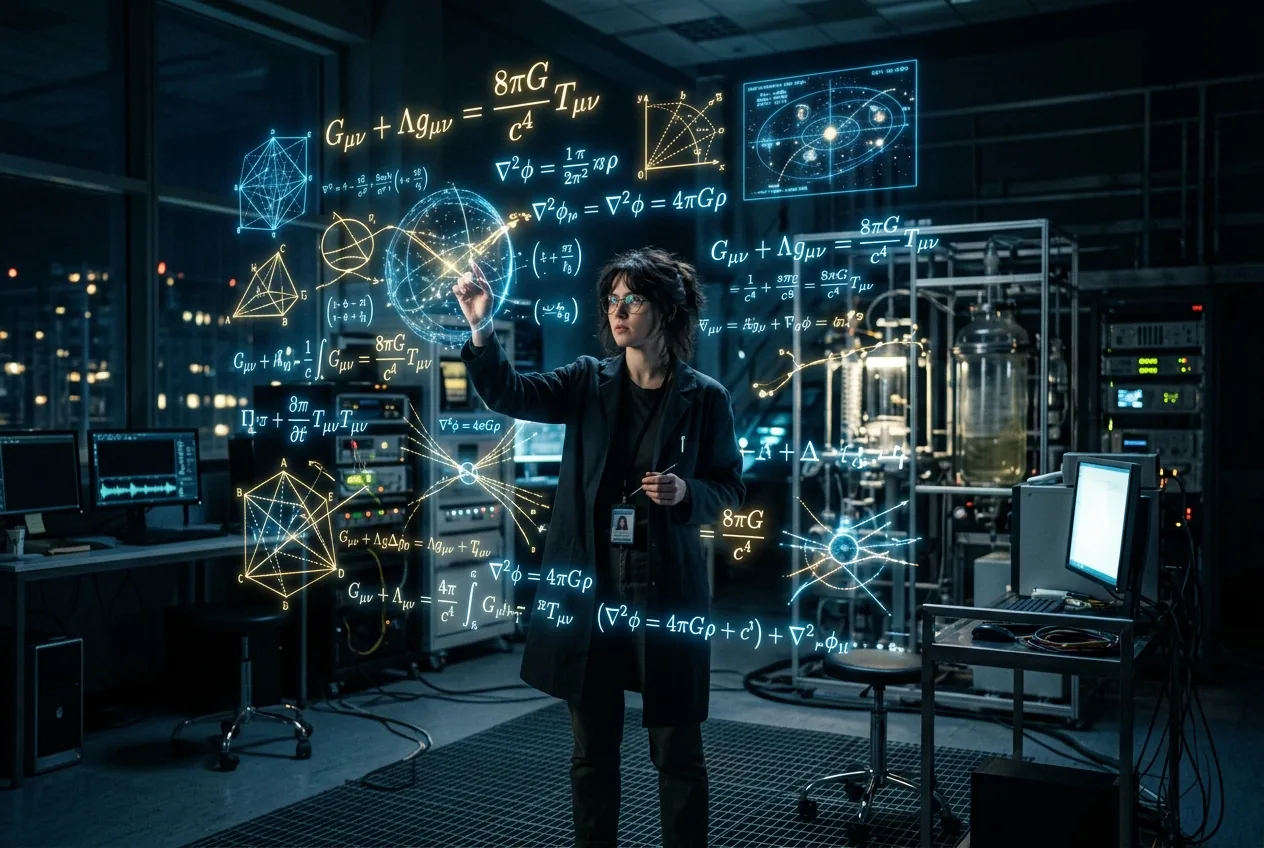
Pasterski is a high-energy theorist at the Perimeter Institute for Theoretical Physics, and she is one of a handful of people on the planet capable of navigating the mathematical minefield known as quantum gravity. Her goal is what she calls the “source code of the universe.” It is the ultimate search for a master file: a single, consistent set of rules that explains why the stars stay in their galaxies while subatomic particles behave like caffeinated ghosts. Currently, our best descriptions of reality are written in two different, incompatible languages, and physicists are starting to suspect that the only way to reconcile them is to admit that the three-dimensional world we inhabit is actually a sophisticated projection.
This is not a conspiracy theory about living in a computer simulation, though the terminology often overlaps. Instead, it is a rigorous mathematical attempt to solve a paradox that has embarrassed the brightest minds in science for a century. General relativity, Einstein’s masterpiece, explains gravity and the big stuff—planets, black holes, and the expansion of the cosmos. Quantum mechanics explains the tiny stuff—electrons, photons, and the weirdness of the subatomic realm. The problem is that when you try to use both at the same time, the math breaks. It’s like trying to run a PlayStation 5 game on a 1980s calculator. The universe’s operating system is crashing at the edges, and theorists are looking for the patch.
The glitch in the gravity machine
Physics is currently riddled with contradictions that suggest our understanding of space and time is merely a rough approximation of something deeper. One of the most famous “bugs” in the system is the black hole information paradox. According to general relativity, anything that falls into a black hole is gone forever, crushed into a singularity. But according to quantum mechanics, information can never be truly destroyed. If you throw a book into a black hole, the information contained in the arrangement of its atoms should, in theory, be preserved. When a black hole eventually evaporates via Hawking radiation, that information seems to vanish. This is a catastrophic error in the logic of the universe.
Pasterski and her colleagues are working on a framework called celestial holography to fix this. The idea is based on the “holographic principle,” which suggests that all the information contained within a volume of space can be described by the data on the boundary of that space. Imagine a soup can. All the information about the soup—its temperature, the number of carrots, the salt content—could theoretically be written on the two-dimensional label wrapped around the outside. In this view, our 3D reality is just the “bulk,” while the real “code” is written on a 2D surface at the very edge of the universe.
Why the Holometer failed to find the pixels of space
If the universe is a projection, then space itself should have a resolution. Just as a digital photo becomes a grid of pixels if you zoom in far enough, many theorists believe that space-time is not smooth, but “chunky.” At the Planck scale—the smallest possible distance, roughly 10 to the power of minus 35 metres—the fabric of reality should become grainy. In 2015, researchers at Fermilab tried to find this graininess using a device called the Holometer. It was a pair of massive laser interferometers designed to detect “holographic noise,” a slight jitter in the universe that would prove we are living in a low-resolution projection.
The experiment failed. The lasers remained steady, and no holographic noise was detected at the sensitivity levels they were testing. For many, this was a blow to the idea that we live in a literal hologram. But for theorists like Pasterski, the result wasn't a dead end—it was a refinement. It suggested that the “source code” isn't as simple as a pixelated screen. The connection between the 2D boundary and the 3D bulk is more subtle. The lack of evidence for a jittery universe didn’t disprove the holographic principle; it just proved that the universe isn't “glitching” in the specific way Craig Hogan and his team at Fermilab expected.
This is the iterative nature of the hunt. You build a machine to find a specific error, you don’t find it, and you go back to the whiteboard to figure out why the code is better hidden than you thought. The tension remains because the math still demands a unification. We know dark matter exists, for example, because we can see its gravity pulling on galaxies, but we have never seen the “code” for the particle itself. We are looking at the effects of a software program while being unable to see the lines of text that make it run.
Stripping the universe to its foundations
When Pasterski describes her work, she often refers to it as an “existential puzzle.” There is a certain irony in the fact that to understand the vastness of the cosmos, you have to spend your life staring at a piece of paper covered in Greek symbols and line integrals. But this is the only way to probe environments that no human or probe will ever visit. We cannot go to the edge of the universe, and we cannot survive the trip inside a black hole, but we can build mathematical models that represent those extremes with terrifying accuracy.
This approach requires a level of focus that borders on the meditative. Pasterski talks about getting into a mindset where the equations of a simplified, four-dimensional universe—three of space, one of time—flow for hours until time itself seems to disappear. It is a process of stripping away the “user interface” of reality—the trees, the people, the light—to find the raw variables underneath. If we can find the source code, we don't just understand how the universe began; we might understand what it is actually made of at its most fundamental level.
There is also the question of what happens if we actually succeed. Throughout history, every time we have uncovered a new layer of the code, we have built a new world. Understanding the laws of thermodynamics gave us the steam engine. Understanding the electron gave us the computer. If we understand the code of gravity and quantum mechanics, the engineering applications could be beyond anything we see in science fiction. We aren't just talking about better rockets; we are talking about the ability to manipulate the fabric of space-time itself.
The burden of the legacy
The search for a “Theory of Everything” has a habit of chewing up the lives of the world’s most brilliant people. Einstein spent the last three decades of his life trying to find a unified field theory and failed. Stephen Hawking, whom Pasterski once famously met and joined in a conga line at a Harvard event, spent his career chasing the same ghost. There is a weight to this legacy that can be crushing, but Pasterski seems to view it with the same pragmatic curiosity she applied to her Cessna. It is just another hard problem that needs solving.
The community is deeply collaborative, even if it is tiny. Because the math is so dense, progress happens in increments. One researcher finds a way to describe a specific type of particle interaction on a 2D plane; another figures out how to map that onto a 3D gravity field. Slowly, the image begins to resolve. They are like developers working on a massive, open-source project that has been running for billions of years, trying to reverse-engineer the original programmer's intent.




Comments
No comments yet. Be the first!