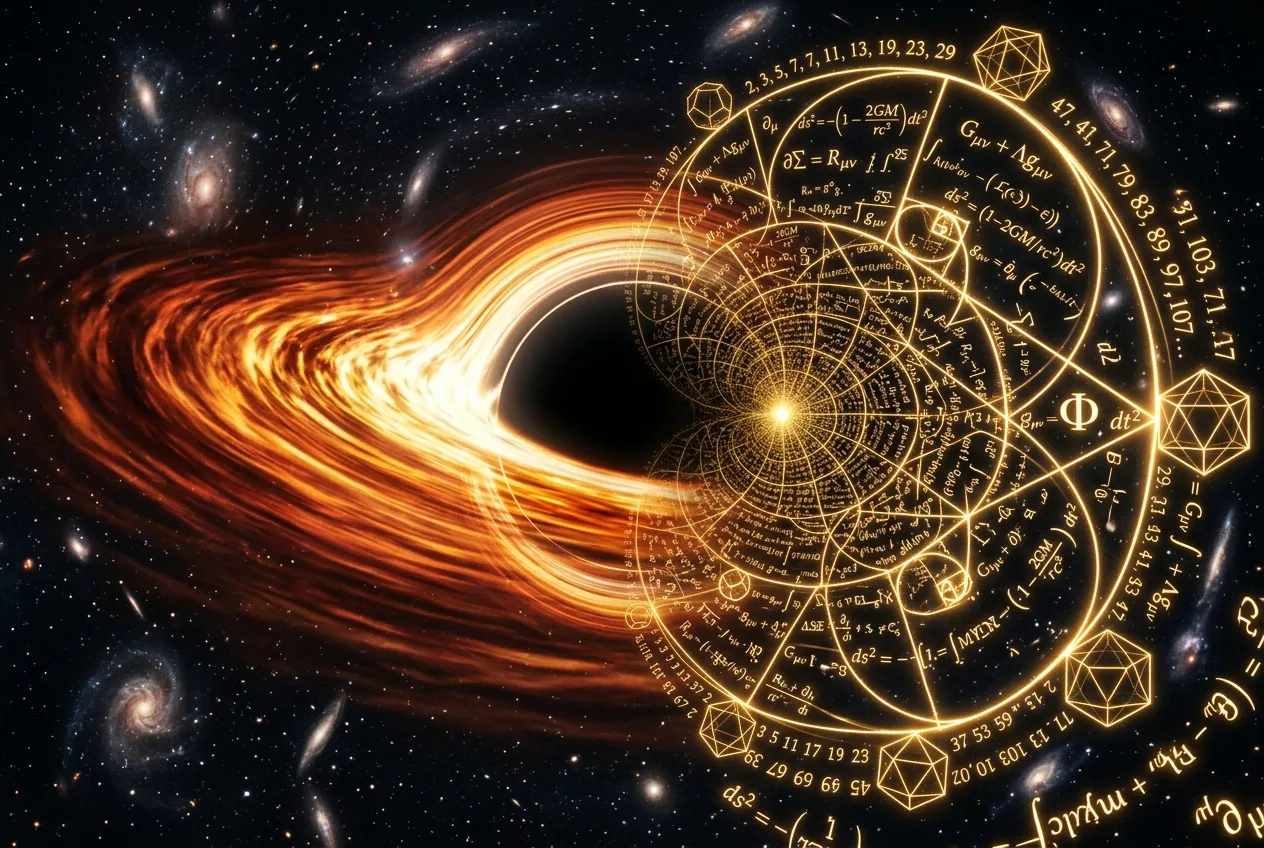
When spacetime reaches the end of its rope, it doesn’t just snap; it begins to play billiards. At the very center of a black hole, where general relativity famously fails and the equations begin to spit out infinities, there is a region known as a spacelike singularity. For decades, the standard model for this terminal chaos was the BKL scenario—named for Belinski, Khalatnikov, and Lifshitz—which describes the geometry of space as it oscillates violently, stretching and squeezing in a jagged, unpredictable rhythm. It was a mathematical mess that most physicists treated as a dead end, a signpost saying 'Quantum Gravity Needed Beyond This Point.'
But in early 2025, University of Cambridge physicist Sean Hartnoll and graduate student Ming Yang stopped looking at the mess as a failure and started looking at it as an alphabet. In a pair of papers that have rippled through the theoretical physics community, they demonstrated that the quantum bookkeeping required to describe these chaotic bounces near a singularity is identical to the mathematics used to hunt for prime numbers. Specifically, the 'vibrations' of a black hole’s interior seem to be tuned to the same frequencies as the zeros of the Riemann zeta function, the holy grail of number theory that has remained unproven for 166 years.
This is not to suggest that a black hole is a physical calculator spitting out integers. Rather, it suggests that the deepest mysteries of the universe—the distribution of primes and the collapse of gravity—share a common structural foundation. For a field like physics, which has spent the last century trying to reconcile the smooth curves of Einstein with the pixelated world of the quantum, finding the fingerprints of number theory inside a singularity is like finding a German engineering manual inside a nebula. It implies that the 'randomness' of primes and the 'chaos' of black holes are actually the same kind of order, just seen through different lenses.
The transition from abstract math to gravitational reality happens through what physicists call 'automorphic L-functions.' These are high-level mathematical tools used to study symmetries in number theory. When the Cambridge team quantized the BKL 'billiard' motion—the chaotic bouncing of spacetime geometry—they found that the resulting wavefunctions were built from these L-functions. In a specific mathematical direction, these functions can be rewritten to look exactly like the partition function of that long-theorized primon gas. The singularity, it turns out, is a natural laboratory for the most abstract concepts in the history of mathematics.
The implications for the Riemann hypothesis are particularly sharp. The hypothesis, which carries a $1 million prize from the Clay Mathematics Institute, posits that the non-obvious zeros of the zeta function all lie on a single 'critical line.' It is the most famous unsolved problem in mathematics, and it governs how primes are scattered across the number line. If the physics of black holes is truly linked to these zeros, it suggests that the Riemann hypothesis isn't just a quirk of human counting, but a fundamental law of how the universe organizes information. If a black hole can exist, then the Riemann hypothesis almost certainly must be true, because the physics of the singularity would otherwise collapse into a different, perhaps impossible, kind of chaos.
From a European industrial and strategic perspective, this isn't just a playground for ivory-tower theorists. Number theory is the backbone of modern cryptography. Every secure transaction in the EU’s digital single market, every encrypted diplomatic cable, and every secure blockchain protocol relies on the assumption that prime numbers are distributed in a way that is hard to predict but easy to verify. If the distribution of primes is encoded into the very fabric of spacetime and gravity, then 'randomness' becomes a physical property that can, in theory, be understood or even manipulated through quantum gravity research. The race for quantum sovereignty isn't just about building faster chips; it’s about understanding the mathematical substrate they run on.
There is also a historical resonance here that feels uniquely European. Bernhard Riemann, the man who started all of this, was a product of the University of Göttingen, the epicenter of German mathematical prowess in the 19th century. His work laid the foundations for Einstein’s general relativity. To see his number theory now returning to solve the problems of Einstein’s black holes is a testament to a specific kind of intellectual continuity. The European Research Council (ERC) and various Horizon Europe initiatives have long funded the kind of high-risk, high-reward theoretical physics that produces these results—work that has no immediate commercial application but redefines the boundaries of human knowledge.
However, a healthy dose of skepticism remains the best tool in a physicist's kit. As Hartnoll himself has noted, we do not yet know if this is a 'deeper meaning' or simply a case of math looking like math. The history of physics is littered with beautiful coincidences that turned out to be nothing more than two different problems sharing a similar set of differential equations. The BKL model itself is an approximation—a classical description of something we suspect is ultimately quantum. Until we have a full theory of quantum gravity, we are essentially looking at the shadows of primes on the wall of a cave we cannot yet enter.
Moreover, the jump from five-dimensional theoretical models to the actual black hole at the center of our galaxy, Sagittarius A*, is vast. We can observe the effects of gravity on stars, and we can image the event horizon with the Event Horizon Telescope, but the singularity remains hidden behind the ultimate 'no-go' zone. We are testing these theories on whiteboards and in supercomputer simulations, not in the vacuum of space. The gap between a mathematical mapping and a physical reality is where most 'breakthroughs' go to die.
For now, the discovery serves as a reminder that the universe is far more integrated than our university departments would suggest. The wall between the department of mathematics and the department of physics is a human invention; the universe doesn't seem to care for it. Whether these prime numbers are 'hiding' inside black holes or are simply the only language flexible enough to describe the end of time, the result is the same: the heart of chaos is surprisingly orderly.
Europe has the mathematical heritage to lead this investigation, and the Cambridge papers suggest that the next era of physics might look less like looking through a telescope and more like reading a ledger. If the Riemann hypothesis is eventually proven, it might not be a mathematician who does it, but an astrophysicist looking into the dark. It is progress, the kind that doesn't fit on a slick presentation at a tech conference, but keeps the lights on in the labs of Göttingen and Cologne. The vacuum of space has a bookkeeping system, and we are just starting to audit the accounts.



Comments
No comments yet. Be the first!