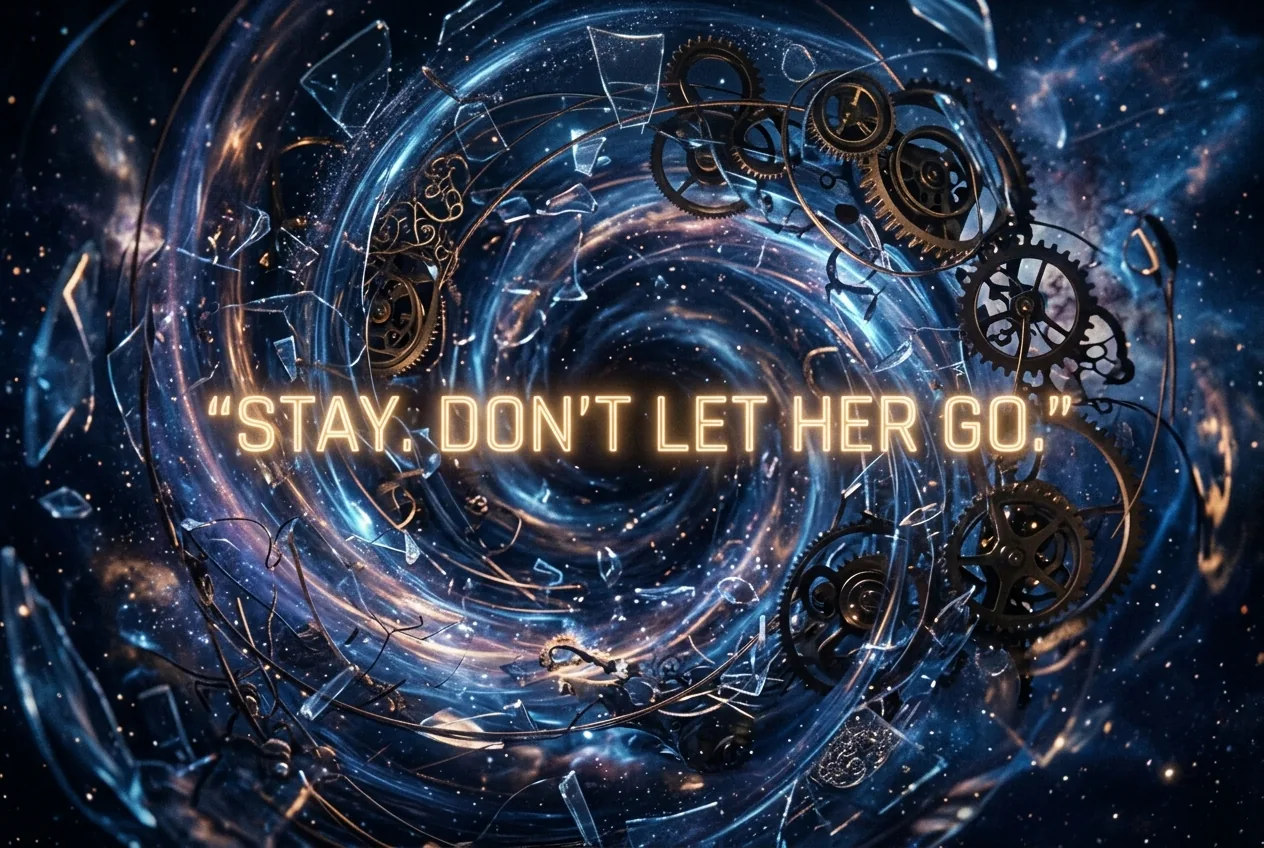
At exactly 2:00 PM, a computer terminal in a high-tech laboratory receives a single bit of data—a simple '1'. The problem is, the researcher operating the machine doesn't actually input that data and hit 'send' until 2:05 PM. For five minutes, a piece of information existed in the present that hadn't been created yet. It sounds like a script meeting for a Christopher Nolan sequel, but the mathematics of general relativity suggest this isn't just a Hollywood trope; it’s a legitimate, albeit mind-bending, possibility of our physical universe.
The core of this breakthrough lies in something physicists call a Closed Time-like Curve (CTC). To understand a CTC, you have to stop thinking of space and time as separate entities and start seeing them as the single, flexible fabric known as spacetime. Usually, this fabric is relatively flat, like a well-made bedsheet. But Einstein taught us that mass and energy can warp that sheet. If you get enough mass in one place—say, a rotating black hole—you don't just dent the sheet; you can actually twist it into a loop. If a path through spacetime loops back on itself, an object following that path could, in theory, return to a moment before it started its journey.
The geometry of the temporal U-turn
While the idea of a physical DeLorean screaming through a wormhole catches the imagination, the reality of time travel is likely to be much more subtle and digital. Physicists are now looking at how information, rather than matter, might traverse these loops. The new research suggests that we don't necessarily need a black hole in our backyard to test the limits of this theory. Instead, the focus has shifted to the 'geometry' of communication protocols that mimic the behavior of CTCs.
This isn't just about sending the winning lottery numbers to your younger self, though that is the inevitable first thought. The implications for modern computing are staggering. If we can reliably 'borrow' computational power from the future, or verify a calculation before it has even finished running, we are looking at an exponential leap in processing speed that makes the current AI boom look like an abacus. It creates a 'perfect' communication loop where the answer to a problem can coexist with the question.
Lessons from the Gargantua black hole
The visual of the 'Tesseract' from Interstellar—where the protagonist interacts with the past through a physical manifestation of time—was more than just a clever piece of CGI. It was based on the rigorous mathematical modelling of Kip Thorne, a Nobel laureate who ensured the film’s physics stayed within the realm of the plausible. This new research takes Thorne's work a step further by stripping away the cinema and looking at the raw data transfer. It posits that if gravity can bend light, it can certainly bend the timeline of a photon.
There is a catch, however, and it’s one that keeps philosophers and physicists up at night: the Grandfather Paradox. If you send a message to the past telling your younger self not to send the message, the universe should, in theory, break. Most researchers are leaning toward the 'Novikov self-consistency principle' to solve this. This principle suggests that you can only send messages that are already part of the past's history. You aren't changing the past; you are completing it. If you received a message from the future today, you were always going to receive it, and you were always going to be the one to send it five minutes from now.
This 'closed loop' logic suggests a universe that is much more deterministic than our 'free will' obsessed brains like to admit. It also raises a weird possibility regarding the search for extraterrestrial intelligence. If a civilization were advanced enough to master CTC-based communication, they wouldn't be broadcasting radio waves into the void of space hoping for a reply in 40,000 years. They would be messaging themselves across their own timeline, creating a perfectly efficient, internalised information network that would be completely invisible to us.
The quantum battery and time reversal
While sending 'Hello' to 1994 remains a distant goal, we are already seeing the practical application of 'time-reversal' in quantum technology. Recent experiments with quantum batteries have shown that these devices can be charged more efficiently by effectively reversing the flow of time at a subatomic level. In the quantum realm, the arrow of time is surprisingly blurry. By placing a quantum system into a state of superposition—where it is both 'moving forward' and 'moving backward' simultaneously—researchers can bypass the energy loss that usually plagues traditional batteries.
This isn't just a laboratory quirk. It’s a fundamental shift in how we understand the 'ingredients' of reality. For decades, the standard view has been reductionist: start with particles, build atoms, build molecules, and eventually you get people and time. But if we can manipulate the direction of time to charge a battery or send a signal, it suggests that time and consciousness might be more fundamental to the universe than the particles themselves. We might be living inside a reality where the sequence of events is just a UI, and we’ve finally found the developer console.
The skepticism remains high, and rightly so. Many physicists argue that while the math for CTCs works on paper, the 'energy conditions' required to create them in the real world are impossible to achieve without 'exotic matter'—stuff with negative mass that we haven't actually found yet. There is also the 'Hawking factor'; the late Stephen Hawking famously proposed the Chronology Protection Conjecture, suggesting that the laws of physics will always conspire to prevent time travel because, well, we haven't been overrun by tourists from the future.
Why the universe might not let us cheat
There is a final, darker tension in this research. If we do figure out how to send signals back, even over short durations like milliseconds, it would instantly render all current forms of cybersecurity obsolete. Modern encryption relies on the fact that you can't know a key before it is generated. If a hacker can receive the key from the future, the 'unbreakable' wall of quantum encryption crumbles. We are effectively talking about a 'temporal arms race' where the winner is whoever can see a fraction of a second further into the future than their opponent.
We are also forced to reckon with the biological signals our own bodies use. New research into organ communication suggests that our cells use 'secret signals' to repair tissue and slow aging, functioning in a way that looks suspiciously like an internalised feedback loop. If our biology has already figured out how to 'anticipate' damage before it occurs, it wouldn't be the first time nature beat us to a physics breakthrough. Our organs might be 'talking' across a tiny temporal gap to maintain the stability of the body, a biological version of the self-consistency principle.
For now, the ability to send a message into the past remains a fragile, theoretical victory. It exists in the complex equations of general relativity and the flickering states of quantum bits. But the fact that the laws of physics even allow for the question to be asked is a profound shift. We used to think we were the masters of space, exploring our three-dimensional cage. Now, it seems the fourth dimension isn't a cage at all—it’s just a very long, very complicated piece of string, and we are finally learning how to tie a knot.
Next time you're in the pub and someone complains about being late, you can tell them with scientific certainty that 'late' is a matter of perspective. If they had a black hole and a very specific set of quantum entanglement protocols, they could have arrived ten minutes before they even left the house. Just don't expect them to buy the next round with money they haven't earned yet.


Comments
No comments yet. Be the first!