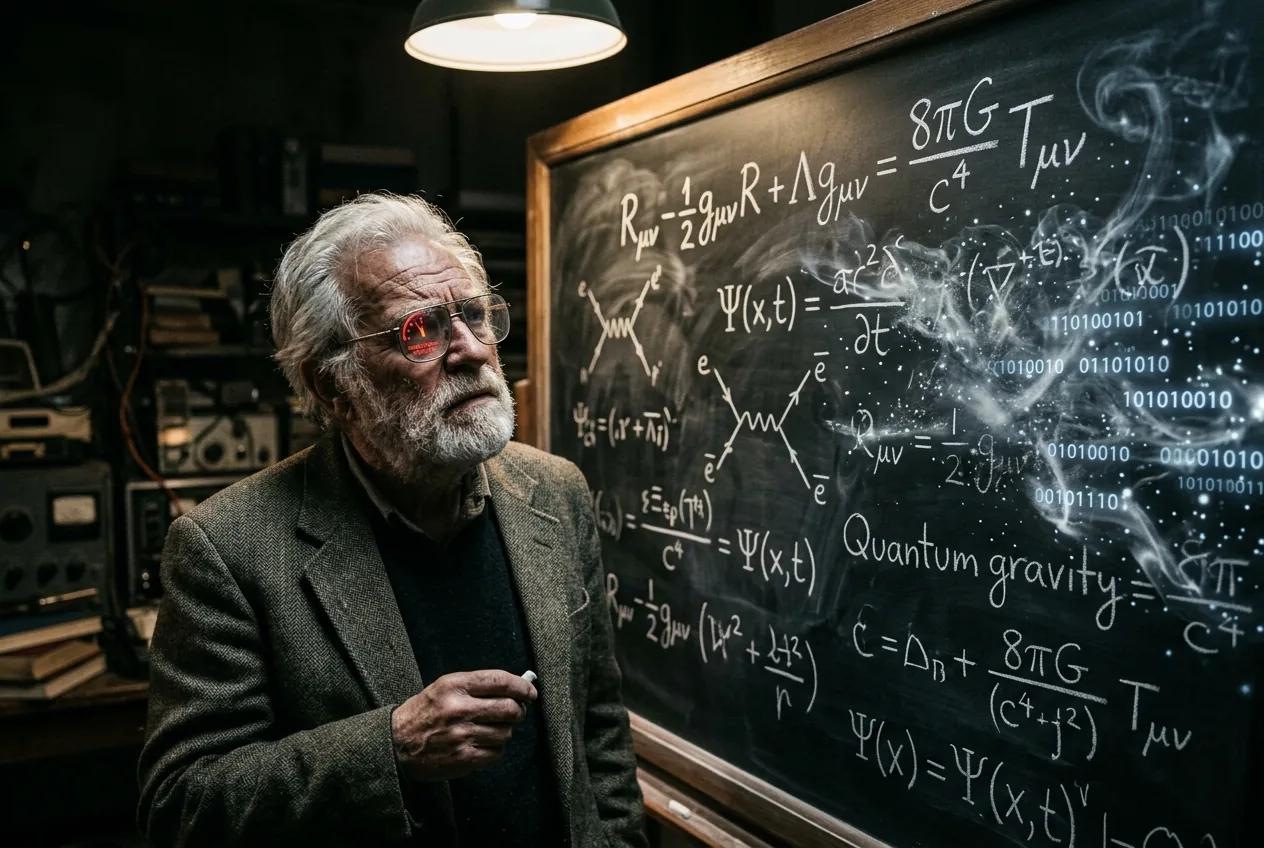
David Gross recently stood on a stage to accept a $3 million cheque for a lifetime of decoding the fundamental laws of reality, but he didn’t spend his time talking about the glory of the cosmos. Instead, the man who helped figure out how the inside of an atom works told his audience that we probably won’t be around long enough to see how the story ends. It is a staggering bit of pessimism from a man whose career has been defined by optimism—the belief that the human mind is capable of grasping the entire blueprint of existence.
Gross is a titan of theoretical physics, a Nobel laureate, and one of the architects of our modern understanding of the subatomic world. Yet, he is now spending a significant portion of his time warning anyone who will listen that the chances of humanity surviving another 50 years are vanishingly small. He isn’t talking about a distant sun exploding or a rogue black hole drifting into the solar system. He is talking about us. Specifically, he is talking about the very real possibility that we will blow ourselves up in a nuclear exchange within the next three decades.
The man who tamed the quark
To understand why Gross’s warning carries so much weight, you have to understand what he did to earn that $3 million Breakthrough Prize. In the early 1970s, physics was in a bit of a mess. Scientists knew about quarks—the tiny building blocks that make up protons and neutrons—but they couldn't understand why they stayed stuck together. No matter how hard you smashed atoms, you could never find a single quark on its own. It was as if they were joined by invisible, unbreakable bands.
Gross, along with Frank Wilczek and David Politzer, discovered a property called "asymptotic freedom." Think of it like a cosmic rubber band. When two quarks are very close together, the force between them almost vanishes. They move around as if they are free. But the moment you try to pull them apart, the force gets stronger and stronger. The harder you pull, the harder the universe pulls back. This discovery was the final piece of the puzzle for Quantum Chromodynamics, the theory that describes the strong nuclear force.
It was a moment of profound clarity. It showed that the universe follows rules that are often counter-intuitive but mathematically perfect. This success fueled the dream of unification: the idea that if we could explain the strong force, the weak force, and electromagnetism, we could eventually fold gravity into the mix. Gross has spent the latter half of his career chasing that white whale through the complex, multi-dimensional world of string theory.
The gravity of our situation
Why 35 years is the magic number for catastrophe
Gross’s prediction that civilization could end in 35 years isn't based on a new physics equation, but on his observation of human behavior and political volatility. He isn't the only one looking at the clock. The Bulletin of the Atomic Scientists currently has the Doomsday Clock at 90 seconds to midnight, the closest it has ever been. For a physicist, the world looks like a system that has lost its equilibrium.
The irony is that the same physics Gross helped pioneer—the understanding of the nucleus—is exactly what provides the tools for our destruction. We have mastered the forces of the atom, but we haven't mastered the impulses of the people who control them. Gross suggests that his time is now split between trying to solve the hardest problems in the universe and trying to convince people that they need to survive long enough to hear the solution.
There is a specific kind of frustration in his warning. It’s the voice of a man who has seen how beautiful the universe is underneath the hood, only to look up and see the passengers trying to crash the car. He argues that the major barrier to a theory of quantum gravity isn't a lack of smart people or a lack of math—it's the clock. We are quite literally running out of time to be smart.
The cost of an unfinished symphony
What happens if Gross is right? If humanity fails to clear the 50-year hurdle, we leave behind a half-finished map of reality. We have identified the particles, we have charted the forces, and we have even glimpsed the first moments after the Big Bang. But the final unification—the single equation that could explain everything from the birth of a galaxy to the blink of an eye—would remain a ghost.
Some critics argue that Gross is being overly dramatic. They point out that humanity has survived the Cold War, the Cuban Missile Crisis, and countless other "end times" scenarios. They suggest that science will find a way to continue even in a fractured world. But Gross’s point is that the *kind* of science we are doing now—the multi-billion dollar, multi-national efforts like CERN or the James Webb Space Telescope—cannot survive in a world defined by nuclear tension and isolationism.
A call to arms for the intellect
Gross’s pivot from pure physics to existential warning is a reminder that scientists do not live in a vacuum. The $3 million prize he received is a testament to what we can achieve when we are at our best—curious, collaborative, and focused on the infinite. But his speech was a reminder of what happens when we are at our worst.
The challenge he lays out isn't just for his fellow physicists to work faster. It is a challenge for the rest of us to ensure that there is still a world for those physicists to work in. We are the first generation of humans who have the potential to understand the entire history of the cosmos, from T-zero to the present day. It would be a cosmic joke if we were also the generation that decided the experiment wasn't worth finishing.
Gross hasn't given up on the math. He is still working on the strings, still trying to see how space-time behaves at the shortest distances imaginable. But his eyes are now firmly on the horizon. He knows that the most important variable in the equation of our future isn't gravity or the strong force—it's us. If we want to know the secrets of the gods, we first have to survive the impulses of the primates.



Comments
No comments yet. Be the first!