The Day That Changed Everything
Forty years ago today, a grainy, otherworldly smear of light began crawling across computer screens in Moscow, Toulouse and Pasadena. It looked nothing like the elegant, ghostly comets sketched by astronomers for centuries. This was not a luminous head with a trailing veil of ice and dust. It was a smudge with a hard edge — the first proof that comets had solid hearts.
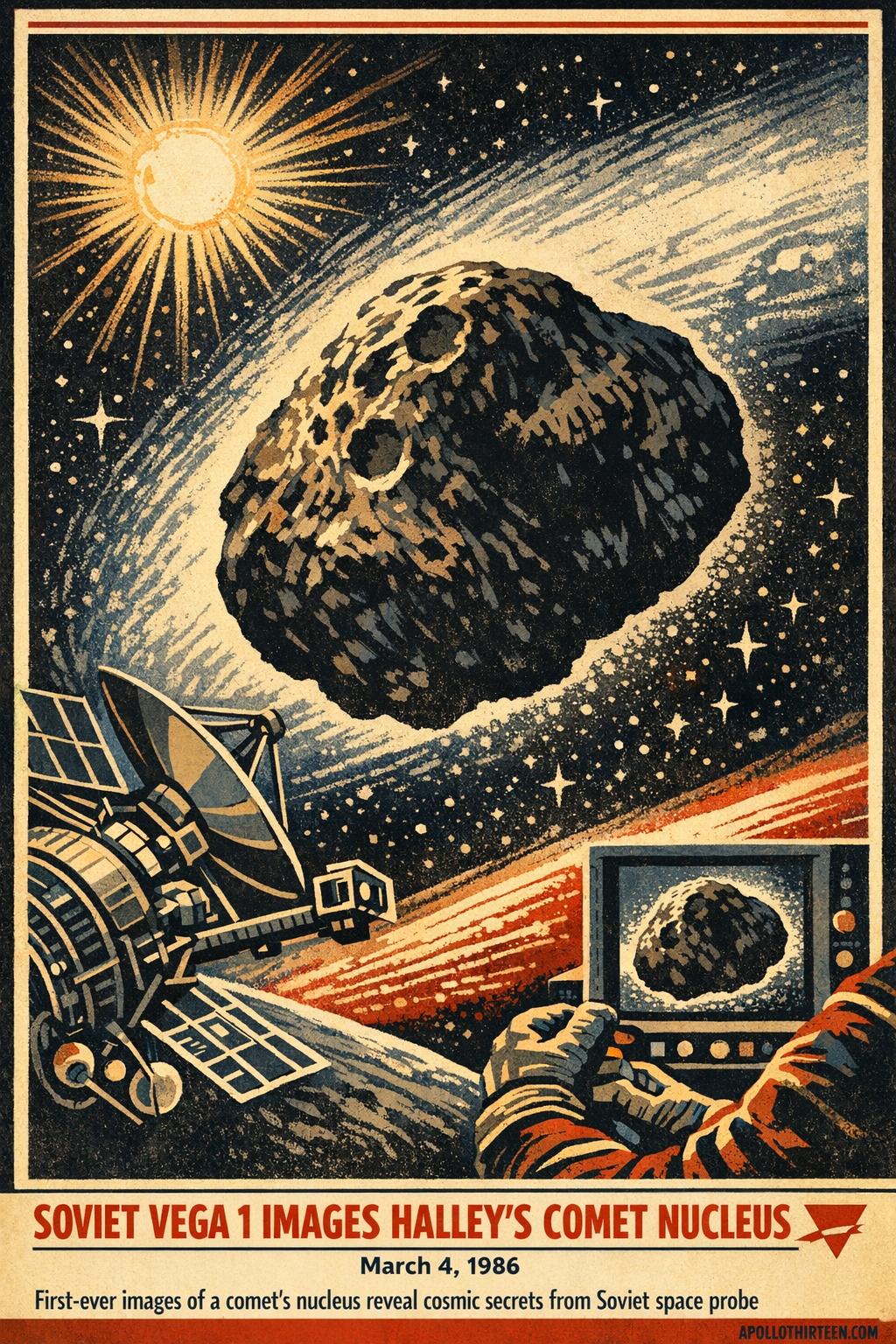
On March 4, 1986, the Soviet probe Vega 1 began transmitting the first-ever images of a comet’s nucleus back to Earth. For the first time in human history, people did not merely infer a comet’s core from telescopes and theory; they saw it with their own instruments: a dark, irregular, surprisingly warm rock—an alien landscape that would upend long-held ideas about what comets are and how they behave. It was a scientific bombshell wrapped in the politics of the Cold War, carried by a spacecraft designed in Khrushchev-era factories and built to tour two planets in one mission.
The images were crude, noisy and almost embarrassingly fuzzy by modern standards. But they contained a truth that reshaped planetary science: comets are not pristine, icy snowballs untouched since the dawn of the solar system. They are ragged, devolatilized bodies with a thin, dark crust of dust and organics covering buried ice. That realization began on March 4, 1986, as Vega 1’s data trickled across thousands of kilometers of radio and bureaucracy to scientists hungry for a look inside the comet that had been tracked by human eyes for more than two thousand years.
What Actually Happened
Vega 1 was born of Soviet ambition and a practical bit of rocketcraft. Launched from Baikonur on December 15, 1984, the spacecraft was a hybrid of the earlier Venera design for Venus missions and new gear tailored for cometary science. Its twin goals were audacious: drop scientific balloons into Venus’ hellish atmosphere and then, using a gravity assist, sweep outward to intercept Halley’s Comet in 1986. It carried cameras, spectrometers, plasma detectors, magnetometers, dust counters and a heavy-duty dual bumper shield to protect the probe from a barrage of cometary grains.
The Venus leg was a success the likes of which few expected. In June 1985 Vega 1 released a pair of spherical balloons, the first long-lived probes to ride the clouds of another planet. They floated for two days, relaying atmospheric data to the orbiting mother ship before burning away. The gravity nudge from Venus sent Vega 1 on a computed arc that would bring it within nine thousand kilometers of Halley.
On March 4, 1986, as the comet approached perihelion and the sun fried its freshly exposed dust, Vega 1’s cameras began to receive photons reflected from the nucleus itself. The first pictures were tentative — low-resolution strips and pixelated blobs — but they were unmistakable. What scientists had only speculated about for decades now had form: a dark, elongated object, roughly 15 kilometers across, lumpy and irregular.
Onboard instruments recorded an uncomfortable surprise. Infrared spectrometers read surface temperatures between 300 and 400 kelvin — far hotter than anyone had expected for a body mostly thought to be ice. That suggested a thin, insulating mantle of dark dust and carbonaceous material had formed on the surface, baking in the sunlight and masking the icy interior. The dust itself resembled the carbon-rich chondritic material found in certain meteorites; clathrate hydrates—ice structures trapping volatile molecules—were inferred in spectral signatures. Dust detectors recorded thousands of tiny impacts on the shield, but the spacecraft’s protection held up as designed.
Vega 1 did not fly by in the way Hollywood imagines: a leisurely glide by a pretty rock. Two days after those first images, on March 6 at 07:20:06 UTC, the probe screamed past Halley at 79.2 kilometers per second, coming as close as 8,890 kilometers from the nucleus. It transmitted continuously during the encounter, beaming back spectra, dust counts and higher-resolution images. Two sister probes—Vega 2, and international craft such as Japan’s Sakigake and Suisei and the European Giotto—would follow in the weeks after, but it was Vega 1 that offered the first real look at Halley up close.
The Vega images were not the end of the story; they were the incandescent beginning. They refined Halley’s position in space to within tens of kilometers, enabling Giotto’s dramatically closer pass, and they forced a rethink of comets as simple icy balls. Suddenly, cometary nuclei were demonstrably complex, layered objects that carried within them a record of the solar system’s chemical past.
The People Behind It
The Vega program was not a one-man triumph. Its success was the product of hundreds of engineers in Soviet design bureaus, planners in Moscow, and a surprising chorus of international collaborators. The spacecraft itself came from NPO Lavochkin, the storied design bureau that had built many of the Soviet Union’s planetary probes, and the scientific team was coordinated through the Space Research Institute (IKI) of the Soviet Academy of Sciences.
Roald Sagdeev, then director of IKI and a physicist with a reputation for bringing international science collaborations together, played a key role in shaping the scientific payload and in negotiating instrument contributions from other countries. His experience with plasma physics and planetary missions made him a natural steward for an effort that required both political finesse and scientific judgment.
On the French side, Jean-Pierre Bibring and his team shepherded the balloon experiments and contributed cameras and spectrometers. France’s involvement was not merely symbolic: French instruments were on board Vega 1 when those first nucleus images arrived. West German teams provided neutral gas mass spectrometers, and scientists from Hungary and other Eastern Bloc nations supplied dust detectors and other hardware. That international mix was deliberate. The Soviet Union wanted to demonstrate its technological prowess, but it also wanted the credibility and expertise that came from working with the best instrument builders in Europe.
In the control rooms and laboratories, the scene was a blend of exhaustion and exhilaration. Engineers who had spent years hunched over wiring diagrams and thermal models watched signals come alive; scientists who had argued over comet models for decades suddenly found their hypotheses confronted with a physical object. After the initial images appeared, room temperatures spiked and cigarettes—still tolerated in some corners—were stubbed out as teams leaned in, arguing about what they were seeing.
Individual names are sparse in the public record. Soviet mission management rarely mattered as much as the collective effort. But the human stories are plain in the margins: the French team in Toulouse impatiently awaiting each data packet; the Soviet technicians in Baikonur monitoring telemetry as if it were a living creature; the dust instrument scientists who counted impact signatures and felt relief when the shield held. There was pride, too—an unmistakable sense that these men and women had given the world something no single nation could have done alone.
Why the World Reacted the Way It Did
The mid-1980s were an odd moment for space. Cold War rivalry still set the terms of so much that happened off planet, but détente and scientific collaboration had found a foothold. The Vega mission arrived at the intersection of these tensions and hopes. Five spacecraft—the so-called Halley Armada—would converge on Halley’s Comet in March 1986: two Soviet Vigas, Europe’s Giotto, Japan’s pair of probes and NASA’s ICE, which sampled the comet’s tail from a distance. For a brief moment the space age’s bipolarity softened; instruments and data flowed across ideological lines, and scientists shared preliminary results at hastily convened conferences.
Public reaction was immediate and robust. In the Soviet press, Vega’s Venus success and its Halley images were hailed as proof of the nation’s scientific muscle. Broadcasts showed the fuzzy first photos with triumphant voiceovers. Western journalists, while suspicious of Soviet hyperbole, were genuinely impressed. For many in the West, especially in Europe, Vega embodied successful cooperation—French cameras on a Soviet probe, German mass spectrometers working alongside Soviet magnetometers. It was exactly the kind of project that made pragmatists in Paris and Moscow trade grudging handshakes for shared triumph.
There was also an element of cosmic showmanship. Halley’s return is a once-in-a-lifetime event for most people; its visits have been recorded in human histories and myths for millennia. The idea that machines could now visit and photograph its nucleus captured the public imagination. In the days after Vega 1’s first pictures, newspapers ran enlarged, contrast-enhanced versions that made the nucleus look almost sculpted. The reality—grainy and scientifically crucial—was less photogenic, but no less profound.
At the same time, the timing was politically loaded. The United States had been planning its own shuttle-based comet experiments as part of the ASTRO-1 payload, but the tragic loss of the Challenger in January 1986 and subsequent program suspensions curtailed U.S. plans. That left a vacuum that Soviet and European missions readily filled. For the Soviets, Vega offered a moment of prestige at a time when the international narrative was often shaped by U.S. technology. For Western scientists, the data were an all-too-rare chance to look without the filter of geopolitics—if they were willing to collaborate.
The practical payoff was immediate. Vega’s early comet images and trajectory refinement enabled Giotto’s navigators to plan a much closer, far riskier pass. Without Vega’s positional accuracy—improved to within tens of kilometers—Giotto might not have been able to thread the gap and survive its hair-raising encounter.
What We Know Now
In the decades since Vega 1’s historic images, comet science has advanced in ways both anticipated and wholly unexpected. Vega’s data proved the nucleus was dark, irregular and covered by a refractory dust mantle. That dust, composed of carbon-rich organics and silicates, absorbs sunlight efficiently and heats the surface to temperatures the pre-Vega models had not predicted. The 300–400 K temperature readings were not the last word—they were a beginning. They told scientists that cometary surfaces can be warm and devolatilized even while ices hide beneath, accessible only when fissures or impacts expose them.
Vega, Giotto and the later Rosetta mission have together painted a picture of comets as complex, evolved bodies. Halley’s nucleus—roughly 15 kilometers end-to-end, with a density under one gram per cubic centimeter—behaves like a primordial rubble pile: a loose aggregation of ice, dust and organic compounds. Its surface shows little exposed ice; instead, jets—narrow plumes of gas and dust—arise from active regions where subsurface volatiles find pathways to escape through the insulating crust. Those jets are powerful enough to nudge the comet’s trajectory in measurable ways, producing non-gravitational accelerations that must be included in orbital calculations.
Perhaps most consequentially, Vega’s observations helped shift the dominant comet model from the simplistic “dirty snowball” to a more nuanced view of layered, processed objects. Comets are not frozen relics unaltered since the solar system’s birth; they undergo surface processing that can create crusts, sintered layers and strata of differing compositions. That matters if we want to use comets as probes of primitive solar system chemistry. The interiors might be more pristine than the exteriors, but accessing and interpreting that interior record requires careful modeling of what the surface tells us.
Vega also taught engineers and mission planners invaluable lessons about risk. The dust shield took thousands of micrometeoroid hits during the approach, and the probe survived. That informed protective strategies for Giotto, which flew even closer, and influenced design considerations for later comet missions. The surprise that the surface was so hot reshaped instrument design for future probes; thermal considerations became paramount.
On a larger scale, Vega’s work fed into the narrative about how small bodies delivered volatiles and organics to the early Earth. Spectroscopy of dust and gas from Halley showed molecules and complex organics that are plausibly part of the prebiotic chemistry available to nascent planets. While Vega did not provide definitive proof that comets delivered Earth’s water, its data strengthened the hypothesis that comets carried substantial amounts of organic material across the early solar system.
Legacy — How It Shaped Science Today
The immediate legacy of Vega 1 is practical and institutional. It demonstrated that international missions could flourish even amid geopolitical tension. The cooperative spirit fostered by Vega smoothed the path for later multinational projects such as ESA’s Rosetta, which would in 2014 place a lander on a comet and return unprecedented datasets about composition and behavior. Vega showed what could be achieved with modest budgets, clever trajectories and multinational instrument suites.
Scientifically, Vega’s images rewired thinking about comets. By showing a hard, dark nucleus and by measuring a hotter-than-expected surface, Vega pushed models toward a layered interpretation of cometary bodies. Short-period comets like Halley have evolved under repeated solar heating, sculpting surfaces that hide their ancient interiors. That realization has consequences for how planetary scientists interpret spectroscopic observations, measure mass loss, and predict a comet’s future behavior. The observation that Halley has likely lost a tiny but measurable fraction of its mass each passage led to calculations showing the comet is aging; by 2061, its next return, cometary activity will likely be measurably different.
There is also a cultural legacy. Vega 1’s mission design—Venus drop, balloon relay, gravity assist outbound to a comet—was a masterclass in creativity. It brought together scientists across national lines in a pre-internet era, requiring diplomatic goodwill, technical compromise and mutual trust. It showed that the impulse to explore could bridge political divides in ways that benefited pure science.
And finally, Vega’s data continue to be relevant. As new missions visit comets and models grow more sophisticated, the observations from that March week in 1986 remain fundamental constraints. They are a touchstone for students trying to reconcile laboratory work on clathrates and organics with real-world behavior, and for mission planners balancing the hazards of dust impacts with the scientific rewards of closer scrutiny.
When Rosetta’s Philae lander bounced and came to an awkward rest on comet 67P/Churyumov–Gerasimenko in 2014, scientists and mission engineers alike nodded to a lineage that stretched back to Vega. The idea of an active, complex comet with a crust hiding volatiles beneath was by then widely accepted because of the data returned in those frantic days in March 1986.
Fast Facts
- Date of first nucleus images: March 4, 1986 (40 years ago today).
- Closest approach: March 6, 1986 at 07:20:06 UTC — 8,890 kilometers from Halley’s nucleus.
- Flyby speed: ~79.2 kilometers per second.
- Surface temperature measured by Vega 1: 300–400 K.
- Nucleus size estimate: roughly 15 kilometers across (elongated, irregular shape).
- Launch date: December 15, 1984 from Baikonur Cosmodrome.
- Notable contributors: NPO Lavochkin (spacecraft builder), Space Research Institute (IKI) under Roald Sagdeev (science coordination), French teams led by Jean‑Pierre Bibring (balloons, imaging), West German and Hungarian instrument teams.
- Other Halley Armada: Vega 2 (Soviet), Japan’s Sakigake and Suisei, ESA’s Giotto, NASA’s ICE.
- Legacy: Enabled Giotto’s close pass; shifted comet models from “dirty snowballs” to layered, devolatilized nuclei; influenced later missions such as ESA’s Rosetta.
Forty years on, the grainy smudge that first arrived downlink by downlink feels like an origin story. It offered not only new data but a new way of seeing: comets as evolving, dynamic worlds, not static catalog entries. The images from Vega 1 opened a window into the processes that shaped the early solar system and continue to shape small bodies today. They taught a generation of scientists and engineers how to approach a dangerous, beautiful target: to expect the unexpected, to protect against a sandstorm of cosmic dust, and to value international partnership in the face of planetary-scale questions.
Looking up at Halley today, as it winds its long orbit toward its next perihelion in 2061, we do so with different eyes because of that week in March 1986. The pictures were fuzzy; the conclusions were not. Vega 1 gave us a nucleus to study, argue over and learn from. It gave us a map into the comet’s behavior and into the very chemistry that might have seeded life on Earth. And it reminded the world that even in a time of division, curiosity could draw engineers and scientists together to touch, in the only way humanity could then, the dark heart of a visitor from the deep.



Comments
No comments yet. Be the first!