A rapid alarm in numbers and places
This week a cluster of studies and expert assessments landed with an unusually sharp tone: scientists issue warning global that the climate system is moving toward thresholds they can no longer confidently reverse. Researchers reporting in a One Earth paper and in a consortium Global Tipping Points Report describe a planet in which the last three years rank among the hottest on record, atmospheric CO2 sits far above preindustrial levels, and a run of extreme weather and ecosystem losses is already visible from the Amazon to the coral reefs. The finding that global temperature averages have briefly breached the 1.5 °C benchmark for an extended period — combined with evidence that natural carbon sinks are weakening — is the proximate cause of the concern.
The new analyses stitch together observational records, satellite monitoring and model studies to show how otherwise distant risks — Arctic permafrost thaw, Antarctic ice-sheet retreat, collapse of reef ecosystems, and large-scale forest dieback — could align in ways that amplify warming and damage. Scientists including William Ripple, Johan Rockström and Tim Lenton warn the world has moved away from the climatic stability that supported agriculture and modern societies for the last 11,000 years. Policymakers and citizens are being urged to read the data as a call to immediate, sustained action rather than another long-term planning exercise.
scientists issue warning global: tipping points and thresholds
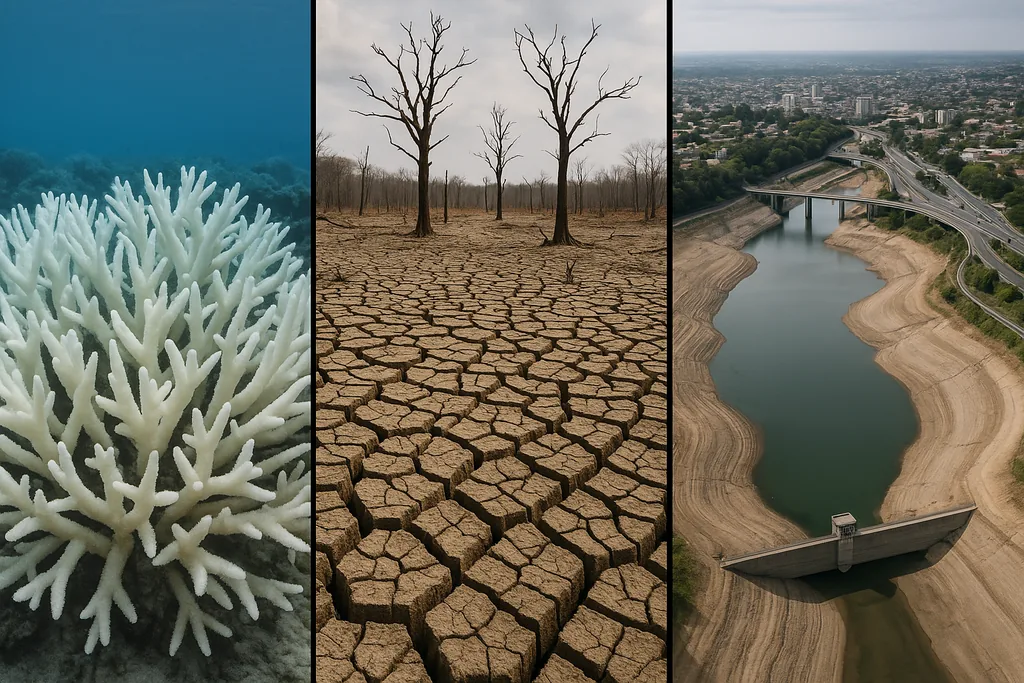
When climate scientists talk about a "point of no return" they mean a tipping point — a threshold in a planetary subsystem that, once crossed, pushes that system into a qualitatively different state that is difficult or impossible to reverse on human timescales. That definition applies to disparate systems. Warm-water corals respond to sustained ocean heating and acidification; once the coral communities collapse, the complex reef structure that supports fisheries and coastal protection is lost. The Global Tipping Points Report and a Science News synthesis argue that reef systems may already have crossed such a boundary.
The Amazon has long been singled out as another archetypal tipping element: a mix of deforestation and sustained drying could convert large tracts of rainforest into savannah-like scrub, a state that recycles far less water and stores far less carbon. Carlos Nobre and other Amazon specialists estimate that a combination of around 20–25% deforestation and a few degrees of warming would make the conversion essentially irreversible in many regions. Ice sheets in Greenland and West Antarctica, if pushed past melt thresholds, would commit the planet to centuries of higher seas even if emissions fall decades from now.
Crucially, these tipping points are not isolated. Scientists emphasize the risk of domino effects: losing one buffer (for example, Amazon transpiration) can stress another (regional rainfall and soils), and ice melt can perturb ocean circulation systems such as the Atlantic Meridional Overturning Circulation (AMOC). Because these processes interact, the probability that at least one major planetary threshold would be crossed grows rapidly if global warming persists above certain levels for extended periods.
scientists issue warning global: how close are we to irreversible change
Estimating "how close" is a technical exercise that blends short-term observations with long-run averages. The Paris Agreement’s 1.5 °C limit is conventionally assessed as a multi-decade average to smooth natural variability; still, several recent analyses show three-year stretches that exceed 1.5 °C and record-high global heat anomalies. That pattern — three consecutive years of record warmth — is a signal that the planet is entering a danger zone, even if formal statistical confirmation of a permanent overshoot requires longer time windows.
Several concrete trends increase the risk that transient overshoots become long-term commitments. Natural carbon sinks — forests, soils and the oceans — are showing signs of weakening in places, and there is growing evidence of accelerating releases of greenhouse gases such as methane from thawing permafrost and disturbed wetlands. Models run by teams at institutions such as the Potsdam Institute and others indicate that if temperatures do not return toward 1.5 °C quickly, the chance of crossing at least one major tipping point by century’s end rises substantially.
Put simply, some parts of the Earth system are already at the threshold; others may be a few tenths of a degree away. The difference between a short-lived overshoot and a sustained one matters: a brief spike that is rapidly reversed by strong emissions cuts and active carbon removal carries lower risks than a prolonged overshoot that allows feedbacks to strengthen and cascade. Yet current policy signals and emissions trajectories in many regions make a prolonged overshoot increasingly plausible without immediate changes.
Regional signals and human impacts
These planetary warnings are not abstract. They translate into heat-related deaths, livelihood losses, and disrupted food and water systems now. Urban water crises in places such as Tehran underscore how drought and weak infrastructure can force sudden social stress; officials warned of unprecedented shortages and possible evacuations when reservoirs dropped to critically low levels. In coastal and tropical economies, mass bleaching and collapse of coral reefs threaten fisheries and tourism that sustain hundreds of millions.
That reality is why scientists issue warning global: the consequences are socially immediate and globally interconnected, amplifying hunger, migration and political instability if unaddressed.
Paths to avoid or limit crossing tipping points
There is no silver-bullet response, but the scientific community points to a portfolio of urgent actions that reduce the probability of triggering irreversible change. First, deep and immediate cuts in CO2 and other greenhouse-gas emissions remain the primary lever: the faster atmospheric CO2 growth slows, the less chance that feedbacks gain self-sustaining momentum. Because some feedbacks respond to short-lived pollutants, rapid reductions in methane and aerosols can buy critical time by chopping near-term warming.
Second, restoring and protecting natural sinks — halting deforestation, reforesting degraded lands, and conserving peatlands and wetlands — both stores carbon and preserves ecosystem services. Third, developing and scaling robust negative-emissions technologies and practices (from verified nature-based solutions to direct air capture where feasible) is increasingly seen as necessary to limit the duration of any overshoot and to draw down accumulated CO2 over coming decades.
Finally, risk-management approaches must be scaled: better early-warning systems, strengthened land-use governance, and targeted investments to insulate communities from heat, drought and flood will reduce immediate harm. Many scientists caution against large-scale solar geoengineering except as a last-resort contingency, noting ethical, governance and risk trade-offs; they stress that geoengineering does not remove greenhouse gases and could leave weather systems fundamentally altered even if temperatures fall.
Policy, governance and the window for action
Scientific warnings are clear, but translating them into effective global policy remains the central hurdle. The Paris architecture was designed for gradual, linear change; tipping points demand governance that anticipates abrupt, interacting threats. A number of assessments and climate governance researchers argue that limiting both the magnitude and the duration of any overshoot should become a practical rule in international negotiations.
That will require national commitments to negative emissions, legally binding safeguards for critical ecosystems, and enforcement against activities — from illegal deforestation to organized criminal actions — that push vulnerable systems closer to collapse. It will also demand large public investments to scale clean energy, retrofit cities for heat resilience, and deploy scientifically credible carbon-removal at the pace the models show is necessary.
The window for effective action is narrow but not yet closed. Rapid deployment of available solutions, stronger short-term pollutant controls, and governance reforms that treat tipping risks as central rather than peripheral could still reduce the odds of the worst outcomes. That is the practical meaning of the phrase in the headlines: scientists issue warning global — and the world must act on that warning now.
Sources
- One Earth (research paper on planetary tipping elements)
- Global Tipping Points Report 2025 (consortium assessment)
- Potsdam Institute for Climate Impact Research (modeling of tipping risks)
- University of Exeter (tipping-points and tipping-risk research)
- NASA Goddard Space Flight Center (observational analysis of recent weather intensity)
- University of São Paulo (Amazon research and Carlos Nobre’s work)




Comments
No comments yet. Be the first!