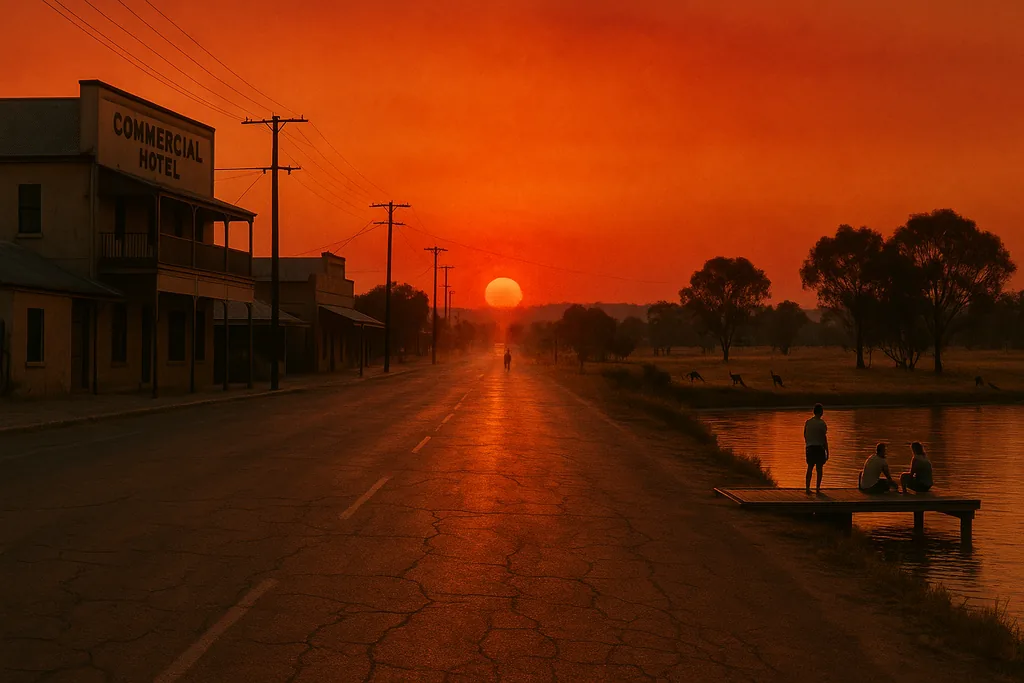
On an evening this week in Ouyen, a small Mallee town in north‑west Victoria, the lake offered a rare and fragile relief: people and dogs splashed in the shallows as the sky turned a deep, flaming red. But the air itself still pressed like a hand on the chest. Locals and visitors described the heat in visceral terms — smothering, bullying, stabbing — and said that even inside, with floors and furniture radiating warmth, thinking felt slower and the body more clumsy.
Heat that presses and slows
The raw meteorology is stark. Remote weather stations recorded temperatures approaching 49°C in parts of Victoria and neighbouring South Australia this week, with towns such as Hopetoun and Renmark among those that briefly neared the upper 40s. In cities, Melbourne and Adelaide saw suburbs climb well above 45°C and suffered unusually hot nights when temperatures failed to drop far below 30°C. Those numbers matter in two ways: they stress biological systems directly and they change the baseline for what counts as an ‘extreme’ day.
Heat at these levels does more than make you sweat. People reported persistent low‑level nausea, slowed cognition and the feeling that skin was raw even in shade. Physiologists describe a progression from dehydration and heat exhaustion to heatstroke; vulnerable populations — older people, infants, those with chronic diseases, and outdoor workers — are most at risk. Overnight heat is particularly lethal because it prevents the body from cooling and increases cumulative thermal stress over successive days.
Climate scientists have repeatedly demonstrated that extremes like these are now more likely because of human‑driven warming. Rapid attribution work on the recent Australian events found that this kind of heatwave was multiple times more probable in today’s climate than it would have been in a pre‑industrial world. That shift alters planning assumptions: what used to be a once‑in‑a‑generation event can become an every‑few‑years event, and in some scenarios far more frequent if emissions remain unchecked.
Wildlife, shorelines and strange blooms
Heat leaves fingerprints in ecosystems as well as on people. Along Melbourne’s Port Phillip Bay this week, thousands of red lion’s mane jellyfish washed into the shallows and onto beaches. Experts point to a mix of warmer nearshore water, nutrients and onshore winds that concentrate drifting jellies in shallow coves. Most of the specimens were modest in size, but their tentacles stretched up to a metre and their presence altered how beaches were used: lifesaving authorities warned swimmers to avoid visible swarms and to stick to patrolled areas.
These marine flushes are seasonal and sometimes dramatic; they do not constitute an ecological apocalypse in themselves. Still, they are an example of how a warming ocean and altered wind patterns can rearrange the timing and distribution of marine life — with consequences for tourism, public safety and the local economy. For people living inland, the sight of wildlife seeking water — mobs of kangaroos gathering at lakeshores, birds struggling in the heat — becomes a visible marker of the same climatic pressure hitting towns and coasts simultaneously.
Infrastructure, events and public health
Heat also complicates how we manage large public gatherings. Music festivals and sporting events already present health risks related to drug use, dehydration and crowding. A coroner’s recent finding into a death at a Melbourne event earlier showed how countermeasures intended to deter drug possession — sniffer dogs, intrusive bag searches and heavy security — can push people to take greater risks before they arrive, such as consuming larger doses to avoid discovery. Layer in a heatwave and the pressure on emergency responders intensifies: ambulant heat illness can look similar to drug‑induced emergencies, water access may be restricted by security protocols, and medical teams can be overwhelmed.
Harm‑reduction measures such as on‑site pill testing, clear water provision and shaded rest areas have been associated with reduced harms. In a climate where hot spells are increasingly likely, public‑event guidance and emergency planning need updating so that heat becomes an explicit factor in event design and safety protocols.
Policy, exports and the politics of preparation
Experts and commentators argue that adaptation and mitigation must be pursued in parallel. Adaptation means practical, near‑term measures: strengthening power grids, creating and funding cooling centres, retrofitting housing to reduce indoor heat, and updating public‑health guidance and event codes to reflect heat risk. Mitigation means halting the expansion of high‑carbon fuels and accelerating a managed transition for industries and communities dependent on them. Both require an honest national conversation and policy decisions anchored in the changing probabilities that climate science now provides.
What communities can do now
There are tangible steps communities and individuals can take immediately. Local authorities can map and publicise cooling centres and ensure they are accessible to the people most at risk. Event organisers should adopt harm‑reduction and heat‑resilience plans: reliable water access, shaded recovery zones, trained medical teams prepared for overlapping heat and substance‑related emergencies, and clear communication with attendees. Coastal and conservation managers can issue targeted safety messages when marine life concentrates near shore.
At the national and state level, the challenge is both bureaucratic and moral: update codes and emergency responses, fund infrastructure that keeps people cool and connected during extremes, and align export and energy policy with a realistic appraisal of long‑term global warming. Without that alignment, the lived experience of heat — the sense of being pressed and slowed, animals pushed into new behaviours, and systems fraying under strain — will only grow more common.
The week’s heat in Victoria was both immediate drama and an instructive preview. It was a vivid reminder that climate change is not a distant threat but a current condition, reshaping daily life, seasonal patterns and the choices that governments must make about energy and resilience.
Sources
- World Weather Attribution (rapid analysis of the January 2026 Australian heatwave)
- Coroners Court of Victoria (finding into death without inquest, 2026)
- Urgewald (report on planned expansion of coal and metallurgical coal projects)
- Life Saving Victoria (public safety guidance for jellyfish and coastal swimming)
- Museum Victoria (species information on Cyanea annaskala, lion’s mane jellyfish)
- Climate Action Tracker (analysis of emissions pathways and projected temperature outcomes)




Comments
No comments yet. Be the first!