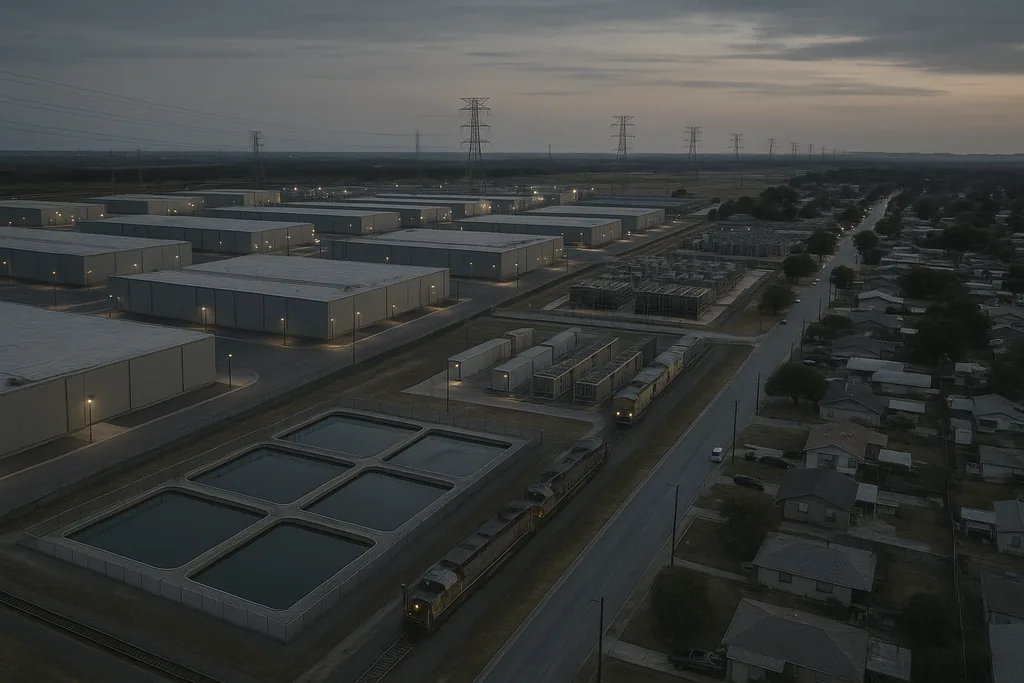
When servers become battlefields
On 3 January and again through late January 2026, a variety of commentators, activists and analysts drew a direct line between recent geopolitical moves—regime‑change operations and diplomatic threats—and an accelerating scramble for resources that underpins the global AI build‑out. That connection is not just rhetorical. It comes into focus when contracts, corporate expansion and legislation are examined together: multibillion‑dollar defence and surveillance deals, a fast‑tracked permitting agenda for new data centres, and a surge in mineral extraction needed for semiconductors, batteries and cooling systems.
Those overlaps are changing the environmental map. Communities hosting data centres now face heightened water stress, air and noise pollution, and the downstream harms of resource extraction in distant mining regions. At the same time, the firms building the infrastructure for generative AI are increasingly tied to military customers, creating a feedback loop in which strategic and commercial incentives both push capacity growth and obscure its environmental costs.
How big is the footprint?
Several recent build plans make the scale tangible. Some mid‑sized centres already use as much water as a small city of about 50,000 inhabitants. Projections attached to major hyperscale projects are more startling: one hyperscale facility in Louisiana is reported in corporate filings and local projections to require a volume of water comparable to the entire city of New Orleans; another proposed site in Wyoming has energy draw projections that, if taken at face value, would exceed the annual electricity consumption of the entire state.
Those numbers are not just accounting curiosities. They reshape local utilities, raise prices for households and farms, and create competition for limited water in drought‑prone regions. They also produce an emissions profile that extends far beyond the site of the data hall: diesel backup generators frequently sit on‑site to meet shortfalls, producing localized air pollution when they run and a stock of heavy engines that use diesel the size of a railcar.
Pollution, noise and e‑waste
Data centres introduce multiple environmental burdens into their host communities. The continuous hum of transformers and cooling equipment creates noise pollution that studies link to anxiety, sleep disruption and cardiovascular stress when chronic. Emergency diesel generators and frequent testing can elevate particulate and nitrogen oxide levels, compounding respiratory illness in already vulnerable populations.
Equipment turnover produces electronic waste: servers and specialised cooling gear have finite lifespans, and disposal chains for high‑value electronic components are unevenly regulated. When combined with inadequate environmental review—an issue resurfacing in debate over recent federal fast‑track measures—the result is a set of risks that disproportionately affect low‑income and minority communities where many projects are sited.
Minerals, militarism and the supply chain
Compute centres don’t run on electrons alone. They rely on a steady supply of 'critical' minerals—copper for wiring, lithium and other metals for batteries, and rare earths for specialised components. Those extraction chains are linked to environments and societies thousands of miles away. Mining for these materials has been associated with deforestation, water contamination and violent conflict in regions such as parts of the Democratic Republic of Congo and other mineral‑rich areas.
The entanglement of defence interests with mineral and technology supply chains adds another layer. Recent corporate and government moves—large defence contracts for AI and surveillance firms, and stakes by military‑adjacent investors in mining companies—blur the line between commercial expansion and strategic resource access. Military demand for aluminium, titanium and weapon‑grade materials sits alongside commercial demand for semiconductors and data‑centre batteries. That proximity creates incentives to secure raw materials by political and, in some cases, coercive means.
A revolving door of people and contracts
The human networks binding tech firms and the military are also deepening. Executives at major AI companies have taken formal roles in military reserves and advisory positions, while defence departments have signed multibillion‑dollar, multi‑year agreements with commercial AI firms. These links help explain why policy choices—such as permitting, security exemptions and procurement rules—are increasingly shaped by an intermixed set of actors with both commercial and strategic objectives.
Policy choices and the fast‑track dynamic
Justice, organising and alternatives
Local groups and national coalitions are responding. Organising has targeted both the immediate impacts of proposed plants—water allocations, noise limits, generator testing schedules—and broader questions about whether communities should host strategically important infrastructure that brings disproportionate harms and few local benefits. Many of these campaigns frame data centres as the newest form of environmental injustice: large, capital‑intensive facilities placed in communities with limited political power, while the strategic benefits accrue elsewhere.
Some activists and policy analysts press for stronger, enforceable conditions: rigorous cumulative impact assessments, binding limits on water and diesel backup use, public disclosure of contracts and end‑use clauses, and truly independent review of proposed projects. Others call for systemic alternatives—shifting incentives away from centralized hyperscale compute toward distributed, energy‑efficient models, public ownership of critical infrastructure, and stricter limits on military‑commercial procurement links that channel public resources into private build‑outs.
Why this convergence matters
The confluence of AI scale‑up, military demand and resource extraction poses a strategic environmental question: what kind of infrastructure and economy do we want to power advanced intelligence systems? Choices made now will determine whether compute growth is insulated from democratic oversight and environmental accountability, or whether it becomes subject to the kinds of constraints—transparent procurement, robust environmental review and equitable siting—that other critical infrastructures must meet.
That decision is not merely technical. It shapes who breathes polluted air, who loses water access, and which landscapes are opened to the disruptions of mining and militarised extraction. If policymakers treat data centres as simply another industry to be expedited, the social and ecological costs are likely to be concentrated in communities with the least capacity to resist.
For activists, researchers and policy makers, the challenge is to make those costs visible—and to translate visibility into enforceable rules that balance innovation with health, equity and ecological limits. The debate unfolding this month is an early test of whether democracies can govern the environmental side‑effects of a technology race driven by both profit and strategic competition.
Sources
- U.S. Department of Defense (contract announcements and procurement records)
- U.S. House of Representatives (legislative text and committee reports on data‑centre permitting)
- Company filings and press releases (Palantir, Meta, OpenAI, Anduril and other major tech firms)
- Environmental health reports and site reviews for Camp Lejeune and other military environmental assessments (U.S. EPA/ATSDR)




Comments
No comments yet. Be the first!