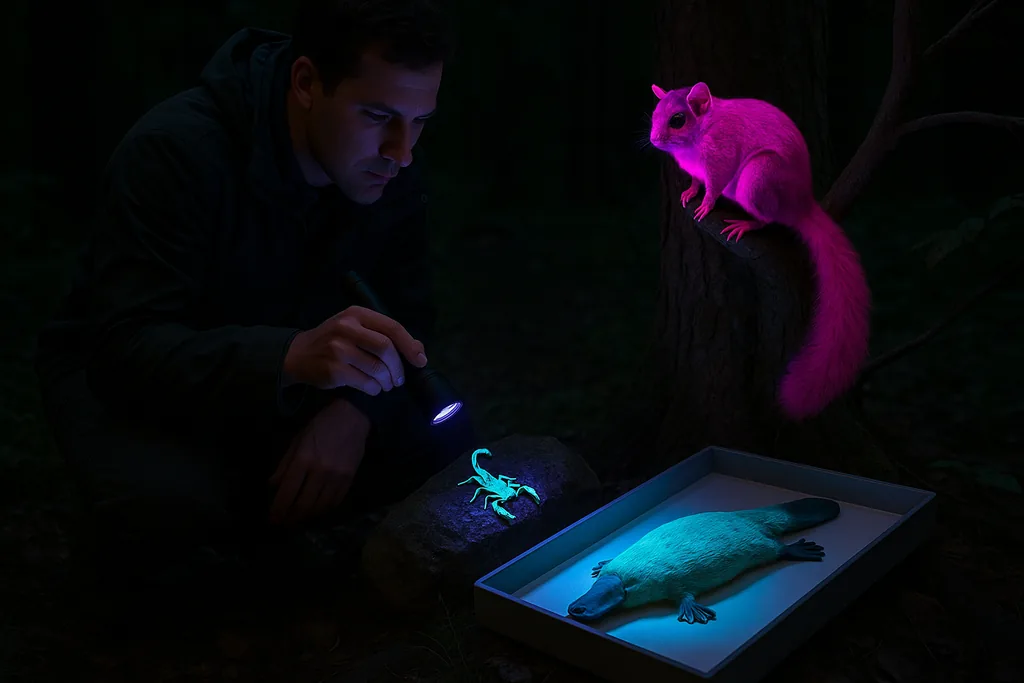
Imagine walking a woodland path after dusk with a small ultraviolet torch. Leaves and bark look ordinary until a blue-green scorpion suddenly shimmers on a rock, a flying squirrel's fur throws an unreal pink, and a preserved platypus in a museum cabinet glows like a pale neon toy. That surreal scene is not a special effect: under UV, many animals become unexpectedly colourful. Recent surveys and lab tests have shown photoluminescence — the absorption of ultraviolet light and re‑emission at visible wavelengths — is far more common than scientists thought, and the discovery is forcing biologists to re‑think how animals use colour in low‑light environments.
Night‑time pigments and glowing mechanisms
Photoluminescence is not the same as bioluminescence. Fireflies and some marine organisms produce light biochemically; photoluminescent tissues instead act like passive fluorescent dyes, absorbing UV and re‑emitting it at longer wavelengths. The compounds responsible vary between groups: in scorpions the glow comes from components in a thin layer of the exoskeleton, in some frogs it is linked to skin proteins and pigments, and in mammals recent work suggests a mix of keratin, porphyrins and other molecules can fluoresce when struck by UV.
In practice, UV light is widespread at night — from moonlight and starlight to UV reflected off snow or water — and many animals have visual systems tuned to these wavelengths. That reality means fluorescence can, in principle, be detected by other animals even when humans miss it. What remains uncertain is which species actually perceive and use those signals, and for which ecological tasks: hiding from predators, finding mates, navigating or even detecting when a scorpion is sitting in the open.
Scorpions: the oldest neon show
Scorpions have been the poster children of fluorescence since the 1950s, when researchers first noticed their exoskeletons glowing under UV. The effect is visible across the group: every known scorpion species fluoresces to some degree. Structural chemistry points to molecules in the hyaline exocuticle — a mixture that likely includes mucopolysaccharides and lipoproteins — as the primary source of the blue‑green emission.
Scientists have proposed several functions. One intriguing suggestion is that the cuticle acts as a whole‑body photon collector, helping scorpions judge ambient light levels and avoid exposure to daylight. Another is that fluorescence assists species or sex recognition in dim light, or that it interferes with the visual systems of small prey. The trait is deep in the fossil record too: fossil scorpions hundreds of millions of years old can also fluoresce, implying the chemistry has ancient origins even if its adaptive role is still debated.
Mammals: a surprising pink and blue world
Frogs, snakes and the forest palette
Amphibians and reptiles are also full of surprises. Large surveys have shown that a majority of frog species tested carry fluorescent compounds in their skin; one release in 2025 reported that over 90% of a sample set of frogs showed photoluminescence. For snakes, a 2024 analysis across dozens of species found that many tree‑living snakes exhibit UV reflectance that could match the UV‑reflective leaves and lichens in their habitat, potentially improving camouflage.
That pattern — different functions in different lineages — is a recurring theme. In some reptiles fluorescence may aid concealment among foliage; in amphibians it could help individuals stand out to prospective mates or conspecifics under moonlit conditions; in birds UV features are already known to play roles in mate choice. The key point is that fluorescence is not a single adaptation with a single purpose; it is a toolkit of optical effects that evolution has repeatedly co‑opted.
Underwater neon: a hidden visual channel
The ocean, too, has its own ultraviolet stage. Coral reef fish, sharks and turtles show a wealth of photoluminescent patterns. Blue light penetrates deepest in seawater, and species active at depth or at dusk use UV contrasts that are effectively invisible to many predators or human observers. Researchers cataloguing reef species have documented dozens of fish and turtle patterns that glow in distinct colours; some sharks appear green under the right wavelengths. In these systems, fluorescence can be a private communication channel among animals that share similar visual sensitivities.
Why biologists are puzzled
Despite the mapping of fluorescent traits across taxa, the functional evidence remains thin in many cases. Some experimental work — for example, tests that placed fluorescent and non‑fluorescent mouse models in natural settings — failed to produce clear preferences by potential predators, suggesting fluorescence alone is not a universal cue. In many animals the effect could be a by‑product of pigments that evolved for other reasons, such as UV protection or antimicrobial defence, with fluorescence incidental rather than adaptive.
Others see the distribution of fluorescence as an opportunity: it could add a previously overlooked sensory axis to behavioural ecology. If some animals can both produce and detect UV‑shifted signals, entire behavioural systems — mate choice, territorial marking, predator‑prey interactions — may have optical layers hidden to human eyes. Testing those hypotheses demands careful behavioural assays under natural light regimes, better characterization of the fluorescent molecules, and an understanding of animals' visual capacities.
Citizen science, collections and the next steps
For now, the night world looks far more colourful than we imagined. Across deserts, forests and reefs, ultraviolet light reveals a neon dimension of life that evolved long before humans arrived with flashlights. What scientists know with confidence is simple and striking: fluorescence is widespread, often spectacular, and almost certainly meaningful for many species. What remains uncertain is the why: teasing apart incidental chemistry from adaptive signal will keep biologists and ecologists busy for years.




Comments
No comments yet. Be the first!