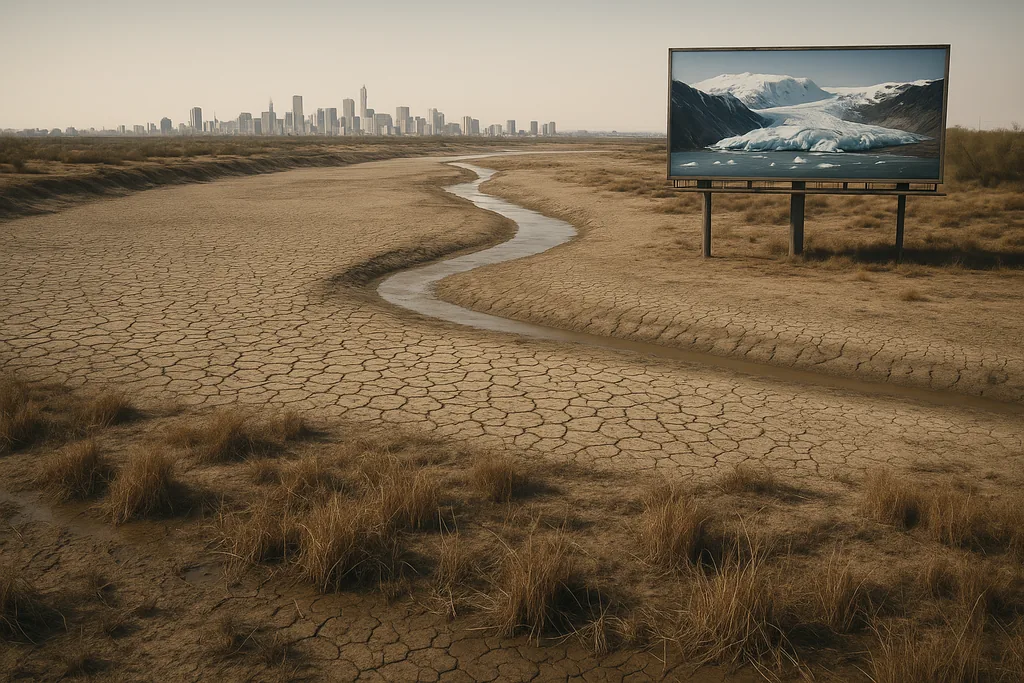
UN report: a blunt, financial metaphor for a physical collapse
At United Nations headquarters today, scientists from the UN University Institute for Water, Environment and Health (UNU-INWEH) presented a stark diagnosis: many of the world's major water systems are not merely stressed or in episodic crisis, they have entered what the authors call "global water bankruptcy." The report, released 20 January 2026 and led by Kaveh Madani, reframes decades of hydrological loss in financial terms: humanity has overspent its annual water "income" and is now drawing down the long-term "savings" held in aquifers, glaciers, wetlands and soils.
The language is deliberate. Where "water stress" implied reversible pressure and "water crisis" suggested an acute shock, "water bankruptcy" describes a post-crisis condition in which past baselines for supply and ecosystem function can no longer realistically be restored. The report accompanies a peer-reviewed paper that formalizes a definition of the term and argues for embedding the concept into global monitoring and policy frameworks.
A stark diagnosis, with numbers
The report assembles global datasets and recent studies to make its case, and the statistics are both detailed and sobering. More than half of the world's large lakes have lost water since the early 1990s, and roughly 410 million hectares of natural wetlands — an area comparable to the European Union — have disappeared over the past five decades. Globally, glacier mass has declined by more than 30 percent since 1970, eroding a seasonal water buffer relied on by hundreds of millions of people.
Hidden below ground, around 70 percent of the world’s major aquifers show long-term declines. The visible consequences are dramatic: land subsidence across millions of square kilometers, cities and deltas sinking, and a shrinking share of water that is actually safe for people and crops because pollution, salinization and untreated wastewater reduce usable supplies. The UNU report pulls together widely cited figures: roughly 4 billion people experience severe water scarcity for at least one month each year; about 2.2 billion people lack safely managed drinking water and 3.5 billion lack safely managed sanitation; and the annual global cost of drought-related damage is estimated at around US$307 billion.
These physical losses feed through to food systems and economies. Some 170 million hectares of irrigated cropland face high or very high water stress. The report estimates the lost ecosystem services from wetland destruction at roughly US$5.1 trillion — an accounting of the services that wetlands once supplied for flood control, filtration and habitat.
What 'water bankruptcy' actually means
In technical terms the UNU team proposes a two-part definition: a persistent over-withdrawal of surface or groundwater relative to renewable inflows and safe depletion limits, and the resulting irreversible or prohibitively costly loss of water-related natural capital. In plain language, it means relying so heavily on stored water and ecosystem services that the system's capacity to regenerate has been fundamentally eroded.
That erosion can be literal — compacted aquifers that no longer hold the same volume of water, or salt intrusion into coastal aquifers — or ecological, such as wetlands that have been drained and cannot be restored to their original function without enormous expense. The report emphasises that a single wet year does not reverse bankruptcy: regions can record floods or high river flows even while their long-term water accounts are in the red.
Where the damage is concentrated
The report highlights regions where the symptoms are most acute but stresses that the condition is not limited to any one geography or income bracket. The Middle East and North Africa face a toxic mix of high demand, low natural inflow and expensive desalination; parts of South Asia are seeing chronic groundwater declines driven by irrigation and urban growth; and the American Southwest — typified by the Colorado River system — illustrates over-allocation of a finite river system under a warming climate.
Policy, justice and security implications
The UNU report frames water bankruptcy as more than an environmental or engineering problem: it is a governance, justice and security challenge. The people who disproportionately bear the costs are smallholder farmers, Indigenous communities, poor urban residents and women — groups whose livelihoods depend on local water access yet who typically lack political power to prevent overextraction or pollution.
UNU and allied voices warn that unmanaged water insolvency raises the risks of instability. The report links water bankruptcy to drivers of fragility: food insecurity, displacement, intercommunal tension and cross-border stress. It urges that bankruptcy management must include explicitly just transitions — support for people whose livelihoods must change — to avoid transferring an environmental debt onto the most vulnerable.
Practical shifts the report urges
UNU lays out a practical, if ambitious, agenda. First, stop further irreversible damage: protect remaining wetlands, halt destructive groundwater pumping where feasible, and prevent rampant pollution. Second, rebalance rights and expectations so water allocations match degraded carrying capacity rather than historical promises. Third, transform water-intensive sectors — notably agriculture — through crop shifts, irrigation reform, and more efficient urban water systems.
The report also calls for better diagnostics and monitoring — using Earth observation, integrated modelling and AI to embed water-bankruptcy indicators into global frameworks — and for elevating water within climate, biodiversity and land negotiations. UNU proposes using the upcoming UN water milestones and the 2030 SDG deadlines as opportunities to reset global priorities from incremental fixes to systemic restructuring.
Not everyone rejects the report’s tone: some scientists welcome the attention and agree that the international system needs new tools. Others caution that the global label risks obscuring local improvements and the heterogeneous nature of water systems; the report’s authors acknowledge that not every basin or country is bankrupt, but argue enough critical systems are to justify a new category and new responses.




Comments
No comments yet. Be the first!