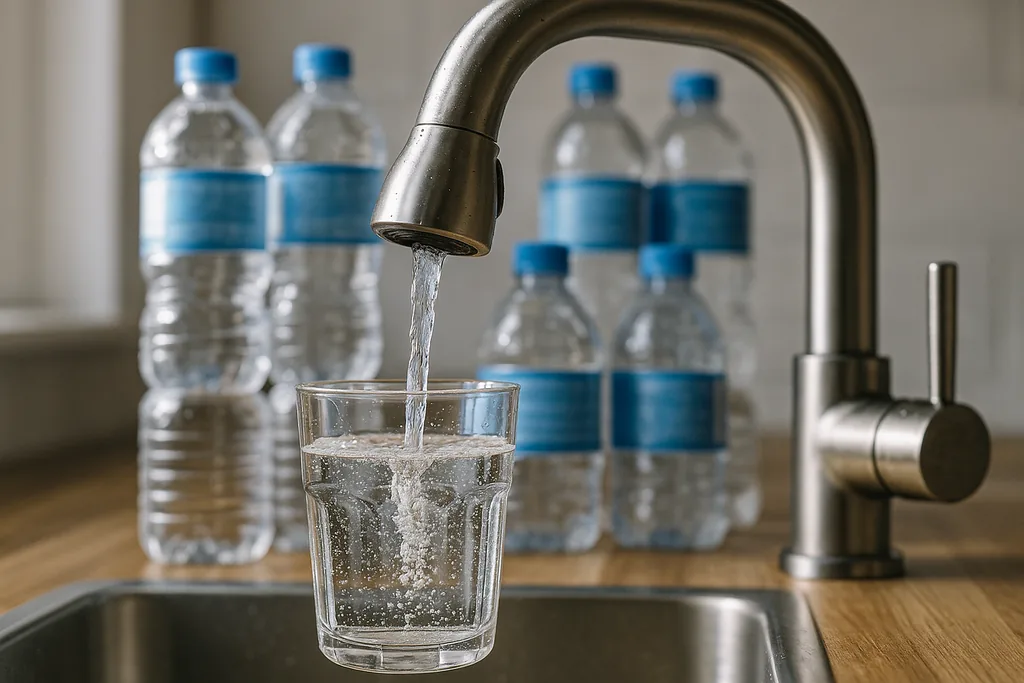
Bottled water vs. tap: a surprising lab result this week
This week researchers at Ohio State University published a study in Science of the Total Environment that will change how many people think about bottled water. The team analyzed treated drinking water samples from four treatment plants near Lake Erie and compared them with six leading bottled water brands; their novel combination of high-resolution imaging and chemical identification found that bottled water contained roughly three times as many nanoplastic particles as treated tap water. That result is striking because it flips a familiar assumption: bottled water is often bought as a safer, cleaner alternative to tap, but the new data show a previously undercounted source of tiny plastic particles coming from bottles themselves.
Bottled water vs. tap — what the Ohio State study actually measured
The Ohio State researchers used scanning electron microscopy and chemical fingerprinting to detect micro- and nanoplastic fragments in both kinds of samples. More than half of the particles they identified were in the nanoplastic size range — small enough, scientists worry, to cross biological barriers and reach internal organs. The team found that the dominant source of plastics in bottled samples appeared to be the packaging itself, a conclusion consistent with other work showing that the act of bottling, sealing and transporting water can shed tiny polymer fragments into the liquid.
Importantly, the study does not claim to quantify health harm from the particles it found. The toxicology of nanoplastics in humans is still an emerging field: lab studies and animal work suggest cellular irritation, inflammation and translocation into tissues are possible, but robust population-level evidence is not yet available. What the Ohio State paper does provide is a careful measurement and a clear indication that bottled water is not free of contamination, and that consumers choosing bottled water to avoid other contaminants may be facing trade-offs they hadn’t anticipated.
Tap water’s known problems: lead, PFAS and the infrastructure question
Separately, PFAS — a large family of persistent industrial chemicals known as "forever chemicals" — have been widely detected in U.S. drinking-water systems, and the Environmental Protection Agency finalized the country’s first enforceable PFAS limits in 2024. Environmental Working Group (EWG) and other scientists caution that thousands of PFAS variants exist and that even low-level exposures are linked to immune suppression, developmental impacts and cancer in some studies. In short: tap water in many communities remains subject to real, measurable risks tied to aging infrastructure, industrial contamination and incomplete treatment.
Health uncertainties: nanoplastics meet the more familiar toxins
Practical choices: filtration, testing and the price of bottled convenience
For people trying to reduce their risk, three concrete steps stand out. First, know your local water: public utilities publish annual Consumer Confidence Reports and many state and local health departments — like Connecticut’s Department of Public Health — provide resources and maps showing where systems test above advisory levels for lead, PFAS or other contaminants. Second, test private wells and older home plumbing; if you rely on a private supply, only certified labs and periodic testing will reveal hidden problems.
Third, use certified filters when needed. Health and consumer groups recommend filters certified to NSF/ANSI standards: Standard 53 for lead reduction, Standard 58 for reverse osmosis systems (which are effective against many dissolved contaminants) and appropriate activated-carbon systems for some PFAS. But no filter is universal: activated carbon reduces many long-chain PFAS and organics, while reverse osmosis removes a wider range of dissolved ions and small molecules; both will remove particulate matter, including many microplastics, but laboratory capabilities and maintenance (cartridge replacement, correct installation) determine real-world effectiveness.
Bottled water vs. tap: environmental and economic tally
Beyond contamination trade-offs, bottled and tap water differ sharply in environmental footprint and cost. Bottled water requires plastic production, packaging, transportation and often single-use disposal; those stages create greenhouse gases and persistent waste streams. The Ohio State finding that bottles themselves shed nanoplastics underlines one lifecycle hazard that never affects tap supply: the container becoming a contaminant.
Economically, bottled water is also far more expensive than tap. Most analyses show bottled water costs many times — often hundreds to more than a thousand times — as much per gallon as municipal tap water. For households that buy bottled water for everyday use, that adds up to a substantial, recurring expense. The environmental and financial costs make filtered tap a compelling option for many people who want lower-risk drinking water without the climate and waste impacts of bottled products.
How to decide for your family
There is no one-size-fits-all answer. If you live in a community with known lead service lines or local PFAS contamination, short-term use of bottled water certified free of particular contaminants may be prudent while you arrange testing or plumbing replacement. But this week’s nanoplastic results show bottled water is not a contamination-free refuge: many brands shed particles from packaging, and bottled water companies are not required to meet the same public-transparency standards utilities do for regular testing and reporting.
For most consumers, the most sensible path is local information plus targeted interventions: check your utility’s report, test private or suspect sources, and install and maintain a certified filter matched to the contaminants of concern. Where lead risk exists, filters rated to NSF/ANSI 53 and NSF/ANSI 58 reverse-osmosis systems are reliable interim protections; where PFAS are detected, look for systems tested specifically for those chemicals. And if you choose bottled water for convenience, consider using bulk, refillable containers (and recyclable materials where available) to reduce single-use waste and the chance that bottle shedding will become the dominant source of your exposure.
What this means for public policy
The new measurements strengthen two policy messages. First, investments in public infrastructure — replacing lead service lines, upgrading treatment to address PFAS and improving monitoring — remain essential to reduce well-understood chemical hazards for whole communities. Second, regulators and industry need to expand the set of contaminants they track. The Ohio State work shows that packaging and product lifecycles can create exposure pathways that standard chemical monitoring misses; policy responses that focus only on a handful of chemicals will overlook particle-based contamination and other emerging threats.
For consumers and policymakers alike, the broader lesson is that ‘safer’ is a relative concept. Bottled water reduces some acute risks but brings others; treated tap water is generally well regulated but is vulnerable to infrastructure failures and persistent industrial contamination. Both public investment and clearer, broader monitoring would narrow those trade-offs.
Until then, use local data, get drinking water tested if you have concerns, and choose certified filtration when necessary — and remember that bottled water is not a guarantee of purity.
Sources
- Science of The Total Environment (Ohio State University research paper on nanoplastics in bottled and tap water)
- Ohio State University (research team and press materials)
- Environmental Protection Agency (2024 PFAS drinking-water regulations)
- Natural Resources Defense Council (analysis of lead in drinking water and infrastructure issues)
- Connecticut Department of Public Health (drinking water guidance and resources)
- Environmental Working Group (PFAS review and tap-water database)
- Environment Massachusetts (policy work on lead in schools’ drinking water)




Comments
No comments yet. Be the first!