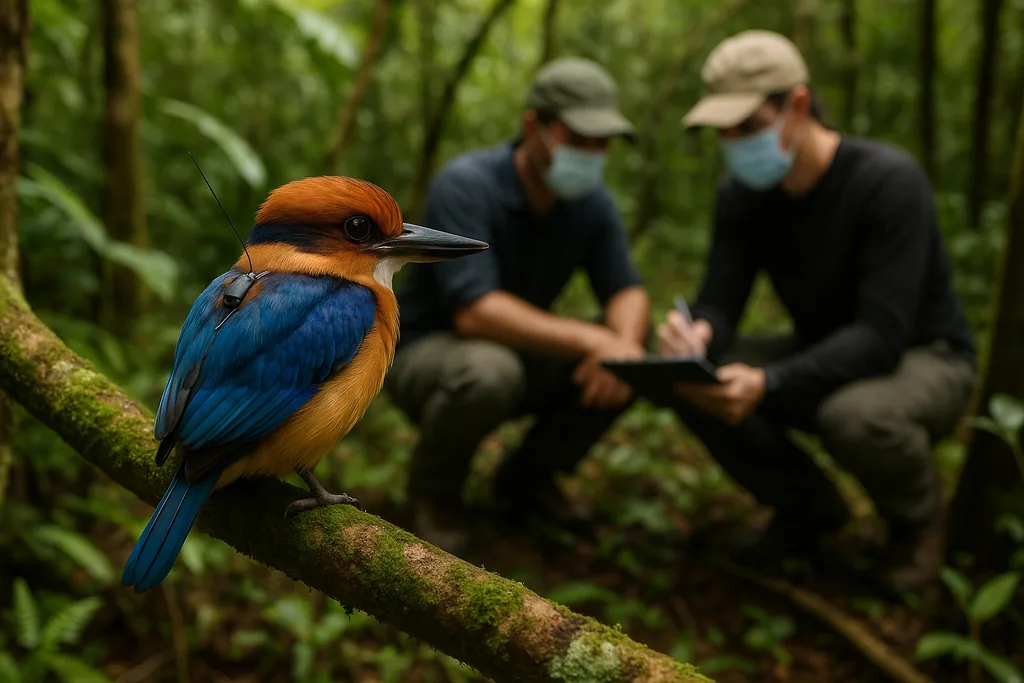
A small, brilliant bird that vanished from Guam’s forests has reappeared and laid eggs
On Palmyra Atoll this spring, conservation biologists found the unremarkable sight that scientists and communities have been waiting decades to see: a compact, cinnamon-and-sapphire kingfisher excavating a nest cavity and laying eggs. These are the first confirmed wild eggs for the sihek, the Guam kingfisher (Todiramphus cinnamominus), since the species disappeared from Guam in the late 1980s. The milestone follows the carefully planned release in September 2024 of nine hand-reared birds into a predator-free, protected atoll and marks a hopeful step toward rebuilding a species once driven from its native home.
From captivity to a living population
The sihek’s modern odyssey is a textbook case of ex situ conservation turned reparative rewilding. As Guam’s native forest birds collapsed after the accidental introduction of the brown tree snake in the mid-20th century, conservationists captured a small number of sihek and established an international captive-breeding program across Association of Zoos and Aquariums (AZA) facilities in the United States, Europe and Australia. Birds were carefully managed for health, behaviour and genetic diversity for decades, producing the generation that would be flown to Palmyra.
The translocation was logistically complex. Eggs and nestlings from multiple AZA partners were hatched and hand-reared at a dedicated facility, quarantined and transported more than 3,500 kilometres to The Nature Conservancy’s (TNC) Palmyra Atoll Preserve and research station on Cooper Island. There the young sihek spent weeks in aviaries acclimating to local forest conditions, learning to hunt the geckos, spiders and crabs that will form their diet before managers opened the aviaries and tracked their dispersal across the atoll. Tiny radio transmitters fitted to each bird made it possible to monitor movements and survival in the weeks and months after release.
Why Palmyra was chosen
Palmyra Atoll is not Guam, but it offers the critical conditions the sihek need to demonstrate that a wild population can persist: a fully protected refuge with virtually no introduced mammalian predators and a management infrastructure that supports continuous monitoring and rapid response. The atoll lies within overlapping federal protections and is managed in partnership with conservation organizations, giving the team a rare combination of security and scientific access for an early-stage rewilding. For species that evolved without terrestrial predators, islands like Palmyra act as a laboratory where conservation teams can reduce the number of variables that cause reintroduction attempts to fail.
How the sihek learned to be wild again
Hand-reared birds face a steep learning curve when they are released. The sihek team approached that challenge deliberately: initial releases were staged from protected aviaries, birds were given supplemental food while they mastered local foraging, and researchers tracked behaviour with telemetry to detect early problems — dispersal into unsuitable habitat, disease signs, or inability to forage. Early reports from the field describe encouraging signs: birds instinctively preening after rain, hunting small reptiles and invertebrates, establishing territories and, crucially, forming mated pairs and building nests. Those behavioural cues are the same metrics conservation scientists use to judge whether captive-bred animals have regained a functional wild repertoire.
The long shadow of an invasive snake
The sihek’s collapse on Guam is tightly linked to the brown tree snake (Boiga irregularis), a nocturnal, arboreal predator that spread across Guam after World War II and devastated native bird populations that had evolved without terrestrial mammalian predators. By the late 1980s the sihek was no longer observed in the wild and was designated extinct in the wild. That history still governs decisions about when or whether sihek can be returned to Guam: any permanent reintroduction will require robust, demonstrable control of the snake across target release zones, and a management plan that reduces the likelihood of renewed predation losses. Until those conditions are met, Palmyra provides a safer place to let behavioural competence and demographic resilience grow.
Genetics, husbandry and the arithmetic of recovery
Saving a species from extinction is not just about keeping individuals alive; it is about producing a demographically and genetically robust population. The sihek program has coordinated egg selection, transfers and husbandry across a broad network of institutions—including Sedgwick County Zoo, Cincinnati Zoo & Botanical Garden, Brookfield Zoo, the National Aviary, the Smithsonian’s National Zoo and ZSL’s London and Whipsnade facilities—to balance genetic representation and reduce inbreeding risk. The captive population maintained by those partners provides the supply pipeline for staged releases to Palmyra in coming years. Program leaders have set explicit population targets to judge success: initial goals published by partners include establishing at least 10 breeding pairs on Palmyra as an early benchmark, with other partner documents describing a longer-term target of 20 breeding pairs as the atoll population grows. Those figures guide decisions about how many individuals to move each year and how to prioritize genetic lineages for release.
Cultural meaning and shared stewardship
The sihek is more than a conservation symbol: it has deep cultural resonance for the CHamoru people of Guam. Program leaders and Guam officials have repeatedly emphasized that the recovery work is a partnership that must include CHamoru voices, values and aspirations. For many on Guam and in the diaspora, the idea of sihek soaring again over lancho and shoreline is both an ecological and a cultural restoration. The staged approach — raising a viable wild population in a safe place before attempting a return to Guam — is intended to maximize the chance that any eventual reintroduction will be durable and respectful of local communities’ relationships with the species.
Risks, realism and the road ahead
Breeding in the wild is an extraordinary break in a long string of losses, but it is not the end of the work. Young birds making their first flights, eggs that may fail for behavioural or environmental reasons, infectious disease risks introduced during translocations, and the ever-present challenge of maintaining sufficient genetic diversity are all things the team will monitor closely. Perhaps most consequential is the requirement to find scalable, cost-effective ways to reduce or exclude brown tree snakes from zones on Guam where sihek might eventually return. Advances in snake detection and control are progressing, but any move to repopulate Guam itself will depend on demonstrable reductions in predation risk and a long-term commitment to biosecurity.
For now, the sight of sihek eggs tucked in a nest cavity on Palmyra is a tangible reminder that deliberate, collaborative conservation can change trajectories once thought irreversible. The next months and years will show whether those eggs hatch and whether hatchlings survive to reproduce; each successful fledging would deepen the case that a self-sustaining wild population is possible. If that happens, biologists and communities will face the harder but more meaningful challenge: how to return a living species to a landscape where the proximate cause of its disappearance still waits to be addressed.
Sources
- The Nature Conservancy (Palmyra Atoll news release on sihek eggs and rewilding)
- National Aviary (announcement on sihek release and program partners)
- Zoological Society of London / Institute of Zoology (Sihek Recovery Program descriptions)
- Guam Department of Agriculture, Division of Aquatic and Wildlife Resources (program coordination and cultural context)
- Sedgwick County Zoo and Association of Zoos & Aquariums (captive-breeding and translocation coordination)




Comments
No comments yet. Be the first!