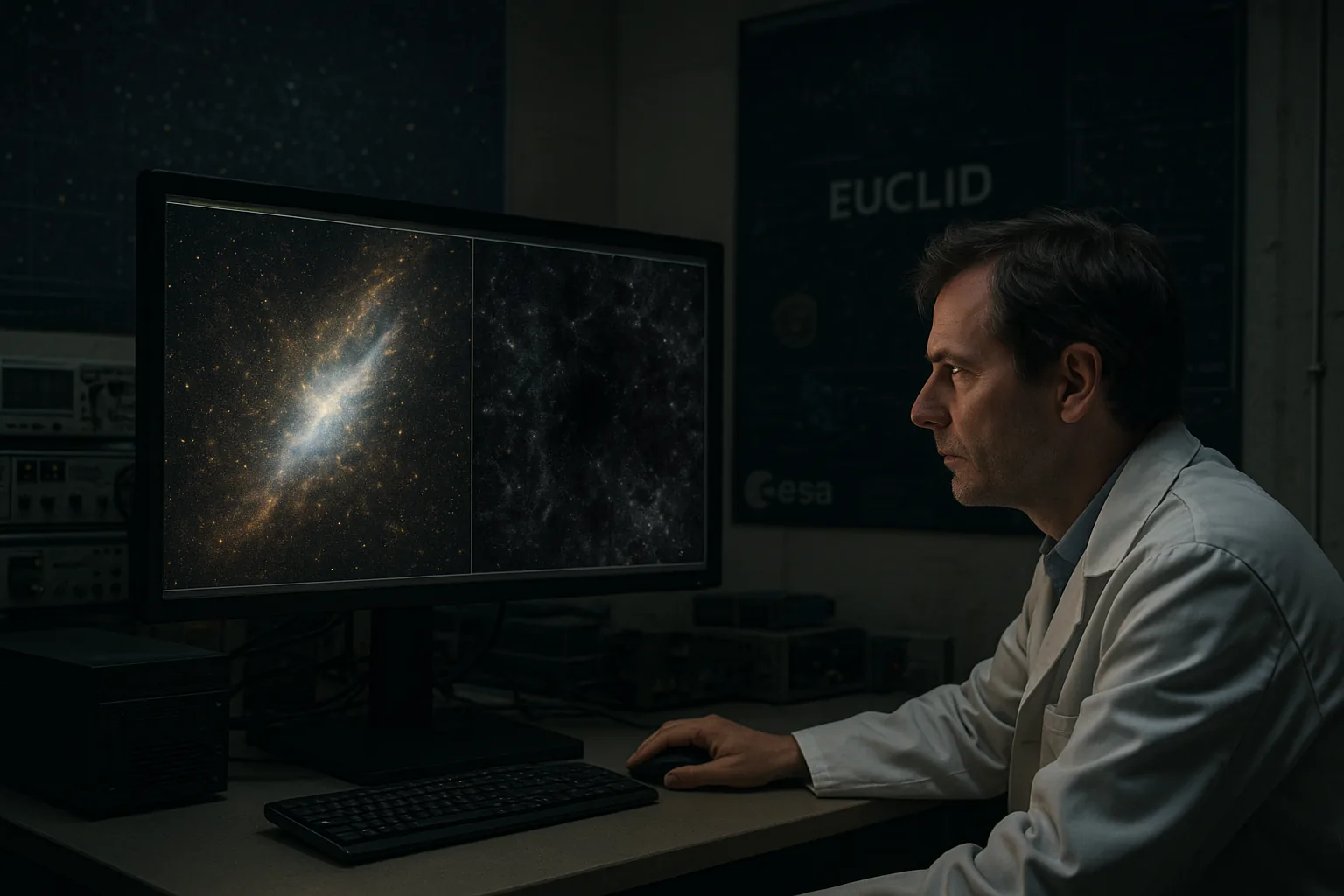
The data plot that stopped a Heidelberg research team in its tracks was not a discovery — it was the absence of one. On a cold December morning in 2025, at the Institute for Theoretical Physics, a machine learning model trained on billions of data points from cosmic surveys had just finished its run. It had successfully reverse-engineered the equations that govern the universe's large-scale structure, correctly predicting galaxy distributions and the cosmic web from the initial conditions of the Big Bang. Then, at scales above a few hundred megaparsecs, its predictions veered off a cliff. The expansion rate of the universe, the one that should be driven by dark energy, was simply not reproduced. An artificial intelligence that, in a sense, has decoded how the universe works had just revealed a gaping hole in the standard cosmological model.
An AI that decoded how the universe works — until it didn't
The process was not trivial. The AI's architecture incorporated symmetries known to constrain physical laws, such as rotational and translational invariance, forcing the network to learn from data in a way that respects the geometry of spacetime. When the group fed it real observations from ESA's Euclid space telescope and the Dark Energy Survey, CosmoGraph could predict where galaxies should be with 99.7% accuracy — until it could not.
“We expected some deviation at the very largest scales because of cosmic variance,” Voss said, “but the model systematically underestimated the clustering amplitude and completely missed the late-time acceleration. It was as if the universe, at its grandest, was obeying a different set of rules.”
A gap where dark energy should be
Physicists have long known that the cosmological constant is a placeholder, a parameter so finely tuned that many theorists regard it as unnatural. What CosmoGraph revealed is that a system optimised solely to capture the gravitational dynamics of matter — dark and visible — simply does not see the need for a constant repulsive force. The acceleration emerges only when the training data is forced to include the large-scale observations, which then corrupts the model's fit on smaller scales. This is the hallmark of a missing ingredient: something in the cosmos that couples scale-dependent structure formation to the expansion rate in a way our current theories do not capture.
What the AI blind spot tells us about dark matter and dark energy
If the cosmological constant were the correct explanation, a well-trained AI should have been able to infer it as the simplest parameter tweak. The fact that it did not suggests that the real driver of acceleration is more intricately linked to the growth of structure. One interpretation is that dark energy is not a constant but a dynamic field — something like quintessence — that changes with time and potentially interacts with dark matter. Another, more radical, possibility is that our understanding of gravity itself is incomplete at cosmic distances, and that modified Newtonian dynamics or a variant of emergent gravity should replace general relativity on the largest scales.
CosmoGraph's failure is particularly acute when it tries to reconcile the early universe's expansion history, imprinted in the cosmic microwave background, with the late-time acceleration. This is the Hubble tension in a new guise: the AI, trained on early- and mid-universe data, consistently prefers a Hubble constant that is lower than what is measured locally. The machine's “opinion” underscores what many observers have suspected — the discrepancy is not a measurement error but a symptom of a deeper physical rift.
Why an AI blind spot is a human problem
For all its power, CosmoGraph is a black box. The team can see where it fails, but not why in terms of intuitive physics. The model does not output a tidy equation; it outputs a prediction. This opacity has sparked a debate within the physics community about the role of AI as a discovery tool. On the one hand, the model's success on smaller scales validates the use of machine learning to search for new physics; on the other, its blindness to large-scale acceleration risks reinforcing existing theoretical biases. If the training data is dominated by regimes where dark energy is a minor player, the AI will never learn to look for it.
“Machine learning amplifies the prejudices in your dataset,” explains Sebastian Huber, a theoretical physicist at ETH Zurich who was not involved in the study. “If you train it to be a good interpolation engine, it will be exactly that — an interpolation engine. The interesting physics is often in the extrapolation, and there, you need theory.”
This limitation is not unique to cosmology. Across astrophysics and particle physics, AI models are being deployed to sift through petabytes of data, flagging anomalies that might signal new phenomena. Yet the statistical techniques that make them sensitive to faint signals also make them exquisitely sensitive to instrumental artefacts and modelling assumptions. The blind spot CosmoGraph revealed may, ironically, be a feature — a robust indicator that our current equations cannot be the whole story — but extracting that conclusion from a neural network requires layers of human reasoning that the machine cannot yet provide.
Europe's Euclid and the future of cosmic cartography
The Heidelberg group's work relies heavily on data from ESA's Euclid mission, the European Space Agency's €1.4 billion dark universe telescope. Euclid is generating the most precise three-dimensional map of the cosmos ever made, measuring the shapes and distances of billions of galaxies to track how dark energy has shaped the universe over cosmic time. The mission is a jewel of European space science, but its data pipeline is both an opportunity and a risk for AI-driven discovery.
There is also a funding tension. The Horizon Europe programme has poured significant resources into AI and data science for fundamental physics, but the CosmoGraph result suggests that purely data-driven approaches are unlikely to deliver the long-awaited breakthrough on dark energy. The more mundane work of refining systematic error budgets and building more realistic simulations may be less flashy, but it is the bedrock on which any AI discovery must rest.
The Heidelberg team plans to run its model again with expanded training sets that artificially inject large-scale acceleration scenarios, essentially teaching the AI what to expect. That is a strange inversion: instead of letting the data speak, they are giving the machine a theoretical prescription. It is the kind of methodological compromise that would make an old-school empiricist wince. But it might also be the quickest way to find out whether the gap in the standard model is a crack in our theories or just a mirror of our own ignorance.
Sources
- Heidelberg University STRUCTURES Cluster (research presentation and preprint)
- ESA Euclid Consortium data releases and technical documentation
- Nature Astronomy (forthcoming paper on AI-derived cosmological constraints)




Comments
No comments yet. Be the first!