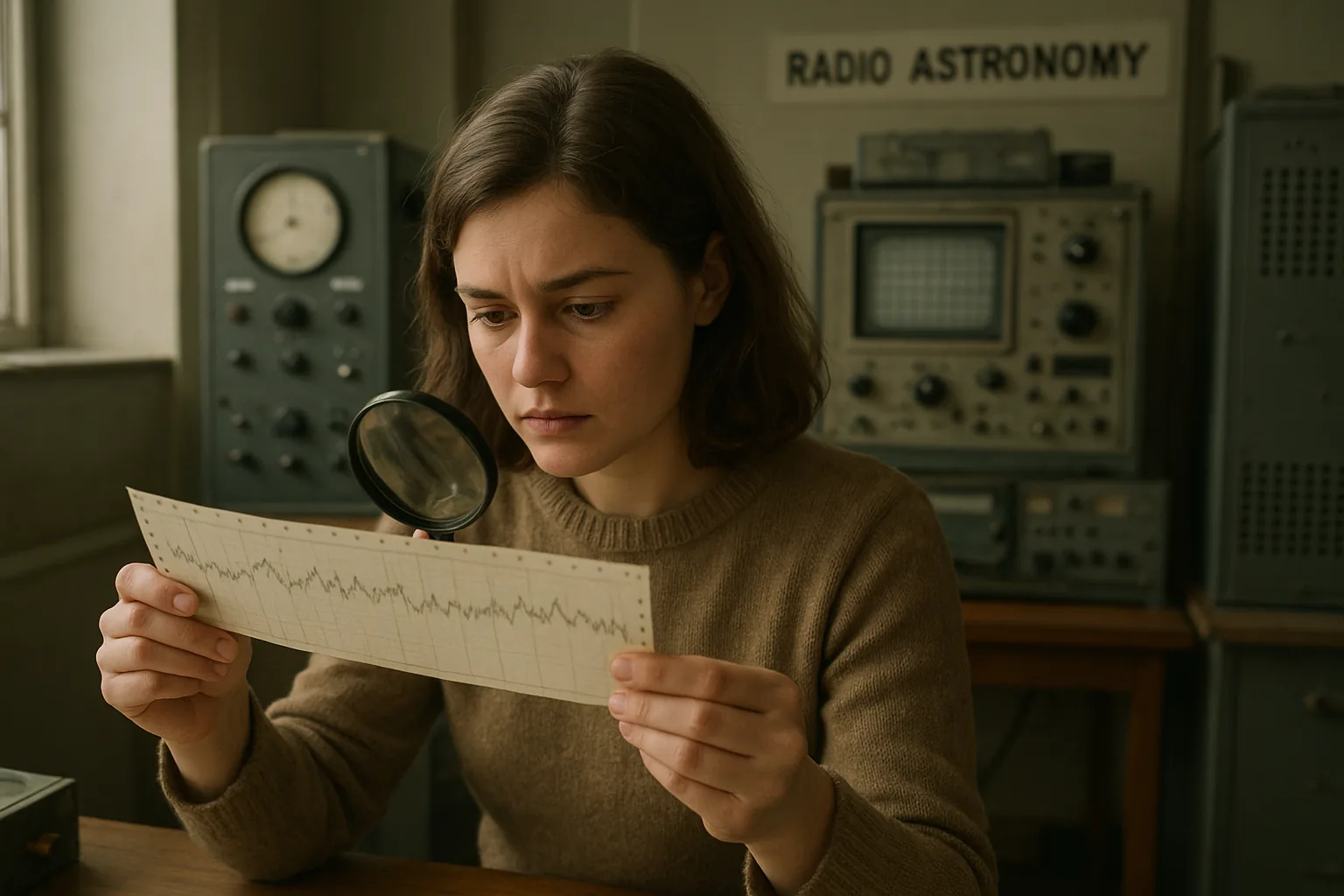
It was a tiny squiggle on a strip of chart paper, easy to miss. But the 24-year-old PhD student who spotted it in midsummer 1967 knew instantly that it didn’t belong. Jocelyn Bell Burnell had been hand-analysing hundreds of metres of data each night from a new radio telescope at the University of Cambridge. The instrument, a field of wooden posts and wires covering four acres, was designed to study the twinkling of distant radio sources. What she saw instead was a train of pulses arriving from the same patch of sky with a tick-tock regularity that bordered on mechanical.
Her supervisor, Antony Hewish, thought it was interference from a nearby transmitter. Bell Burnell wasn’t convinced. She kept combing through the charts, and found the signal again — an unwavering pulse every 1.337 seconds. When she showed Hewish the evidence, the team’s first reaction was incredulity. They jokingly labelled the source “LGM-1”, for Little Green Men. The name was a joke, but the data was deadly serious.
How a 24-year-old PhD student spotted the signal that became pulsars
Bell Burnell’s discovery didn’t come from a single eureka moment. She had spent weeks poring over printouts from the Interplanetary Scintillation Array, a telescope that produced about 30 metres of paper per day. The array consisted of over 1,000 dipole antennas laid out across a field, and it recorded changes in radio brightness from cosmic sources as the solar wind passed through them. The telescope’s output was entirely analogue — no digital computer to flag anomalies — so spotting a signal meant training your eye to recognise what was normal and what was not.
That summer, Bell Burnell noticed a faint mark that appeared not quite random, occupying roughly half a centimetre of paper. It took repeated observations before she could convince herself it was real. The pulse was too fast to be a star, too stable to be a planet, and it came from a fixed celestial coordinate. When Hewish and the team ruled out earthly interference and orbiting satellites, the only remaining explanation — an artificial beacon from an alien civilisation — seemed both tantalising and absurd.
Within weeks, Bell Burnell found three more such pulsing sources in other regions of the sky. The alien hypothesis crumbled. If multiple civilisations on opposite sides of the galaxy were all signalling at radio wavelengths with remarkable consistency, they’d have to be in cahoots. The more plausible explanation, the team realised, was that they had stumbled onto an entirely new kind of astronomical object.
The birth of a new class of stellar object
Physicists soon identified the signals as coming from neutron stars — the collapsed cores of massive stars that have blown off their outer layers in supernova explosions. These objects, just 20 kilometres across, pack more mass than the Sun into a sphere so dense that a teaspoonful would weigh billions of tonnes. As they spin, magnetic fields trillions of times stronger than Earth’s whip charged particles into narrow beams of radiation that sweep across the cosmos. If one of those beams points towards Earth, we see a pulse — much like the flashing of a lighthouse.
The discovery of pulsars proved that neutron stars were real, not just theoretical curiosities. It opened a new field of astrophysics focused on the behaviour of matter at nuclear densities and under unimaginable gravity. In the decades since, pulsars have become laboratories for studying general relativity, stellar evolution, and even the fabric of spacetime. Some millisecond pulsars spin hundreds of times per second with a stability that rivals atomic clocks, making them exquisite tools for detecting gravitational waves.
A Nobel omission that still echoes through science
In 1974, the Nobel Prize in Physics was awarded to Hewish and his colleague Martin Ryle for their work on radio telescopes and the discovery of pulsars. Bell Burnell, the 24-year-old PhD student who had first spotted the signal, was not on the ticket. The decision ignited a debate about scientific credit that has not subsided. Sir Fred Hoyle, the eminent astronomer, publicly criticised the committee, arguing that Bell Burnell’s critical role had been overlooked. Many historians of science agree that while Hewish designed the instrument and led the observing campaign, it was Bell Burnell who recognised the anomaly and doggedly tracked it down.
The omission became a touchstone for discussions about gender and recognition in science. Bell Burnell herself has consistently downplayed any injustice, noting that she was a student at the time and that the Nobel typically goes to senior figures. “I believe it would demean Nobel Prizes if they were awarded to research students, except in very exceptional cases,” she told the BBC years later. Still, the episode highlights how the labour of junior researchers — particularly women — can be rendered invisible in great discoveries.
The legacy of the signal a 24-year-old PhD student spotted 60 years ago
Nearly six decades later, Bell Burnell’s “bit of scruff” continues to drive cutting-edge science. Astronomers now know of more than 3,000 pulsars, each a beaming remnant of stellar catastrophe. Researchers use them to map the galaxy, to measure cosmic distances, and to test theories about the ultimate fate of matter. The first indirect evidence for gravitational waves came in 1974 from a binary pulsar system discovered by Russell Hulse and Joseph Taylor — a finding that earned its own Nobel Prize and confirmed Einstein’s general relativity in a new regime.
Bell Burnell’s own career flourished. She went on to lead major observatories, advocate for diversity in physics, and in 2018 received the $3 million Special Breakthrough Prize in Fundamental Physics. She donated the entire sum to fund scholarships for women, ethnic minorities, and refugees studying physics — a decision that drew widespread admiration. Her story, from a student staring at squiggly lines to a revered figure in astronomy, remains one of the most compelling narratives in modern science.
The signal that a 24-year-old PhD student spotted in a cramped Cambridge lab did more than uncover a new cosmic species. It proved that the universe, even in its most extreme deaths, can produce astonishing beacons that guide us across the darkness.
Sources
- Nature (1968 paper announcing pulsar discovery)
- University of Cambridge archives on Jocelyn Bell Burnell
- Breakthrough Prize Foundation announcement (2018)
- BBC interviews with Bell Burnell




Comments
No comments yet. Be the first!