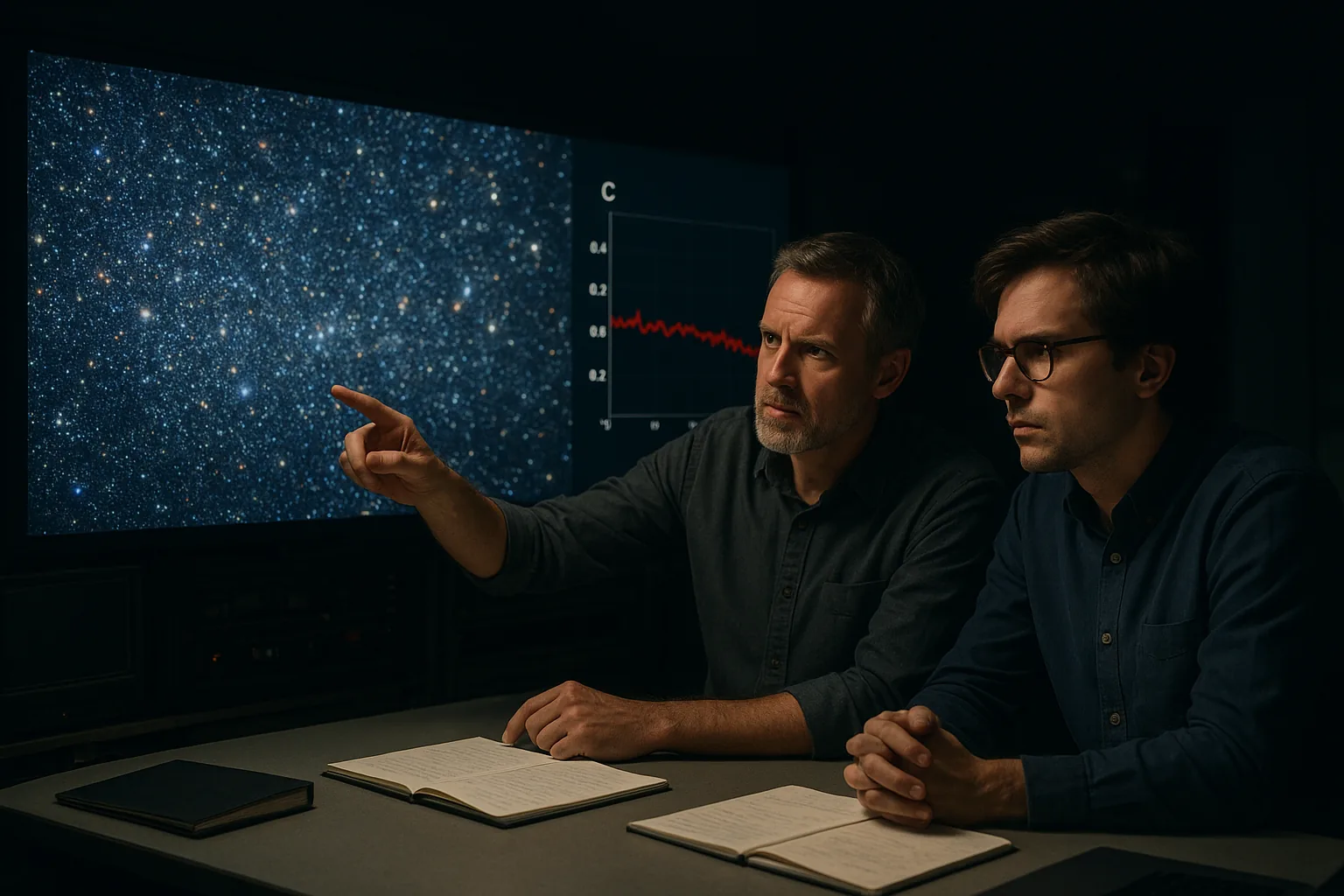
They put the universe on a graph and the line wouldn’t behave
When Signe Maj Koksbang and Asta Heinesen fed Pantheon+ supernova distances and DESI galaxy‑survey numbers through a machine‑learning reconstructor this year, a test statistic known as C refused to land on zero. Physicists have discovered cracks in the structure of the universe, the researchers report: deviations that sit between about two and four standard deviations depending on which catalog and selection rules are used. That sentence is the kind you hear rarely in cosmology — not a new particle or flashy detection, but a structural test that probes the geometry we’ve assumed for about a century.
It matters because C is not testing a particular dark energy model or one weird calibration. It tests the Friedmann–Lemaître–Robertson–Walker (FLRW) assumption — the simple idea that on the largest scales space is smooth and the same in every direction. If FLRW fails, a lot of familiar fixes for other cosmological puzzles could be addressing the wrong problem.
physicists have discovered cracks — what the C statistic actually checks
The C test combines two observable quantities: a distance measure (how big things look) and the Hubble parameter (how fast space expands at a given redshift). In any FLRW universe, those two must obey a specific relationship so that C = 0 for all redshifts. That property makes C a very blunt, model‑independent chisel: if it’s non‑zero, something is off with the large‑scale spacetime assumptions, not merely one ingredient in the cosmic inventory.
Previous attempts used Gaussian Process smoothing to reconstruct distances and derivatives, but that technique quietly biases results toward smooth, well‑behaved curves — in other words, toward FLRW. Koksbang and Heinesen used symbolic regression instead, letting the data pick functional forms with minimal prior shape assumptions. The cost is more methodological judgement calls, but the reward is a reconstruction that can expose departures that Gaussian Processes might hide.
A different way of reading the numbers
The papers ran bootstrap samples through symbolic‑regression pipelines and applied the tests to Pantheon+, BOSS/eBOSS BAO inputs and DESI release data. Across the redshift window roughly from z ≈ 0.4 to 1.4 the C statistic stays persistently non‑zero. An integrated test called O climbs toward three to four sigma in some analyses, especially when feeding DESI DR1. With updated DESI data the peak significance relaxes but does not disappear entirely: choices in selection criteria and which symbolic fits are kept shift the exact sigma level.
That sliding significance is crucial. Cosmology is full of two‑sigma tempests that evaporate with fresh data or an alternative pipeline. These results are interesting precisely because they are targeting the geometric assumption beneath Lambda‑CDM, not another parameter inside it. But they are not yet a smoking‑gun refutation.
physicists have discovered cracks — plausible non‑radical explanations
Heinesen and Clifton have already derived how these different mechanisms would imprint distinct shapes on the C and related statistics, so future data might distinguish them. But teasing apart a geometry failure from observational subtleties demands better, denser measurements of the Hubble parameter and distances — exactly what DESI, the Vera Rubin Observatory and the Euclid mission promise.
Why this could force a rethink of a 100‑year‑old assumption
The FLRW metric traces back to Friedmann, Lemaître, Robertson and Walker in the 1920s–30s. It’s elegant and tiny in assumptions: homogeneity and isotropy on the largest scales. That simple backdrop makes cosmology calculable and gives Lambda‑CDM its conceptual architecture. Many proposed solutions to the Hubble tension and oddities in late‑time cosmology — new dark energy physics, interacting dark sectors, tweaks of gravity — start by keeping FLRW and changing the contents.
If FLRW itself is the part that’s wrong, then those solutions may be solving the wrong equation. You’d need models where the lumpy cosmic web and voids alter the average expansion directly, or where the observational path of photons through a textured spacetime systematically biases distance inferences. That is a harder shift than swapping one particle for another; it asks for a different mathematical scaffolding.
Where the other evidence stands — not a demolition of the Big Bang
It’s tempting to hear the phrase "cracks in the structure of the universe" and imagine the whole cosmological edifice collapsing. That would be premature. The Big Bang — the hot, dense early phase, the cosmic microwave background and the primordial light‑element abundances — is supported by independent, precise measurements. What’s under debate here is a century‑old geometric simplification applied to the post‑recombination, large‑scale universe.
Nor does a failure of FLRW necessarily demand throwing out general relativity. GR is a local field theory; FLRW is a global ansatz about averaging. The tension is less about Einstein’s field equations than about how we coarse‑grain the messy universe into a tractable, smooth model.
How other recent findings feed into the picture
What will settle this — and how soon
The community will want independent reproductions using different reconstruction tools, and more data. DESI will continue to deliver denser BAO and redshift‑space distortion measurements; the Rubin Observatory will provide orders‑of‑magnitude more supernova light curves; Euclid will map cosmic expansion from space. Those datasets should shrink statistical errors and pin down the derivatives that make C sensitive.
If the signal persists and the shape of the deviation matches predictions for back‑reaction or Dyer–Roeder, theorists will gain a clear direction. If the deviations evaporate when the data get denser or when different, less subjective selection rules are used, FLRW will be reinforced. Either outcome is a win for science — an assumption either survives a crucial test or it doesn’t.
What this means for the public and for science policy
This is not a result that changes daily life or space policy overnight. It is, however, the sort of foundational question that shapes long‑term priorities: what telescopes to build, which survey strategies to fund, and which theoretical directions to nurture. If cosmology must quit the smooth‑universe shortcut, modelling becomes more computationally intensive and more observationally demanding. That has cost and career implications across the field.
At the human level, this is a reminder of how scientific progress works: the most durable theories are those that expose their own limits and invite sharper tests. The FLRW assumption has served cosmology incredibly well. Now it is being pushed to the edge — and that is where interesting physics waits.




Comments
No comments yet. Be the first!